Showing posts with label bookbuying. Show all posts

Sunday, 26 January 2020

Bookbuying: 2MBS FM Book & CD Fair, Australia Day weekend

I saw the email from the radio station on 9 January and marked the date in my calendar. On Saturday with a printed map made with Google Maps I drove off, heading to Crows Nest. I turned off the Pacific Highway into Albany Street then headed south on Alexander Street and found a parking spot, paid for it (about $11) and wandered off with my rucksack looking for the site.


I found it eventually with the help of the same app. It was tucked around in the local community centre off a pedestrian mall. The books were mostly classified in categories so it was easy to find things to buy. For $62 I snagged 13 gems:
  • L.P. Hartley, ‘The Go-Between’ (1953)
  • Graham Greene, ‘The Quiet American’ (1955)
  • Peter Hopkirk, ‘Setting the East Ablaze: Lenin’s Dream of an Empire in Asia’ (1984)
  • Bruce Porter, ‘Blow’ (1993)
  • Ahmet Altan, ‘Like a Sword Wound’ (1997)
  • Peter Robb, ‘M’ (1998)
  • Edmund White, ‘My Lives’ (2005)
  • Orhan Pamuk, ‘Istanbul: Memories and the City’ (2005)
  • Ali Abunimah, ‘One Country: A Bold Proposal to End the Israeli-Palestinian Impasse’ (2006)
  • Kazuo Ishiguro, ‘The Buried Giant’ (2015)
  • Mark Brandi, ‘Wimmera’ (2017)
  • Cyril Wong, editor, ‘Best New Singaporean Short Stories, Volume Three’ (2017)
  • David Bowman, ‘Big Bang’ (2019)

Wednesday, 4 February 2015

42 boxes of books

That's how many boxes of books I have packed so far, including yesterday and today. Yesterday I wrote about some of the sensations this exercise has caused me, but today there's more. It's a kind of excitement-with-anxiety. It's that feeling of separation at the top of the stomach except now it has spread to the extremities of my being. I am light. I feel light. I feel as though I could float away.

I wouldn't say it's entirely a pleasant or an entirely unpleasant sensation, although it is different. Normally I feel quite heavy in the world, quite substantial. Even if I'm feeling happy. But now I feel as though I'm about to spin out of control and go spinning all the way across the room. I don't feel fixed in place. I feel movable. I feel temporary and unstable.

As I said, it's not an entirely unpleasant feeling. It feels as though something is about to happen. And of course that's perfectly true because I am going to move to Sydney early next week. By the end of the week I should be ensconced in the Pyrmont apartment with internet connection and everything. It's just that between now and then a hundred things could go wrong. I tend to be pessimistic.

Most of my bookshelves are now empty. I look forward to a slow afternoon online. This blogpost represents the start of the slow afternoon. I am ready to receive. Over.

Tuesday, 3 February 2015

Packing books in boxes

I am in the middle of packing my books into boxes. I have thousands of books and they all have to be packed up before the removalists take everything away on 9 February.

It is a kind of meditation, packing books. There are books I have not looked at for years, and there are books I have not touched for even longer. Books I never thought I owned, and books I vaguely remember buying. Memories of where the books were bought, whether second-hand in a charity sale or in a bookshop new.

Each book has a personality and a character. I renew my acquaintance with each book as I put it into the cardboard packing box. I come to know my library again. I am reacquainted with my library. I get to know it again, as if it’s new and just acquired, although in reality I have been collecting books for over 30 years. There are books from when I was first at university in the 1980s. There are books bought after I returned from Japan in 2001.

I am becoming familiar once again with my books, and it’s a strange experience. In a way I want to have less books, because so many books are a burden. Each time I move house I have to go through the same process of packing and moving. I have to take the books down off the shelves, put them into boxes, and then put them back on the shelves again at the other end. It’s a problem.

On the other hand I revel in having so many books in my library, as though each book were a separate part of my personality to be handled and discussed at some future point in time, at some indeterminate locus of interaction with the world. In this way I become, in a way, able to be shared with the world because I own so many books. There are some books I forgot I had, and other books I am waiting to find.

I am awash with books, I am steeped in them. I am soaked in their knowledge and their styles of writing. I am in a way submerged by their richness and their excess.

Friday, 14 February 2014

Matt's update Friday, 14 February 2014


Bought USB extension cable.

Book purchases
  • Lao Tzu, Tao Te Ching
  • Lives Like Loaded Guns: Emily Dickinson and Her Family Feuds, Lyndall Gordon, 2010
  • The Arcades Project, Walter Benjamin (thanks to Hannah Forsyth for the lead) – edition of 1999, original German first published in 1982.
  • A Place of Greater Safety, Hilary Mantel (for February Book Chat Oz), 1992
Book Chat Oz
  • February episode is to cover Simon Schama’s 1989 Citizens and Hilary Mantel’s A Place of Greater Safety
  • Both books are about the French Revolution
  • Schama’s book is a history book
  • Mantel’s book is an historical novel
  • Will go live at the end of the month
Made contribution to William Yang: Friends of Dorothy video through Pozible campaign.

Poems
  • ‘Giants’ (posted 30 Jan) looks at the anxiety that the weather can cause in a sub tropical location. 
  • ‘Thoughts of a friend of Geoffrey Zygier’ (posted 10 Feb) takes a look at the father of the Australian who died in 2010 while in the custody of the Israeli authorities.

Saturday, 19 April 2008

Ivan Southall's Simon Black In China - one of twenty or so books I bought today at the 2MBS book bazaar in Leichhardt - didn't register. No blast from the past. No intimation that I'd enjoyed a book (Ash Road, 1965) by this writer when still a child. No connection evident between a boy's adventure book from the 1950s and a very beautiful book of "danger and immediacy" (so says David Beagley on the La Trobe children's books website).

From "RAAF adventure stories" that "were based on Ivan’s own wartime experiences" (so says the Dromkeen Medal PDF on publisher Scholastic's website) to Ash Road is a long way in aesthetic terms.

The Dromkeen Medal is an Australian award begun in 1982 and awarded by the Governors of the Courtney Oldmeadow Children’s Literature Foundation. The name Dromkeen was given to a "homestead" in Victoria, bought by Joyce and Court Oldmeadow. The Oldmeadows ran an "educational" bookshop and in 1978 Scholastic Australia took over responsibility for their collection of children's books.

Kaye Keck, the Oldmeadows' daughter, is the current director of the collection. Other recipients include Colin Thiele and Mem Fox - both 'iconic' brands. Thiele died last year but probably few read his books any more. Fox is a name frequently used by Australian politicians aiming to garner the support of middle Australia.

Southall's early efforts, while working in a print shop, are not well known. The Simon Black books, it appears, are better known but unknown to me. The unnamed writer of the Collecting Books and Magazines website stridently declares a preference for Simon Black over Ash Road. I beg to differ. What I've read (today) of Black and his adventures gives me the geebies. Xenophobic and superior, the character of Black is a two-dimensional 'genre' type that belongs in the past.

More recent genre heroes, beginning perhaps with Philip Marlowe (in books set in Los Angeles), are far superior. Black is an anachronism. This book shows why. In the Big Jack sequence, it's all threat and counter-threat with, finally, Simon producing a gun, which he points at Big Jack.


Luckily, the likes of Big Jack have come of age. The picture is of Bob Abbot, the new Mayor of the Sunshine Coast who ran on a jingle: "Big Bob for a Big Job".

Not ashamed of his bulk or his beard, Bob is a (welcome) contemporary take on a cliche that is part of the book, where Big Jack is a "traitor", and looks it.

But the Chinese fare much worse, as the illustration shows. Every cliche is in the book, the illustrations underscoring woodenly what may only be implied in the text (which I've yet to read; apologies).

Monday, 3 March 2008

The 2MBS book bazaar at Pymble served up a bunch of good things on Sunday. The trip, undertaken while in thrall to raging flu, led to me netting several choice items, including this. Henry M. Stanley's Through the Dark Continent (in one volume, 1879) can be bought for over a thousand dollars through AbeBooks.

My edition is slightly worse for the wear it survived over more than a century in the possession of at least one man, a student of Melbourne's Haileybury College. The headmaster awarded the book for proficiency in Latin and Greek (proving that the traditional disciplines endured as significant elements of secondary education well past the scientific revolution of the mid-1800s).


The book is richly illustrated and includes a map showing the trajectory of the explorers who travelled from the Atlantic coast up the Congo River and across to the Indian Ocean.

Another item is a first edition of Noel Coward's Play Parade (William Heinemann, London, 1934).

The contents page shows the plays included. Like the Stanley book, I intend to sell this. The cover is reasonably stained on spine and is hand-worn at top. The page edges are discoloured with age.

Despite these drawbacks, I think it will net a hundred. Other books in my hoard, which cost me $225, are more likely to remain on one of my many bookshelves. This, despite the fact that several are worth a good deal more than I would normally pay for the privilege of reading the author.

One such is William Styron's first novel, in a first edition, which was published in New York and Indianapolis by The Bobbs-Merrill Company, in 1951. Online listings show a value near US$2000 for a good exemplar. Which this volume most decidedly is, as the picture shows.


The dust jacket is slightly torn but it at least exists. The original owner, or someone who had the book in their collection subsequently, took care to add a plastic wrapper over the paper cover. As a result, the illustration is clear and clean. Which brings me to observe that an author's early books may be better-presented than those which are published in his or her maturity.

Thea Astley, who died in 2004, is a mature Australian author and is, moreover, one I've never read. This is surprising as she won four Miles Franklin awards, including one for The Acolyte (1972).


Another find in my library following Sunday's binge is her 1979 collection of short stories, Hunting the Wild Pineapple. I now have four Astleys in my library. If she's as good as the literati seem to think she is, there is plenty of enjoyment coming my way.


Another school prize book is this one by "the first Australian novelist to gain international recognition", Katherine Suzanna Pritchard, who is another unknown for me. The lovely cover is worth the insignificant purchase price all on its own. I'm sure the girl who received the book (Fiona Watson, 3rd in grade 4A) treasured it for this reason alone.


The final item's cover shows a painting of Barry Humphries by James Fardoulys and it's delightful. A more serious man is seen in Cecil Beaton's photo, which is on the back cover.


This little volume should help keep me away from the DVD counter, where recordings of The Chaser boys are sold. With Bazza in my hands, I have no need for the common man's Media Watch.

Speaking of which, the series started again tonight with Jonathan Holmes, the new host. Clearly Aunty has taken note of accusations of bias from the right-wing print media. Holmes give good face and is far less strident than Monica Attard, who he replaces in the new series.

I suspect the content is much the same, so any alterations are likely purely cosmetic. Possibly that's all the school bullies need to feel wanted. A less threatening opponent may be less likely to cause them to want to rip his head off and mount it on a stick in the public sphere.

Whatever that is.

Monday, 3 December 2007

Review: The Sex Mook: What Is Our Sex?, edited by Julian Fleetwood (2007), Vignette Press, East Melbourne

Fleetwood's introduction contends that "this book is rough" and that it was done to produce "honesty and openness" but the most satisfying element is that this is a manifesto. It is a very polite one, but a manifesto nevertheless. It's been a while since I read such a thing.

Good are 'Do You Love Me?' by Louise Ellis Carter, which describes the satisfactions of role-play, 'Our Sex Is Not For Sale' by Emily Maguire, a run-down of the highly manufactured character of most sex in the media today, and 'Nympho' by Nithya Sambasivam, a poem about finding your legs in a Western society when you're told to want something else.

The good thing about the collection qua collection is the shortness of the pieces. Most do not go over three pages, including Leticia Supple's 'Private Time', which describes what a young woman gets up to when she locks her bedroom door. Not all of the collection is this good, and much is forgettable. But it's a start.

It's also welcome from the point of view of equity. There are pieces that are more forthrightly about the politics of sex, such as Peter van der Merwe's 'On Not Being Gay', and 'Herpes Male Seeks Herpes Female...' by Anna Krien.

I kept waiting for someone to allude to the father of sex writing (Henry Miller) but he seems to belong to a white, male orthodoxy that is no longer in style. A recent movie by some French people of D.H. Lawrence's Lady Chatterley reminds us that some things still need to be said.

One of which is that conflict can be liberating. In a piece in today's The Sydney Morning Herald, Cate Blanchett reminds us that "You don't want to be surrounded by yeah-sayers" and she's backed up by David Malouf.

His story in a nice collection I'm currently reading (Journeys: Modern Australian Short Stories, Five Mile Press, 2007) 'Elsewhere', includes a classic line about the inner-city elites among whom Andy Mayo (from Lismore) finds himself when his sister-in-law dies (probably from AIDS, though it's never specified).

After the funeral, Andy and Harry (Debbie's father) drive to a house somewhere in the suburbs for the wake. There are a lot of people who totally ignore Andy and the bereft father. Andy feels "He was in the middle of it" but:

No one paid any attention to him, though they weren't hostile. They just went on arguing.

Politics. Though it wasn't really an argument either, since they all agreed.

This is superb, although without doubt the best items in the book belong to Robert Adamson (actually a section from a memoir, Inside Out: An Autobiography) and the inimitable Cate Kennedy, whose 'Dark Roots' (about a woman of 39 with a lover aged 26) starts on page 79.

Also of note is a story by the erstwhile High Court judge Ian Callinan, 'The Romance of Steam', which chronicles a train journey from Sydney to Brisbane and hunger among the three hundred women in uniform on board, during WWII.

I picked up this collection in Wagga Wagga, a town of some 60 thousand souls where it was still 31 degrees Celcius at 4pm and 29 degrees at 5pm. The sex book was bought at Federation Square, central Melbourne. The two young women behind the table brought my attention to the nicely gift-wrapped books it held. I just picked up a naked copy from the pile and paid.

I had immediately beforehand bought two Russian modernist novels, The Silver Dove by Andre Bely and The White Guard by Mikhail Bulgakov. This table was run by Three Bears Books and I plan to contact them with the email address provided to get some Russian Symbolist poetry. The kind Nabokov always talks about.

Saturday, 20 October 2007

More sale book purchases yesterday, this time from the Sydney Uni Union bookshop in Wentworth where several shelves'-worth of ex-library books are priced from one dollar to four.
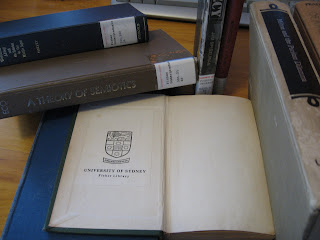

I guess ex-library books are put on sale if nobody borrows them, so it's likely some of these will be boring. Two treat Milton and the Puritan revolution, when the British Commonwealth was established. Milton, a poet of astounding power and possessed of extraordinary visual sweep not dissimilar to modern computer graphics-generated landscapes, was also heavily invested in the reforming process, performing writing duties for the new regime. He died blind but used an amanuensis to complete later works.

Also here is an early book by Umberto Eco on semiotics (a field I would love to understand better). A curiously-titled tome by Barbara Harvey, Westminster Abbey and its Estates in the Middle Ages, and published by the venerable OUP, promises interesting reading. The chapter headings in another, The Liberation of American Literature, are: * The Colonial Complex, * The Puritan Myth, * The Southern Pattern, * From Revolution to Reaction, * The Frontier Force, * From Sectionalism to Nationalism, * Liberation. This promises good reading.

Further cogent ideas will surely be found in The Liberalization of American Protestantism, by Henry J. Pratt of Wayne State University (Detroit). Many of the books are dated in the sixties and seventies. Historiographical paradigms have shifted radically in the years since, so it's entirely possible that I will find those books irrelevant.

Following these purchases I went over to the Wooley Common Room for the launch of a new book by one of my lecturers (pic). Richard is unconventional and possibly very shy. He has worked as a journalist but now heads the public relations coursework program at Sydney Uni.

His thesis is that journalists do not treat international events correctly as they always aim to find a local 'angle' for any story. This, he holds, distorts the focus of most stories in the 'world news' section of newspapers because by imagining events through a local lens, the true nature of an overseas event loses its internal logic. Possibly the most accessible word would be 'trivialisation'.

Demonising non-Western countries as an oppositional 'other' is, he thinks, another result of this effect. Rather than focusing on what, in, say, Japan, is true and relevant for the Japanese, our media frames the issue using outmoded concepts. The method used, he avers, is at least three hundred years old and, thus, inadequate for our purposes. The implication is that this tendency is actually harmful because it corrupts relations between nation states.

I've started reading it and should finish by the end of the weekend. Richard is different from most media theorists in his use of accessible language and a propensity to give examples, so that even an unschooled reader can grasp the meaning. While canonical exponents such as Mayhew and Habermas provide me with tremendous satisfaction, I find it difficult to recycle the actual concepts they use, due to their lexical novelty and grammatical obtuseness.

Given the opportunity, I'd say that in Leon Mayhew's The New Public, the author seeks to characterise the modern public sphere as 'distorted' by the pervasive influence of professional public relations practitioners (aka 'spin doctors'). That's his thesis in a nutshell and Mayhew, though he died in 2000 in California, is a died-in-the-wool liberal.

Habermas' The Structural Transformation of the Public Sphere (1989, though published in German twenty years earlier), the primary point of reference for media theorists, grounds his ideas in an ideal vision of England in the 18th century. Especially toward the end of that period when individuals (the word would be applicable only at this time in its contemporary sense) congregated in coffee houses to discuss commerce and politics.

But Habermas' thesis breaks down under the most casual scrutiny. The franchise was extremely narrow (only men with a taxable income at a set level) and, in any case, women did not frequent coffee houses but would gather in social groups to do needlework together, or read aloud from a novel. I prefer a broad franchise even if the cost is the involvement of professional communicators.

Thursday, 7 June 2007

No more of this book sale, I promise myself, frequently, but return in anticipation of new discoveries. At 50 per cent off the sticker price, many of these books are very cheap indeed. One, a 1500-page anthology of Romantic writings, was a steal at $15. Edited by Duncan Wu, it has been a text book used at Sydney Uni.

Among the others are a novel by Kate Grenville, a history of the microchip in the form of literary journalism, two books on media relations, a novel by Richard Powers, one by Kingsley Amis, and Michael Cunningham's Specimen Days.

More serious perhaps, but definitely to my taste, are such as the pictured book, which is a study of portraiture from 1780 to 1830. I am extremely partial to books about the Early Romantic period. Jane Austen was alive for most of this span, for starters, so each new work supplies reference material for a more critical reading of her wonderful novels.

There's also a study of literature, ancient to modern, by Harold Bloom: Where Shall Wisdom Be Found?. Also an anthology of Katherine Mansfield's writings. This New Zealand author is known to me, but only as a name. Finally there's a collection of essays about Early Modern and Modern intellectual history. Yum.

Sunday, 3 June 2007

A few unrecognised classics may be among 59 of "The Best Novels You’ve Never Read", a list compiled by New York magazine writer Katie Charles for the 4 June issue. This kind of thing always intrigues me, so I've decided to transcribe the list here more, frankly, for future reference of my own than for yours.

I mean, the best thing to do would be to add them all to my BookMooch wishlist, wouldn't it? I've had some trouble with the wishlist recently, as one book keeps being available, but by the time I've clicked to mooch it, it's gone.

To compile this list, Charles approached the National Book Critics Circle for names of people who could make a recommendation that would possess some gravitas. These "professional critics (and some other writers)" gave their opinions. The winner, who only got two votes, was David Markson, author of The Last Novel and Vanishing Point.

I've added some value to the list by placing entries in alphabetical order. I also added information about the author's provenance. Considering the source of the pundits, it's not surprising that most of these writers (40 of 59) are American.

* Jeffery Renard Allen (American who "earned his PhD in English from the University of Chicago") Rails Under My Back
* Jonathan Ames (American) The Extra Man
* Martin Amis (we all know who he is) Experience
* Ellis Avery (American) The Teahouse Fire

* Calvin Baker (American "born in Chicago and graduated from Amherst College") Dominion
* Jesse Ball (American) Samedi the Deafness
* Russell Banks (American) The Darling
* Jonathan Baumbach (American) On the Way to My Father's Funeral
* Charles Baxter (American) A Relative Stranger
* Madison Smartt Bell (American) Master of the Crossroads
* Judy Budnitz (American who was "born in 1973 and grew up in Atlanta, Georgia. She attended Harvard University, was a fellow at Provincetown Fine Arts Work Center, and received an MFA in creative writing from New York University in 1998") Nice Big American Baby
* Aldo Buzzi (Italian born in 1910!) Journey to the Land of Flies and Other Travels

* Patrick Chamoiseau (Mexican) Texaco
* Elizabeth Cook Achilles
* John Cornwell (English) Seminary Boy

* Helen Dewitt (American) The Last Samurai
* Geoff Dyer (English) Out of Sheer Rage

* Leslie Epstein (American) San Remo Drive
* Bernardine Evaristo (English/Nigerian) The Emperor's Babe

* Kathleen Finneran (American) The Tender Land: A Family Love Story
* Leon Forrest (African-American) Meteor in the Madhouse
David Fulmer (American) Rampart Street

* Mavis Gallant (Canadian) Varieties of Exile
* C.S. Godshalk (American) Kalimantaan
* Abdulrazak Gurnah ("born in 1948 in Zanzibar, Tanzania") Desertion

* Ron Hansen (American) Mariette in Ecstacy
* Jim Harrison (American) The Road Home
* J. M. Hayes (American) Prairie Gothic
* Robert Hellenga ("grew up in Three Oaks, Michigan") The Fall of A Sparrow
* Andrew Holleran (American) Grief
* Andrew Huebner (American) We Pierce

* Gary Indiana (American) Do Everything in the Dark

* Hari Kunzru (of mixed English and Kashmiri Pandit ancestry) Transmission

* John Lanchester (English) The Debt to Pleasure
* J. Robert Lennon (American) Mailman
* Kelly Link (American) Stranger Things Happen
* Sam Lipsyte (American) Home Land
* Margot Livesey ("born in Perth, Scotland") Banishing Verona

* Javier Marías (Spanish) Dark Back of Time
* John McGahern (Irish) The Lake
* Lydia Millet (American) Oh Pure and Radiant Heart
* Antonio Muñoz Molina (Spanish) Sepharad

* Kem Nunn (American) Tapping the Source

* George Pelecanos (American) Drama City
* Giuseppe Pontiggia (Italian) Born Twice

* Elwood Reid (American) What Salmon Know
* Maggie Robbins ("works as a psychotherapist for adults and children in New York City") Suzie Zeus Gets Organised
* Norman Rush (American) Motals

* James Salter (American) Last Night
* Robert M. Sapolsky (American academic) A Primate's Memoir: A Neuroscientist's Unconventional Life Among the Baboons
* Barbara Seranella (American, now deceased) The Munch Mancini Mystery Series
* Carol Shields (American-born Canadian) Unless
* Ali Smith The Accidental
* Olen Steinhauer (American) The Confession; Liberation Movements

* Curtis White (American) Memories of My Father Watching TV
* Jincy Willett (American) Winner of the National Book Award
* Meg Wolitzer (American) The Wife
* Stephen Wright (American who was "educated at the U.S. Army Intelligence School and the Iowa Writers’ Workshop") The Amalgamation Polka

* Akira Yoshimura (Duh) Shipwrecks

Thanks to Currajah for the heads-up.

Wednesday, 16 May 2007

Sydney book lovers should note three sales of 2MBS FM taking place over the next two months.

On 19 May (this weekend) there's a very small sale ("12 trestle tables of books direct from our warehouse") in Gosford. Such an offer is meagre inducement, from my point of view, to travel so far out of the city. 8am – 1pm at 2/13 Dell Rd, West Gosford.

On 16 and 17 June they've got a "Big range of fiction" at a sale, also in Gosford. "Manns St or Dane Drive. Right next door to the Bluetongue Stadium."

Then from Saturday 30 June to Tuesday 10 July there's a sale at the Willoughby Civic Centre, in Chatswood. This is a regular venue for 2MBS, but this will be the last for a while as the centre will shut "before renovations are done & the centre will be closed for more than 2 years". 10am to 6pm daily.

Wednesday, 9 May 2007

My purchases from the Co-op Bookshop's biannual sale now number 52. It started in April, and the trouble is — what makes me go back every few days — they keep adding new titles to fill spaces when books are sold. It's an addiction, I swear.

One of the beaut titles I picked up is the collected letters of Mary Wollstonecraft ($20!).

Fiction by Amos Oz, Naguib Mahfouz, Shirley Hazzard, Louis-Ferdinand Celine, Jose Saramago, Ismail Kadare, Anita Desai, Margaret Atwood, Mary McCarthy, Julian Barnes, Nick Hornby and Gabriel Garcia Marquez.

Non-fiction predominates. There are some great titles, including a Michael McGirr travel memoir on the Hume Highway (the road connecting Sydney and Melbourne), The Koran, a collection of journalism by Mark Bowden (of Blackhawk Down fame), a biography of pioneering journalist Martha Gellhorn, a study of a nineteenth-century Sinologist, a collection of pieces by famous journalist H. L. Mencken, a history of World War One that focuses on the imperialist aspects of the conflict, a biography of Virginia Woolf, and a history of New Zealand.

But there's more. I recently received four mooched books including Barcelona by Robert Hughes, a Dubravka Ugresic and a Mikhail Bulgakov. The image at top is from a postcard that Susha included under the cover of one book with "Happy reading" on the back. I used to put cards inside books I sent, but as the number increased, I stopped. But I think it's a nice, friendly token between fellow moochers.

I've also been busy sending books that were mooched and, since I'm not mooching at the usual rate, my points have accumulated so that I can comfortably add more titles to my wishlist, sure that I can mooch them when they turn up.

Tuesday, 6 February 2007

Behind the dreamy foreshore with its landscaped pathways and cotton trees lies a very different, but no less real, version of Maroochydore. Not everyone can have a piece of the waterfront, after all. This afternoon, on an errand to find tourist info that would guide me over the last few days of my stay up here, I encountered some of that world. The best way to do this is on foot.

I walked down Memorial Avenue to the RACQ. Mum had telephoned in advance, so when I went to the counter they were expecting me. I got a couple of brochures that I'll look through later on tonight. I left the RACQ and crossed the road, where I bumped into a cart outside the local op-shop filled with books. My search resulted in two purchases:

The Scent of Power, Susan Mitchell (1996)
A Death in Belmont, Sebastian Junger (2006)

What this version of Maroochydore looks like is this (I presume most small towns anywhere in the new world would provide views like it).


After spending my $4, I left the shop and turned east into Aerodrome Road, which is a functional strip of two-lanes-each-way that is lined with dozens of businesses like those shown above. It's not the sort of street that would appear in tourist brochures, let's put it that way. But a town like this couldn't work without its ilk.

On the lookout for the information office, I turned north into Sixth Avenue after about 600 metres. It was, unfortunately, closed, but a little further on is the public library. Outside, what should I see but a table covered with books for sale, with more such treasure-laden furniture inside. I picked up two books for another $4:

The Volcano, Venero Armanno (2001)
The Samson Option, Seymore M. Hersh (1991)

Unlike Aerodrome Road, Sixth Avenue is lined with apartment blocks painted in a rainbow assortment of pastel shades. Here is a typical example.


Beyond these east-facing blocks of apartments lies the beach and the Pacific Ocean.

I went to the dentist today, so tomorrow I will be climbing Mount Coolum.

Sunday, 4 February 2007

Vic Grimley is a stallholder at the Cotton Tree Markets, in Maroochydore. A local, he drives down to King Street every Sunday to display his wares and, hopefully, to make a sale or two. Today he was lucky. He made two sales. Both my mum and I purchased books from his trailer.


Vic boasts that he owns about 800 books. Many of them are science fiction titles, like the two shown in his hands in the photograph above. He likes tradition. He lives with a 94-year-old woman who he has known for decades. And he says he doesn't have time for the Internet, even though he knows that his first editions might fetch a good price on eBay.


Although I don't read much science fiction nowadays, I couldn't resist these two. I paid $20 for the two. Both have dust jackets, as you can see, although they have been repaired with masking tape (it's on the reverse of the jacket, which is why you can't see it).

Mum bought two first editions, without dust jackets, to send to my brother, who remains a sci-fi buff after over thirty years.

Saturday, 3 February 2007

Shopping, for me, usually means going shopping for books. Books are my passion. But there comes a time when shopping for other items is necessary. Today, I went shopping for things other than books.


I walked along the promenade that skirts the estuary. The cotton trees are blooming at present. They are curious trees. Not grand, not showy. But their yellow flowers catch your attention. You want to pick them and take them home. In the above picture, you can see a number of yellow cotton tree flowers — about the size of a fist — among the foliage.

Sunshine Plaza was busy. The sale signs at the bag shop attracted me, so I went in and bought a new satchel. Following my initial impetus, I headed toward the Myer department store, which is located at the end of the shopping centre. In the perfume department a young woman approached me and asked what I needed. I pointed out that I was searching for a deodorant stick. Since we were standing in front of the stand that carried them, a simple wave of the hand was enough to indicate my interest. I bought one.

Then I headed east, toward the shoe department. There, a middle-age woman who seemed perfectly cast for the role she would be required to fulfill, approached me. I told her that I needed shoes for work. Several selections were on sale, and I chose a pair of black Hush Puppies.

On the way home, I stopped at the Big Top and bought half a dozen beers. Then I headed toward the north exit. There, I espied a sign saying 'Book Exchange'. A new bookshop! Naturally, I went in. Two books caught my attention: The Secret River and one by Don DeLillo.


Back at the apartment I unscrewed a beer. A limousine pulled up after a spell. Two young and slim women wearing purple gowns alighted. They were followed by a number of men wearing black suits. One was clearly the driver. The party, which was eventually joined by the bride, ambled along the pier where, no doubt, photographs were snapped.

After a while they drove off.

The sunset is quite beautiful, with silvery streaks binding the bottom of the clouds. The paperbark trees in the park are emerald in the waning glare.

Thursday, 1 February 2007

The Duporth Book Exchange is one of a row of shops on a narrow street in the heart of downtown Maroochydore. The footpath is paved with nice stone pavers and the cars park, on both sides of the street, at 45 degrees to the curb, front-in or rear-in. They line up like water buffalo practising for a synchronised swimming competition. There are parking slots reserved for drivers with disabilities. Modern-looking garbage bins dot the street.

Its windows are filled with books. Where they have been shone-on by the sun, their jackets are burnt completely blue. A whole window full of books with blue covers attests to the strength and duration of sunshine in Maroochydore. Tall piles of tropical cloud lie across the horizon, but the sun still shines.

I have been here before, so I knew where to go to find the good literature. Unlike some parts of the shop, the literature section (probably because nobody buys literature, very much), is a total disaster. Piles of books stand in front of other piles of books, so that you can't see the spines of those that are stacked behind the front pile.

Fossicking can, however, unearth gems. And fossick I did. I found 12 books, for which I paid $90:

1988, Andrew McGahan (1995)
All the Pretty Horses (volume one of The Border Trilogy), Cormac McCarthy (1993)
Light in August, William Faulkner (1932)
Pascali's Island, Barry Unsworth (1980)
Year of Wonders: A Novel of the Plague, Geraldine Brooks (2001)
The Sportswriter, Richard Ford (1986)
Plays:1, Wole Soyinka (1984)
Absalom, Absalom!, William Faulkner (1937)
Twilight of Love: Travels with Turgenev, Robert Dessaix (2004)
The Best of Granta Reportage (1993)
Identity, Milan Kundera (1998)
Mason & Dixon, Thomas Pynchon (1997)

Not wishing to overload my parents with my — no doubt ascerbic — company: after purchasing these treasures I headed straight for the bottle shop. There, I pondered again why Amsterdam Mariner is so cheap (it sells for $12 half a dozen stubbies). Apparently, it's because the company that imports the beer from Holland is owned by Woolworths (which also owns BWS, the liquor shop itself).

Then I sat on the balcony of the apartment they have rented for me and watched a group of five young men play cricket and skylark. Four of them had no shirts on. Bushpigs, I thought. No doubt they're prefectly pleasant young men when you get to know them. But there's something about this town that turns them into potential bag-snatchers.

It might have domething to do with the fact that the RSL club is so large, in such a small town. But is it a small town? I'll have to investigate further.

Thursday, 25 January 2007

BookMooch is the first point of call I approach when I find a title or author I'm interested in. With my Internet Explorer 7 browser open, I click back and forth between the article I'm reading and BookMooch looking for the title I want.

But having mooched several books from people who never respond to my request, I've become more careful about who I mooch from. So after finding the title, I immediately check the person's profile page to see a) if they are willing to send overseas (most books I want are with U.S. residents) and b) if they have logged in recently.

If the answer to (a) is 'No', obviously I can't mooch the title. Frequently, I'll find people who want you to e-mail them before mooching a book. Well, in that case I send off an e-mail and hope for the best.

If the answer to (b) is 'No', I don't mooch the book. Simple as that. There's nothing more annoying than sitting, staring at your pending page wondering why the heck this person isn't checking their damn e-mail.

So I've become a picky, a choosy moocher. A finicky denizen of this little purveyor of fun on the Internet. After all, if mooching isn't fun, why do it?

When I send a book, I generally write up a card, with a nice picture on it, and insert it in behind the cover before posting it. I've had some very nice little acknowledgements of this largesse. (A card only costs a couple of dollars.) Mooching should be fun!

And it is. In fact, I've received four books named in one of my favourite titles of 2006, Robert Boynton's The New New Journalism. And I've got another four books mentioned in that interesting tome on the way.

Thursday, 4 January 2007

Got my book fix again this afternoon during a visit to Centro Bankstown, which I've never set foot in before. Curiosity, more than anything else, and the need to replace my coffee maker, urged me to venture out west. I jumped into the car at around 5.00 and scooted down Canterbury Road.

Navigating was easy, and I found a parking spot immediately. It's a cavernous shopping centre, and you enter via the food hall. At least from where I parked my car, just off North Terrace. After that you follow the signs. To David Jones, in my case (I'd seen their ads for coffee makers in the paper earlier in the week). Books were the furthest thing from my mind, and I walked straight past Angus & Robertson (although not before checking out the sales displays filed along the front of the store).

DJs in Centro Bankstown is dilapidated and under-staffed. I bought my coffee maker plus a beard trimmer upstairs. When descending the escalator, I hit trouble: a sale table right in the middle of the aisle. Without thinking I started scavenging. Two books ended up in my hands: Autograph Man by Zadie Smith and Our Sunshine by Robert Drewe (a popular Australian fiction writer).

The second of these books is about Ned Kelly, the famous bushranger.

The sign said 30% off the (already low) sticker price, so I paid just over $10 for these two. I arrived home at 6.15 and immediately entered the books into LibraryThing. It's like an addiction, this inability to go past a cheap paperback.

Saturday, 9 December 2006

The 2MBS FM book and record bazaar is always a good gig to get into. At about ten past eight this morning I logged onto WhereIs.com and charted a course to Chatswood. Having glanced through the route, I went down to the car and opened up the UBD street directory to find the pages I'd need. Then it was off in the Echo for some serious book buying. The journey out took about 40 minutes.

Yesterday I popped into the bookstore and picked up five books. This morning I was intent on collecting many times that number. And I wasn't disappointed.

I arrived in Chatswood at just before 9.00am and stepped into the main hall at the Willoughby Civic Centre ready to rumble. I headed straight to the back wall where the fiction titles are normally stacked, and set to browsing. (To see more detail, click on the images.)

Part of the splurge
I found 25 titles, and paid $82 with my debit card.

More of the splurge
Then I drifted outside and saw another bunch of tables laden with precious cargo. I put my head down once again and found another 5 titles for $15. Then I was off like a rocket to where my car was parked. I had paid for just enough time to cover my splurge.

Two days' worth of buys
Arriving home, I lay down on the couch and read The Sydney Morning Herald. Then, deciding it was time to catalogue, I picked up my full rucksack and headed toward the computer, where I entered my new acquisitions into LibraryThing.

Friday, 8 December 2006

It is 2MBS Book and Music Bazaar time again!

Here are the details of the next sale for you!

Sale location details are as follows:
CHATSWOOD: Starts Thursday December 7th at 9am!
This sale is open Thursday, Friday, Saturday, Sunday & Monday from 9am until 6pm.

The address is:
Willoughby Civic Centre
409 Victoria Ave, Chatswood
(Opposite the entrance to Westfield’s)

The last day of the sale is half the marked price on everything left for sale! All of the sale stock is high quality so there are always bargains to be had. No further discounts will be given on this day.

--------------------

I got this e-mail about a week ago. I'll be there on Saturday morning, bright and early. There's plenty of parking early in the morning, but if you come later, you might have to park in one of Chatswood's shopping centres.