Sunday, 17 September 2006

My desk showing the HP Officejet 5610 and the HP Pavilion computer with 17-inch flat-panel displayThe new HP Officejet 5610 is now officially configured and ready to go. But I don't know what to call it. Primarily, I purchased this piece of equipment to function as a printer. In addition to printing, however, it also provides scanning, fax and photocopying. All for less than $200. When I spoke with dad yesterday he recalled that he had purchased his fax machine in the late nineties for $170. Down goes the cost of technology. Up goes our level of satisfaction.

And I'm well satisfied. Generally trepidacious when confronting new IT bits and pieces, I got the thing rolling in about an hour's time. I painlessly configured it yesterday morning.

But some questions remain. I've set the fax to receive after four rings — the default setting is five — but I wonder what happens if I pick up the phone and find that someone is trying to send me a fax. Do I just hang up? In that case, the fax won't get through. I wish there were some way to divert the call from my handset to the fax.

It was a surprise to be able to set the new piece of equipment up so easily. Everything was in the box. I inserted the CD and followed the instructions, and voila! I'm online. So when I went to buy the broadsheets yesterday morning, I also picked up a ream of A4 paper. They didn't tell me that, actually, you need to have some A4 paper on hand when you set up the machine, but I muddled through by using some old sheets that already had some printing on them. I wondered if this would hurt the new machine, but evidently it doesn't, because it's working fine now.

I just printed the assignment of a classmate. The deal is this: each week the people in my advanced writing class who have been assigned to have their feature articles workshopped must e-mail their assignment to all the other class members by Sunday at 2:00 p.m. It just happened that, this week, the girl who was due to be workshopped sent hers out on Saturday instead. That's fine: earlier is better.

But I find it easier to read things on paper. So I printed it out.

The cost of replacement ink cartridges is also a bit of a worry. They're such tiny things, these cartridges. At Officeworks they are worth $62 a pair, but they are being offered on eBay at $50 the pair. I wonder what I'll do. It's a bit of a risk purchasing from an eBay vendor but, then again, saving ten dollars is always nice if you can do it.

The printer (or whatever you want to call it) is tiny. If I lay down the two dictionaries I keep on my desk (a Macquarie and a Nuovo Ragazzini English-Italian one) they together take up as much room as the printer. It's lovely.

Anyway, I programmed (in a trice!) my parents' fax number into the new machine as a quick-dial button.

Saturday, 16 September 2006

Got mooched again today, this time for Peter Ackroyd's London: A Biography. I'm actually a big fan of Ackroyd, but there was something about this book that didn't agree with me, although it's brilliant, well-researched and encyclopedic, as his work usually is. It's a big, heavy tome. The moocher is located in New Jersey, so I've got to decide which postal option to use. "If this is too costly to send from Aus to the US, feel free to cancel," she said. "Otherwise, you can send it economy mail -- or whatever your slow boat option is." Which is probably what I'll do.

Busy day today. I'll be at Pennant Hills at 8:30 a.m. to get my car serviced. Then I'll go to the post office to send this book away. After that I'm going to drop by my old house-mates' place to have lunch. Finally, while I'm up in that part of the world, I'll drop by to see my uncle, who is living in a dementia-specific care unit at the Anglican Retirement Village in Castle Hill. He's suffering from Stage 2 Alzheimer's Disease, but he still recognises me when I visit.

It's a bit of a worry, his condition, as a South-Australian aunt on the other side of the family tree also had Alzheimer's when she died. Family predisposition is a major factor in early-onset Alzeimer's, so it's likely that I, too, will suffer from the disease at some stage, possibly before the age of 70. Hopefully, keeping my mind active through reading will work against it.

Thursday, 14 September 2006

My second assignment was due today but my references still needed some work. I hadn’t noted down references for all the citations I’d made prior to returning the relevant books to the library. Damn. So today I went there at lunchtime to find the two books I needed and complete the references before handing it in. Then I forgot to check one reference and returned just before class to make sure it was right. It was.

Last Monday I got back my first assignment with a mark and many comments. The mark was lower than I expected: a credit. This is a bit of a disappointment, and quite serious, as there are only two assignments for this unit of study this semester. It means I’ll have to do really well in the final one to maintain my distinction average for the year.

Wednesday, 13 September 2006

Yesterday was a bit of a disaster. Arriving home from work, I found that the electricity had gone off. The land-line telephone, an electric model, didn't work. My mobile had run out of juice during the day. I went around to all eight units in my block: nobody home. Not a one. I was expecting a carpenter to arrive at 5:30. He was to measure up the big bookcase in my study with the aim of installing another shelf for my growing collection (currently, the shelves are quite far apart and I gauged there's room for another).

So I went next door and started knocking on doors over there, trying to find a telephone. Number three bore fruit: they were home. A bunch of Indian students. The guy who opened the door, named Hiresh, said he had a land-line in his apartment but that he was waiting for his flatmate to return home. In the end they found a working mobile and I could use that to call the electricity company, EnergyAustralia. No blackouts in my area, the operator said, but she offered to dispatch an electrician: $88 call-out fee plus hourly rates. I asked the operator to call my electrician (John Moses) for me, but she demurred.

I returned to my flat and located my address book, then stepped onto the footpath to await the carpenter: it was already 5:30. He didn't appear. Then I went back to Hiresh. At first he said he couldn't let me use the land line, but then, apparently changing his mind, he called me back, asked me to sit on the couch, and plugged the telephone cord into the back of a sticky-looking telephone, which he then placed, at my disposal, on the coffee table. I called John Moses.

I waited on the balcony of my apartment, expecting either the carpenter or the electrician to arrive at any minute. At 6:30 the latter pulled up in his truck. We were getting somewhere.

The problem will require another visit from John to fix. He got it working again and I immediately called John Szabo, the carpenter, who apologised, saying he'd completely forgotten about our appointment. He was just then at a nursing home and would come over immediately.

The bookshelf job is not a big one. When he arrived he took the measurements and we calculated the distance that there would be between shelves after adding a new one: 28.6 centimeters. He told me his charges and had me remove one of the shelves so that he could match the stain colour on the new shelf. He'll return on Sunday — if he doesn't forget.

Tuesday, 12 September 2006

I was mooched again yesterday and so I visited the post office during lunch with the aim of sending away the volume: to Perth this time. I also mailed off a photocopy of the Australian Literary Review to someone I met through LibraryThing. She lives in New York and it cost just on $11. She's interested in Australian women authors from the first half of the twentieth century. September's ALR didn't contain a story of that nature, but I think it highly beneficial to encourage such interest in our literature. Hence my largesse.

On the way back to my desk, I dropped in at the Chancellor's Committee Bookfest. Tuesday is a special day: you can gather up a box full of books and pay only ten dollars. So that's what I did. And it was all good stuff, too. Including my Saturday haul, that's 48 books for $54: just over a dollar per volume.

My New York correspondent also suggested I contact the Italian Institute of Culture in Sydney, which is the cultural office of the Consulate General of Italy. Her friend Danilo Sidari, who works there, could help me, she thought, to identify good Italian writers. Having studied Italian at university, I can read the language, but being absent from that milieu for a good twenty years, I'm ignorant of the quality material now being published in that country. He suggested these:

Women:
Marilù Manzini
Francesca Mazzucato
Paola Mastrocola
Dacia Maraini
Elena Stancanelli
Susanna Tamaro

Men:
Aldo Nove
Sandro Veronesi
Stefano Benni
Pino Roveredo
Domenico Starnone
Raffaele Nigro
Paolo Nori
Andrea Camilleri

Monday, 11 September 2006

Edward Champion reviews Haruki Murakami's Blind Woman, Sleeping Woman in The Philadelphia Enquirer.

He's not completely blown away, concluding the article with:

There is no doubt that Murakami has talent and a keen imaginative voice, but panning for gilt in this murky collection yields more fool's gold than the effort is worth.

And earlier:

It doesn't help that many of these stories, as Murakami admits, are templates for other novels and that many were written very fast.

I don't know if I agree with him. I found the collection superb. Many memorable images stick in my brain and that, as they say, is surely the main thing.

It seems as though the short story gets short shrift, again. The novel, despite the surge in popularity for non-fiction works, remains the dominant genre. Of course, Murakami's novels are so superb that it is easy to be disappointed in the face of these brief, volatile, little works. As Ed himself says:

Where the novel permits Murakami to add layer upon layer of narrative intrigue, the short story's taut format often results in disappointing draftsmanship.

I'm still not convinced. It's annoying to find oneself thrown back into the belligerent stance of the follower loyal unto death. Maybe I should just re-read the collection and make up my mind again.

Saturday, 9 September 2006

I arrived at the Chancellor’s Committee Bookfest at around 8:10 a.m. this morning. It was raining, as it would continue through the morning. I was the fourth person in line.

Half an hour or so later a chap drove up in his car and told us that the entrance would be around the back this year. So we all trooped over to the clock tower, where we could stand sheltered from the rain. We chatted amiably — I didn’t have the opportunity or inclination to read the magazines I’d brought for company.

When the doors finally opened at 10:00 there was a rush, but it was quite orderly. Wet floors made a dangerous setting for our excursions along the tables laden with books. I made it to the check-out by 10:30.

I found 24 books, which cost me $44.50, and which I think is a pretty good bargain all round. They take my LibraryThing total up to 897 books.

The Armies of the Night, Norman Mailer (1968)
The Moor’s Last Sigh, Salman Rushdie (1995)
The Right Stuff, Tom Wolfe (1979)
Night and Day, Virginia Woolf (1919)
The Good Soldier, Ford Madox Ford (1915)
Breakfast at Tiffany’s, Truman Capote (1958)
Cat & Mouse, Gunther Grass (1963)
The Great Gatsby, F. Scott Fitzgerald (1926)
Academia Nuts, Michael Wilding (2002)
The Game, A. S. Byatt (1967)
The Unconsoled, Kazuo Ishiguro (1995)
Imaginary Homelands: Essays and Criticism 1981 - 1991, Salman Rushdie (1991)
Swann’s Way, Marcel Proust (1922)
The Book of Laughter and Forgetting, Milan Kundera (1980)
Tent of Miracles, Jorge Amado (1971)
Criticism in Society: Interviews, Imre Salusinszky (1987)
Arrow of God, Chinua Achebe (1964)
Nine Parts of Desire: The Hidden World of Islamic Women, Geraldine Brooks (1995)
Somebody Save Me: War, Peace, Nudity and the End of the Twentieth Century, David Leser (2002)
An Anthology of Australian Verse, edited by Bertram Stevens (1906)
Selected Poems, A. D. Hope (1973)
English Verse Volume I: The Early Lyrics to Shakespeare, chosen and arranged by W. Peacock (Oxford Univ. Press, 1928)
Selected Poems, John Tranter (1982)
John Betjeman’s Collected Poems (1958)
Review: Australian Literary Review, 6 September 2006

The ALR’s launch issue is auspicious. On page three, Richard Nile contemplates “communities of ageing free radicals popping up all over the place”. With a large number of professional intellectuals set to retire, he posits, the outlook is good for Australia’s cultural life.

On page four David Burchell contemplates the divide between the communities of the Blue Mountains and that of Lithgow, “Australia’s first mining town”. He then segues into an analysis of “the culture wars” via “those who rejected the morality of the herd, and strove to better themselves through culture and self-cultivation”. This brief snapshot of the “chardonnay set” allows Burchell to look at a few new books by public intellectuals. “There’s a lot of listening to be done,” he opines, near the end of the piece.

Each article is closed, rather facetiously, by an oversized asterisk, as if there were a single footnote to the whole story.

Ian McCalman’s piece, which starts on page seven: “In 1995, American author Dava Sobel had a seismic impact on the nonfiction publishing business.” “Now, more than a decade later,” he continues, “the market for popular history has become saturated.” It is significant that Longitude was also chosen as a subject for this month’s First Tuesday Book Club. It seems to have long legs. McCalman proceeds, however, to detail the value of each of Sobel’s more recent works. Galileo’s Daughter (2000), for example, is:

… a fine piece of revisionist history that counters anachronistic accounts of Galileo as a heroic professional scientist defying the bigoted irrationalism of the church.

This is very fine criticism — encapsulating the essence of the work in a few words.

Sobel was a guest at the Melbourne Book Festival and the subject of the next piece, on page eight, novelist Lionel Shriver, is a guest at the Brisbane Writer’s Festival — by Nike Bourke. Again, the longer narrative of the piece provides the writer, as in McCalman’s case, with a freedom often absent in the shorter reviews found in the supplements of the weekend broadsheets:

This is the mind of a woman who, perhaps under the awful impress of persistent, untreated postnatal psychosis, rationalises her own abuse by imputing her victim’s complicity, his willingness to be abused. His pleasure in it.

Page 10 brings us a book review by Genevieve Tucker, measuring half a page. The other half of the page is given over to an ad for one of ALR‘s sponsors: the Australia Council for the Arts.

More reviewing on page 11, with a lovely illustration of a flower the name of which I wish I knew. The drooping blossoms next to the rampant ones nicely set off the content of the piece, which is: sex.

Page 12 looks at a recent success story, but with a twist. “Has Australian author Geraldine Brooks won the Pulitzer Prize in the US for a bit of monumental fibbing?” she asks. Later she says: “The plot is Hollywood.” Stella Clarke goes on to beckon to the attendant waiting in the wings: the herald of the History Wars Part II: the novel as a purveyor of palliative potions in the face of the dark forces that once stalked the land. She highlights the value of opprobrium heaped on the heads of novelists, like Kate Grenville, who was (apparently: I haven’t read The Secret River) “coy around 18th-century Aboriginal and settler violence”. The past is, indeed, another country.

On page 13 Jennifer Kloester reviews Kate Legge’s novel The Unexpected Elements of Love. I should read this book, as it deals with dementia, and I fear my father is tending that way.

Deborrah Hope tackles The Ballad of Desmond Kale in a longer review on page 14.

[McDonald’s] attitude is measured, abstract, completely divorced from my heritage-linked histrionics [she is an ancestor of Samuel Marsden] and the immoderately passionate debate over the writing of historical fiction that blew up like a hurricane last year.

On page 16 the essay deals with the Beaconsfield Mine disaster, Pro Hart, and our attitudes toward mining. This is a two-page piece, and starts auspiciously. A compendious effort.

Dwelling on the ordinary has made the efforts of working-class artists and miners shine. It is easy for city-dwellers to imagine that these stories and places are familiar and intimate parts of their lives, but it is clear that it is our literature and art, rather than the actual places and people, that have made them part of our identities.

And:

The modernist period into which Hart, Drysdale and Williams were born is a fading memory and rapidly becoming an interesting historical period only.

Friday, 8 September 2006

Up late with Australian Literary Review last night, luckily. Boy did it rain! Around 12:30 a.m. I noticed a strange sound emanating from the balcony off my living room: the sound of water splashing onto water.

Sensing somehow exactly what the problem was, I got a kitchen knife out of the drawer and fetched my umbrella from my bag. After slipping on my shoes, I unlocked the balcony door, opened it, and released my umbrella against the downpour. A quick glance up at the eaves told me what I needed to know: the guttering is breached. The hole was letting a thick stream flow onto the balcony floor, which was submerged under two inches of water.

After fumbling around I located the drain-hole. Using the knife to clear away the accumulated leaves and debris, I freed the small lake, which promptly gushed down the drain-pipe onto the driveway that passes down the side of the building.

Had I gone to bed early, prior to the rain starting, my living room would have been a mess. My carpet would be ruined and possibly many books damaged.

Thank god for the Australian Literary Review. I made it about half-way through and will post later today about what I found.

Thursday, 7 September 2006

Sydney University is holding its annual Chancellor's Committee Bookfest this Saturday through Wednesday. Georg at Stack intimates that it’s good to get there early. The Great Hall opens for business at 10:00 a.m. But, warns Georg: “Got there about 9.35 and there were already about a hundred people waiting in the queue.”

So, I plan to leave the house at about 8:00 a.m. to arrive by, say, 8:30. I’ll take along some magazines to keep myself entertained while I wait in line outside the big, wooden doors of the hall and the yellow, sandstone towers of the Quadrangle that houses it. Hopefully it won’t rain: it‘s started to rain tonight.

At 10 the doors were opened and the queue starting moving. For perhaps one of the least athletic groups of people I have ever seen the movement was swift. Everyone maintained their manners until the last moment when some old well-dressed bloke decided he couldn’t wait any longer and was trying to force his way past those ahead of him. He tried to act like he had somewhere important to be and the rest of us were holding him up. The problem was, that’s how we all felt.

The last book sales I went to were the 2MBS Book and Record Bazaars in July in Chatswood and June in Balmain where I spent about $50 each time. And I got there at the crack of, on both occasions.

I’ll have to drop by the bank on Friday to ensure I have enough of the ready for the purpose.

I wonder where the money goes, when it’s all collected at the end of the day? And I also wonder where the books come from. From excess library inventory? Donations? (I’ve heard nothing about it myself.)

Wednesday, 6 September 2006

I was mooched today, and it was good.

BookMooch is an online book-swapping portal. When somebody requests that you send a book that is listed in your inventory, that’s called “mooching”.

He wanted my copy of Raymond Chandler's The Lady in the Lake and so I e-mailed him to say that, fine, I would send it. I also brought to his attention the fact that I had two other Chandlers in my inventory. By the time I got to work, he had mooched those as well. Being mooched by an overseas person (he’s in Boston) gets you three points per book. Because he mooched three books, I get nine points to use to mooch other peoples’ books.

It costs two points to mooch a book from a person in another country and one point if they’re in the same country as you. But because most of the inventoried books belong to U.S. residents, I will need to use up two points per book. Unless I’m lucky.

On top of that, however, is the issue of the country-specific inventories being out of service. By clicking on a link, you were previously able to see all books listed for your country. But they were having problems with it and when I e-mailed them they responded saying it would be out of service for another four weeks, as their developer would be on vacation.

So I looked through the list under the topic of ‘Literary’ (currently has 2926 listed books) and located a number of titles I’m interested in, including Oe, Yoshimoto, Vollmann and Kertesz. Once I’ve sent the current crop of mooched books to Boston, I’ll mooch a few of my own. And then when I recieve the books I'll add them to my LibraryThing catalog.
Event: First Tuesday Book Club, ABC TV, 10:00 p.m.

The books featured:

The Shadow of the Wind, Carlos Ruiz Zafón (1st pub. 2001, trans. 2004)
Longitude: The True Story of a Lone Genius Who Solved the Greatest Scientific Problem of His Time, Dava Sobel (1995)

Originally, Helen Garner’s controversial non-fiction account The First Stone was slated to be discussed, and Susan Wyndham tells us in The Sydney Morning Herald’s weekend edition that the author of Longitude, Dava Sobel, was originally to be on the show. “But Sobel had to drop out,” she writes, “and The First Stone gave way to Longitude …” because … well, it’s not clear from what she writes. However, according to Jennifer Byrne, the host of the show: “We will do The First Stone later this year or next year.” We look forward to that.

Both Sobel’s book and Garner’s were published in 1995, which makes both books seem quite old: over ten years old, in fact.

Sobel is an American author who was born in the late forties: on 28 October 2005 she was 58 years old, according to an interview she gave to Powells.com.

“Carlos Ruiz Zafón is a Spanish novelist. Born in Barcelona in 1964, he has lived in Los Angeles, United States, since 1994,” according to the Wikipedia.

Two of the panelists were the same as last month: Jason Steger (The Age’s books editor, who has just been at the Melbourne Book Festival: “It was a gruelling experience, but it was terrific,” he said) and Mirieke Hardy (“a screen writer and radio host and has carved out a degree of online notoriety as a blogger”).

But new to the panel this month were Pru Goward, federal Sex Discrimination Commissioner (“and also a journalist, a broadcaster, and author; maybe a future MP, and a very keen reader,” added host Jennifer Byrne. “Have you got a favourite?” “I‘ve got a favourite,” said Goward, “At the moment I think it‘s The Reader by Bernard Schlink. I think it’s an amazingly pared-down book with a number of layers, complexities.”), and John Safran, a TV personality (“given your interest in religion, do you read a lot of religious books?” asked Byrne. “I do. My favourite religious book is Satanic Verses by Salman Rushdie, which sounds like I’m trying to be a smart-arse … but it’s a fantastic book.” “Anything with Satan in it is cool. It has to be the biblical Satan, not some sort of lame-arsed, just some sort of, I don’t know, atheist Satan knocking some horns on. I don‘t like that.”).

Carlos Ruiz Zafón’s The Shadow of the Wind was first up for treatment: “A huge international success when it was first published a few years back,” began Byrne. “Now [it is] re-released in this smaller format. The story, of course, is precisely the same.” After the initial visual blurb, the conversation (and argument) started.

“So, it’s a thriller, a coming-of-age story, a romance. A page-turner, basically, with a plot as fast and twisty as a fair-ground ride. Jason, would you buy a ticket on that ride?” “I certainly would, it’s a most wonderful book,” replied Steger. “You get yourself completely lost in it. It’s a great, big, baggy novel that takes you to Barcelona. It’s full of atmosphere, it’s full of extraordinary characters, and I think they’re all really well portrayed. It’s a wonderful read.” “What about you, Marieke? Did you like it, from the get-go?”

“No,” replied Hardy. “Not at all. It took me a while and it made me question myself as a reader a little bit. Because I was quite foldy-armed cynical about it. And it was interesting [that] he’s written young adult fiction before. And I felt the beginning for me was very flavoured with wide-eyed, young-adult fiction. But by the time I was into it I was completely gripped, also. I was just swept away.” “It worked for you?” asked Byrne. “Absolutely.”

“Pru?” “Oh, a great page-turner, and I love stories about the coming of age of young people, I loved that. And I was engrossed by him, the central character.” “Daniel,” prompted Byrne. “Yeah. And I thought it was very Spanish. It reminded me very much of Marquez’ writing, that same sort of weird, supernatural-meets-gothic-meets-home-down-coarseness. And I thought it was a great read.” “There you go,” piped up Byrne. “We all agree. Or do we?” turning to Safran.

“Usually, you hate a book by about page ten. I knew I hated it from page one. It’s like: is there any worse combination than dumb and pretentious? … The first page, it’s so obsequious and pandering to its audience. It’s: ‘little Daniel, and no-one understands him, but he’s lost in the world of books,’ and we can sit there and go ‘oh, that’s just like me, no-one understands me but I’m lost in the world of books.’ The only way this book could pander to its audience more was if page one was like: ‘I’ve always thought that forty-something women who sit around on chairs and talk about books are the most beautiful women in the world.’ That is the only way it could have sucked up more.”

“I was not with you to that degree,” responded Hardy. “… obviously you are quite snooty about it.” Hardy liked the Fermin character, she said that “that, to me, was where the book came alive”. “He’s a really well fleshed-out character, all his dialogue is just impeccable,” she added. “I think he’s really colourful without being corny."

“I think there are so many characters in there,” went on Steger. “Not even the large characters, but tiny characters, who are just captured really, really well. I mean, there’s a description early on where he talks about anarchists, and he characterises anarchists as people who ride bikes and wear darned socks. I just thought that was brilliant.” “That makes me an anarchist,” he drolled.

“He’s thought up new ways of being a bad writer,” countered Safran. Groans from the others. “I’ll tell you what I mean. The narrator is a grown-up, but he’s kind of describing what he experienced as a fourteen-year-old boy. So, in the narration there’s this ridiculous conflation of how a fourteen-year old would look at something, with how a grown-up would look at something. Like when he meets a woman, right? When you’re fourteen, a sixteen-year-old is like another generation. An eighteen-year-old is, like, two generations away. And anyone who’s twenty might as well be thirty or forty, right? We’re meant to believe that when he’s fourteen, he sees this twenty-year-old woman and: ‘she looked young for a twenty-year-old.’ Then he meets this other twenty-year-old woman, no, sorry twenty eight. He goes: ‘she was twenty eight but she looked like she had about ten more years on her.”

“I don’t agree with you about the writing,” said Seger. “Because I think some of the descriptions of the characters are absolutely brilliant. And he does those… in very fine brush strokes. Yeah, at times, he lays it on with a shovel, I think.”

“But I think, while it is a very baggy plot, and I love that, and I know you mean that positively…” said Byrne. “You can really get into it,” said Steger. “I think the descriptions of the characters are really sharp.” She quotes from the book.

Some of the discussion was lost in the give-and-take.

“Is the test of a great book: does it play on your mind afterward, and do you come back to it seeking to resolve things?” asked Goward, who had been silent for most of the previous discussion. “It doesn’t do that, there’s too much. You can’t go back to it.” “Thank you,” said Safran.

“The greatest character, in lots of ways, is Barcelona,” said Byrne. “Did it work for you?" she asked Goward. “Yes, I love the gothic and I love the Spanish, and I could just see it as a movie, I could smell it.”

“It does seem a little too much,” she summarised. “I could have done with an extra couple of hundred pages,” said Steger. “But I still think that the whole of the atmosphere, the story, the characters, I think they actually overcome any flaws…” “Do you think though it was more gothic than gothic?” asked Byrne. “It reminded me a little bit of, you know, the albino monk in The Da Vinci Code. He was not only a giant and a monk, but he had thorns around his neck, and he was a killer…”

“I think the author was very pleased with himself,” said Safran. “So, in the middle of a chapter he’d drop some line where he’d go: ‘it was snowing, it was like God’s dandruff.’ And I’m kind of thinking: OK, passable, I’ll let that go, right? And then, he’s so pleased with himself he has to end the chapter with ‘and then I walked down the street under God’s dandruff’.”

“I couldn’t believe it was 512 pages. I went to my bookshelf and took out the New Testament. That’s 423 pages. This guy thinks he has more ideas than God.”

“I think, generally speaking we’re talking favourable except a very strong dispute from Mr Safran. And I just thought it was a little bit corny in places.” “I felt I had been wearing a dress or something after reading this. And then I had to go off and read Biggles or Boy’s Own Annual, to reclaim my masculinity.”

“Well the evidence is it’s sold over a million worldwide, and they couldn’t have all have been women,” said Byrne. “Nearly as popular as Friends,” countered Safran.

This discussion took just over 13 minutes to complete. Sigh. I’ll not reproduce the discussion over Longitude, as it’s getting very late now and it’s high time for me to post!

Monday, 4 September 2006

Review: Joe Cinque’s Consolation, Helen Garner (2004)

Dewey Decimal Classification: 345.947 4

In this non-fiction narrative, Garner takes centre stage, describing, in detail, the events that she noted, armed with a notebook and pens, from 1999 to 2003. The murder — she’s convinced it was murder — of Joe Cinque occurred in 1997. The accused, Anu Singh — a flighty, manipulative and very beautiful girl of Indian extraction — gets four years’ incarceration. Madhavi Rao — a demure, passive, diminutive young woman — gets off scot-free.

Joe emerges, especially toward the end, as a wholly sympathetic character. It’s not surprising, since Singh won’t talk to Garner after her release from Silverwater Prison. Garner is thrown on the resources of Maria Cinque, a woman of towering passions and great dignity, who entertains the writer at her Newcastle home, invites her over to talk to Joe’s friends and family, and generally provides material that will serve to sway the reader’s sympathies.

The book grows on you. After an awkward start, when Garner describes how she started to study the case, the narrative picks up speed and the delineations of the case become clear.

Singh is obviously slightly demented and probably evil. Rao as an accomplice — why didn’t she inform the police when she knew that Singh wanted to kill Cinque? — is clearly remiss in her judgement. But she walks free. Joe’s parents are furious at the judgements.

The apple on the cover of the book is a reference to Joe, a sign of his presence, a promise not to let his memory be forgotten.

I longed to write a lament for Joe Cinque. But what would be the use of one more victim story? What fresh understanding could it bring?

Garner’s complaint is an indictment of the justice system, that allows criminals to earn lenient sentences due to diminished responsibility — Singh’s case. It also refers to the lack of accountability, of blame when a witness, someone close to the crime, doesn’t put out their hand to help — Rao’s case.

The finale is haunting and poignant, not overloaded with sentiment, but reserving its final plaint for the departed: a young man with so much promise cut down in the prime of his life.

Sunday, 3 September 2006

World Vision is a Christian charity organisation that advertises its services on TV. Recently I saw an ad on the public multicultural broadcaster, SBS, and signed up to sponsor a child in Guatemala. It costs only $39 a month. Luis A is eight years old and doesn't go to school. His father is a peasant farmer and his mother looks after five children at home.

Today I employed World Vision's Web site to send a letter to Luis. They say that it can take up to three months to recieve a reply, so I'll just have to wait. I am very curious about him. My letter was quite amusing, I thought. I talked about emus and a bee that I found in my study. I also talked about a trip to the zoo when I was a boy. I hope he enjoys reading it (or having it read to him — he doesn't go to school, after all!).

World Vision's Guatemalan office receives and translates my letter and hand-delivers it to my sponsored child. My profile of Luis says that he speaks the Mam language. According to the Wikipedia, the Mam language "is spoken by the Mam people of the highlands of western Guatemala". So that tells me something about Luis that I didn't know before. He lives in Todos Santos Cuchumatan, a mountainous region in the Huehuetenango department.

So that I don't remain ignorant of Guatemala (a place about which I know virtually nothing) I looked up Guatemalan writers on Wikipedia. About 13 were listed. One of them, Augusto Monterroso, died in 2003. His complete works are available in a translation by Edith Grossman published in 1996 by the University of Texas Press. I telephoned Gleebooks — the independent bookseller here in Sydney that I use frequently — but they told me that it was out of print. So I ordered it on Amazon instead.

Saturday, 2 September 2006

Alana, from a suburb in north-west Sydney, is nineteen. She’s a BookMooch member and I mooched In Cold Blood from her last Sunday.

The Australia Post delivery notice appeared in my letterbox on Wednesday (or Thursday; I can’t remember) and this morning I fronted up at the post office during my usual Saturday-morning grocery outing.

It’s so neat: inside the front cover of the book, after I’d opened the bubble-wrap package, I found a note. She’d gone to some considerable trouble to find relevant images. "I’ve printed out some pictures I found online of the real characters of this story," she wrote. "Very interesting. (And chilling.)"

It’s cool to find a note like this in a book you’ve just received free of charge. And one you’d wanted to read for some time. The only difference was that it was the Vintage edition that was advertised on the BookMooch Web site and what I received was the Penguin edition. No biggie.

Her orthography speaks volumes about her earnest and enterprising character. I’ll keep this note inside the book for future reference. Each of the pictures on the A4 sheet is captioned in her hand. There’s ‘The Clutter Family’: ‘Herb’, ‘Bonnie’, ‘Nancy’, and ‘Kenyon’. There’s also ‘The Clutter Farmhouse (Present Day)’. There’s also ‘Richard “Dick” Hickock’, ‘Perry Smith’, and ‘Dewey’.

I added In Cold Blood to my LibraryThing inventory and tagged it: ‘american’, ‘twentieth century’, ‘non-fiction’, ‘crime’, ‘new journalism’. It takes the total in my collection up to 870 books. Here’s my current tag cloud (although it will probably keep changing slightly: I work on it almost every day; refining, correcting).
Basement Books is located in the underground pedestrian concourse between Broadway and Central Station. After knocking off work yesterday afternoon, I took shank's pony down Broadway. A classmate told me on Thursday evening that a copy of The Best Australian Profiles, edited by Matthew Ricketson, could be found there for four dollars. So I jumped at the chance to secure a piece of Australian publishing history at a discount price.

Walking was not my first option but after deciding that no bus would arrive within two minutes that wouldn't take five minutes to load, and wouldn't be carrying less than 150 passengers, I opted for healthful locomotion over rapid transit.

But the book wasn't available: they sold the last copy on Thursday, I discovered when I asked the young man behind the counter for assistance.

Instead, I picked up four more books for about $30:

The Icarus Girl, Helen Oyeyemi (2005)
Joshua Reynolds: The Life and Times of the First President of the Royal Academy, Ian McIntyre (2003)
Martini: A Memoir, Frank Moorhouse (2005)
The Nehrus and the Ghandis: An Indian Dynasty, Tariq Ali (2005)

The reasoning behind my profligacy? The Oyeyemi I'd seen recommended on MetaxuCafe. The Moorhouse we'd read an excerpt from in preparation for class some weeks ago. The Reynolds book reflects my interest in the eighteenth century. And I'd recently started reading another book by Ali, which I'd enjoyed.

Friday, 1 September 2006

Started on Joe Cinque’s Consolation by Helen Garner yesterday evening. Despite my study workload, I’m treating myself to this book, stretching my own patience with myself and indulging in the activity I enjoy the most: reading. I’m going to read more of it this afternoon – my ‘free-Friday’ as I’ve come to call it (two hours’ study leave a week approved by my employer).

From the outset, Garner places herself in the middle of the narrative. Her recent marital breakdown and subsequent depression, her experience with an earlier work of non-fiction, The First Stone, her conversations with the young journalists in the Canberra courtroom – all these aspects of her life come to the fore. Her reactions to the people involved in the murder and its aftermath, are visible to the reader. In fact, she uses them to increase the sense of drama in the narrative, unfolding her feelings in minute detail to show us how crime can affect a rational being.

I really should get back to studying up on the early eighteenth century – the period when Daniel Defoe was active – but I just felt too tired last night after class.

The class was interesting, as always. I can’t express adequately how much I’m enjoying this course. It’s truly wonderful to be able to mix it with these bright, young people and the wise old tutor (? He’s probably not much older than I am – sigh!). We discussed profiles yesterday. One of our readings was Gay Talese’s Frank Sinatra Has a Cold. Now, I’m just not a big fan of American crooners, but Talese’s work is superb. He drags himself back from the narrative and gives all the room to Sinatra, while jumping around in time, giving us the big picture. A wonderful article.

Another was Antonella Gambotto’s profile of the AFL footballer Warwick Capper and his wife Joanne. This I enjoyed immensely. Imagine a hybrid cross between Kath & Kim and Paris Hilton, with a dash of the Beckhams thrown in. Fab-o.

Thursday, 31 August 2006

You know you want it... I promised, and here it is: my first assignment for second semester. I don't know what mark I got as it's still in my tutor's hot little hands.

It contains references to Australian political figures, which non-locals will probably not understand. People living overseas who are not Australian may still find familiar resonances with their own political systems.

Previous posts are on how I got feedback from my friend the journalist, and before that I posted on an e-mail correspondence with my tutor about it. Earlier, I posted on how nervous I was about the workshopping. I also posted on the process of collecting the information for the story.

Suburban Heartland Suffers Electoral Psychosis

“It’s just, you’ve got to look at the bigger picture and get John Howard out,” says Lauren, standing under the shade of the pedestrian overpass at the back entrance of the Penrith Westfield shopping centre as the cars and choppers swish and growl over the speed bump at the pedestrian crossing and the Saturday shoppers scuttle across against the lights.

Lauren, a Penrith resident, is in the minority — at least at the federal level: the Liberal Party holds the federal seat of Lindsay, which encloses Penrith, an enclave on the edge of the suburban sprawl of Sydney, near the Nepean River and the M4 motorway. Driving north along Mulgoa Road from the M4 exit you pass the Penrith Panthers Rugby League Club, its asphalt apron suffocating under the press of thousands of cars that glint luridly in the noon sun.

“And, you know, my mum prefers the Liberal in our area, but I voted for the Labor Party because of the bigger picture,” continues Lauren. “Just to get John Howard out. I quite liked Mark Latham too. Most politicians say what they’re told to say. He’s calling people ‘ass-lickers’ and I like that. But it wasn’t so much that I like Latham’s policies, just I didn’t want John Howard in.”

Robert, another shopper, voted for the Liberals at both state and federal elections. But he’s not always impressed with what politicians get up to. “It’s been a bad week. If you take what they’ve been up to this week with the chickens and whatever, you wouldn’t vote for any of them.” Robert refers to the commotion caused when Labor members brought a toy chicken into the House of Representatives to lambast Peter Costello, the Treasurer, for cowardice in the face of John Howard’s refusal to give up the leadership of the Federal Parliamentary Liberal Party, and the prime ministership. “Who’s running the country when the Wilson Tuckeys and the Kim Beazleys are having a blue outside the Parliament?”

Penrith would seem to be a neighbourhood at war with itself. The federal seat of Lindsay is held by the Liberal Party with a majority of five per cent. The state seat of Penrith, which lies entirely within Lindsay’s borders, is held with a similar majority by the Labor Party.

When the Reserve Bank governor is set to retire, media commentators point to the power of political incumbency. When a state election date is announced, as it was recently, they do the same. But is it incumbency that is at issue? Is it, perhaps, something worse? Do voters just switch off?

“Absolutely. They all lie,” says Sandra, another Penrith resident. Did she remember how she voted last time? “No. I can’t change anything, so I just go with the flow.” David, however, thinks he voted for Jackie Kelly, the federal Liberal member for Lindsay, but he’s not sure. “I do like what she does. But I can’t remember who I voted for,” he says.

Are voters so desensitised to the manoeuvrings of politicians that they just don’t care any more? Or, is it that your average voter is simply tired of the faces of politicians zapping onto the television screen in the living room at 6:30 p.m. every evening when he’d really prefer to be watching a footy match or even a bunch of minor celebrities mucking about on ice skates?

Although most of the 22 shoppers interviewed for this story professed a tendency to vote one way or another, not one of them voted both for Labor at the state level and Liberal at the federal level. All state and territory governments in Australia now are Labor. The federal elections have been dominated by the Liberals for the past ten years. There seems to be no sign of this situation changing, at either state or federal level.

Chris and Emilio are staunch supporters of the current losers and the current winners (but for how long?). “Oh, I’m just a Labor voter from way back. Always been a Labor voter,” says Chris. Emilio tries to remember who he voted for. He thinks he always votes Labor but like many others spoken to on that sunny Saturday afternoon in downtown Penrith, he’s not sure.

The political settlement in Penrith could point to other factors, however. As Imre Salusinszky mused in March in an article about the outer suburbs of our cities, published in The Australian: “Does it mean that the electorate has decided it likes warm and cuddly social democrats to look after its services but right-wing death beasts to manage the economy and national security?”

The opinion outside Penrith Westfield is mixed, but no single individual manifested the behaviour that is causing incumbency to be such a strong point for governments. Some of the people interviewed were committed to an ideal, even if it was a negative one. “Well, Labor’s more for the ordinary people and the Liberal’s more for the upper class,” says Cheryl. “And I mean, the way the federal government gives hand-outs to private schools and forgets the public sector, you know…”

But other voters are simply tuning out, not getting any messages, turning away even before a message can be transmitted. Do they despise an Opposition that rejects everything the Government does, out of hand, simply because they are the Opposition?

“No matter who gets up there, they’re going to be doing the same thing,” says Nicolle. But she voted Liberal at the federal level. “Yes, I did. Because I didn’t like Mark Latham.” She laughs out loud because she thinks it’s funny that she cast her vote out of dislike for one of the candidates. “It’s lovely, isn’t it?”

“I don’t believe in the Government,” says Rebecca, who was the only person interviewed who voted for Pauline Hansen. “I think they’re all in it for the money. I hate voting. I think the politicians are all in it for themselves.”

The donkey vote for the House of Representatives in Australia rose from 3.2 per cent in 1990 to 5.2 per cent in 2004, when it was particularly high in New South Wales, at 6.1 per cent. But it was higher still in Penrith: 7.45 per cent. The statistics include voting results for the Senate, which uses much more difficult ballot papers but shows lower levels of informal voting, and so suggest that many of these donkey votes are deliberate. “Many of these voters will have turned up simply to avoid being fined,” according to an article on the Crikey.com Web site.

Nicolle voted for John Howard at the federal level but she doesn’t remember who she voted for at the state level. “I just went there just so I didn’t have to pay a fifty-dollar fine,” she says. “It’s the truth.” Does the political process turn her off? “No, just all the crap that goes along with it, all the things they say that never happen. So you just go there so you don’t pay the fine.”

Rowena is different. She thinks she voted for The Greens, but she’s surprised to find that she’s not quite sure at first who she voted for. “I did, I voted for The Greens,” she pipes up, relieved. She thinks they offer a louder voice for people who are marginalised.

Other Penrith residents also hold strong convictions and are more involved in the political process. Melissa always votes for Fred Nile at the federal level, but she says that she is a swing voter at the state level. “If they promise something good that I like, I’ll go for them.”

“I voted Liberal,” says Linda. “I look at the policies… I guess I’m what’s called a swing voter. I look at the policies and make my decision.” Does she get turned off by the political process? “No, I think we’ve got one of the best voting systems in the world.” She also volunteers to be an electoral scrutineer on occasion.

What does Antony Green — another electoral buff (perhaps our most significant), who is an election analyst with the ABC, the public broadcaster — think about the current political settlement in Australia? “Well, some of it is just an accident of timing. … [T]he Labor Party seem to do perfectly well at the state level. They just haven’t won any federal elections. So the Labor Party can’t be that weak at the moment.

“The federal Liberal government was elected at a good time,” he says. “It’s profited from a decade of glorious economic sunshine in the same way that the Blair government in Britain has. Both have come to office when the previous governments were discredited with high interest rates in the early nineties.”

Adam, another Penrith shopper, agrees with Green. “I disagree with the Liberal government riding on the back of interest rates. They take too much credit.” He voted for The Greens.

Continues Green: “But the gap between federal and state voting intentions has been seen before. It’s not something which is particularly new to this decade. If you go back to the nineteen-seventies, the electorate was happily electing the Fraser government in the outer suburbs of Sydney at the same time they were voting for Neville Wran and the Labor Party at the state level. So there’s nothing new.

“I think there is always a terrible tendency for people to try and draw conclusions on philosophies of views of the electorate,” he says, “when often what’s occurred is just an accident of history.”

Wednesday, 30 August 2006

Without taking my umbrella with me I took a detour to the Co-op Bookshop at lunchtime. A sale table beckoned! From there I picked up two books:

Selected Cantos, Ezra Pound
Weapons of Choice: World War 2.1, John Birmingham (2004)

And because I just can’t help myself when it comes to sales, I grabbed three more volumes from the 20%-off sale table a few feet away:

Seeing, Jose Saramago (2006)
Shalimar the Clown: A Novel, Salman Rushdie (2005)
A Long Long Way, Sebastian Barry (2005)

The cost? Around $100, which is not so bad for that many books. Sigh.

I then meandered down to a distant newsagent to pick up some magazines, because they’ve got a better selection than the one close by my place of work. I could only find The New Yorker however, which disappointed me somewhat. And on the way back to my desk I got soaked in a spring shower. In two days’ time it’s the first day of spring!

Tuesday, 29 August 2006

Searching for the Secret River has just been released, according to the University of Sydney's Web site.

Kate Grenville wrote the award-winning novel The Secret River and this non-fiction sequel "in her room in the University's Woolley Building as Honorary Associate in the English Department".

It traces her trawl though the original sources and sets quotations from the historical records against the fictionalised scenes they've become. It follows her field research, her bouts of camping in the bush, her attempts to make a slush lamp, her expedition to Kununurra where she met some "very powerful, stern, knowledgeable old men".

Louise Maral from the publications group at the university interviewed Grenville for the story.

But the thanks Grenville has received from members of the Aboriginal community is worth more to her, she said, than any of the prizes.

"They recognise that the book is my act of acknowledgement, my way of saying: this is how I'm sorry."
My next assignment is due on Thursday week. But because I'm a worry-wort, I've already written almost 2,000 words. Yesterday arvo — I had the day off work — the university library beckoned. The number of works there on Daniel Defoe is significant and I found two which I think may furnish further matter for my essay. That brings the total borrowed for this assignment to six.

It is to be presented in class and handed in afterward, and should total about 1,800 words, we've been told. I'm already over the limit, but it's probably not a great issue to be so.

Comparing a work that is over 280 years old with one that was published in 1979 seems to be easy. There is so much water under the bridge, after all. Defoe's True and Genuine Account of the Life and Actions of the Late Jonathan Wild seems to us so stilted and moralistic compared to Norman Mailer's magisterial The Executioner's Song — a prose romance and true account all rolled into one. Where Defoe polished off his pamphlet in 40 pages, Mailer took 1056. That's 26 times the volume.

I want to say that while Defoe may have had the moral majority on his side, Mailer had art. In fact, Mailer insisted that his publishers label his work 'A True Life Novel' rather than journalism. It is of course both. The unit of study I'm enrolled in is called 'Literary Journalism: Theory and Practice'. So far, we've had plenty of the practical side of things. I've not yet read anything that could be classed as 'theory', although our tutor is certainly steeped in the subject.

But I'm really enjoying it. All the eighteenth- and nineteenth-century literature that I read in 2001-03 is starting to pay off. I'll post the whole thing here after I finish.

Monday, 28 August 2006

BookMooch is an online service that allows you to find and have sent to you books that you desire. I just discovered this service via Condalmo.

You get 1/10 of a point for every book that you list in your inventory — that you are willing to give away. There are other rules, but you'll be able to look for yourself.

One point of interest is that at one place in the Web site they say "you have to send out at least 1 book for every 5 you receive" but at another it becomes "you need to give away at least one book for every two you receive".

I'm not sure what the situation is if you have zero points. Are you still able to request books to be sent to you? Oh, OK. I just tried it. If you have zero points, you cannot "mooch" (request) a book. My second mooch was refused: that 1 point of my inventory was cancelled out by my single mooch.

It's a lot of fun. I mooched In Cold Blood by Truman Capote from a member who is located in Australia. Mooching books from people in your own country requires only 1 point. If you mooch a book from someone in another country, you need to have 2 points. There are currently 733 books listed for Australia. So it's quite a big number to choose from.

Except for one, all the books that I listed in my inventory are duplicates. I listed 10 including DBC Pierre's Ludmila's Broken English, Martin Amis' Money and Nabokov's Ada or Ardor: A Family Chronicle (so if anyone's looking for one of these wonderful books, you now know where to find it!).

One caveat: I can't find it now but they stress at one point that you should only list books in inventory that you are genuinely willing to give away. That means: don't just fill up your inventory with books so that you can get points and start fraudulently mooching without any intention of giving your books away. But I can see how the system could be rorted. There are many books on most peoples' bookshelves that nobody would actually want to mooch. So it should be possible to generate many points knowing all along that your collection will remain intact.

Sunday, 27 August 2006

The tools in LibraryThing allow you to create an accurate tag cloud, and to tag all books appropriately. Having started entering my library into this wonderful online interface on 14 August, today I have completed tagging all my books. Finally!

My most popular tag by a long way is 'fiction'. This includes, of course, all novels, poetry, drama and other fictional writings. Next is 'twentieth century' — obviously most of the works I own fall in this period. I took the period for tagging from the date of first publication, even though the date that I used for the volumes themselves is the date of the edition I own.

A friend at work suggested breaking it down even more, but I decided that it would be too time-consuming. For example, you could go for decades: 'nineteen-forties', 'nineteen-seventies', etc. (Maybe I'll make that my next project.)

If you want to see the whole of my cloud, click here.

It's a bit of a struggle, staying consistent throughout the whole 41 pages of entires. Making sure that all tags are allocated for each book in turn, not missing any, and sometimes going back to add tags that occurred to you later in the process. I like my tag cloud. It's neat and efficient. Most books took four tags. An example is Ian McEwan's Enduring Love: 'british', 'twentieth century', 'novel', 'fiction'; and for Banjo Patterson it would be (although I don't have any of his collections) 'australian', 'poetry', 'nineteenth century', 'fiction'. (I decided to clump England, Scotland and Wales together for some reason. If I were Scottish no doubt I'd choose to do it differently.)
Arun Thai is a restaurant on Macleay Street, Potts Point. To get there, after I was invited on Thursday night by my friend Grant, I decided to avoid parking troubles and catch the train. It's only the third time since I moved to this flat that I've taken the train.

Packed in my bag were a swathe of magazines to entertain me on the trip. I needn't have bothered. It takes only about 30 minutes, with the house lights flaring in the blackness as the trees run past before them, although it's disorientating, travelling on an unknown trajectory at night. Sydenham station is painted orange, so I stood there waiting for my connecting train colour-matched in my heavy winter jacket. It would be too hot. Many times I would wish I'd chosen something more suited to the weather of late August.

I saw a young woman descending the staircase holding a lit cigarette, so I snuck in behind the stairs and lit up myself. The train arrived. I got on board. Kings Cross station was soon signed in the window and I got off.

Outside the restaurant there seemed to suddenly be a hundred, or at least dozens of, young women walking down the pavement. I was early, and slipped inside to order a beer while waiting. A friend I'd not seen for twenty years arrived. We shook hands. Others filed into the bar area at the front of the restaurant, and we sat down at a long table set for about twelve.

The food is nothing special, the wine horribly expensive. Corkage for bring-your-own wine is $15 a bottle. All up the account came to about $40 per person. Since I buy my cigarettes by the carton that amount of money would normally last me a week, besides groceries. Much too much for the quality and volume of food served. The conversation was not much better. I spilled a glass of wine into the lap of my old friend, Rahul.

It turns out he's gone mystical in his middle age. He talked about the Devas, the Hindu scriptures, and how he is studying them. Rahul is a doctor. He talked about getting a locum for two days a week and taking a creative writing course, since he wants to write a guide book to good living that would include spiritual as well as lifestyle advice.

I went off about my wife and our hassles. The evening ended. We're all getting old, set in our ways. The spark of youth is gone. "Let's get together," said Rahul before giving me advice about exercising regularly, and we agreed to meet some time for dinner in Campsie.

Saturday, 26 August 2006

Australian Literary Review (ALR) is to be a new supplement to The Australian newspaper, appearing for the first time on 6 September. According to the broadsheet the review will "explore the work of the country's leading writers and thinkers and provide a chronicle of developments in literature, culture, politics, scholarship and the arts".

Following on the heels of the decision by the Australian Broadcasting Corporation (ABC) to launch The First Tuesday Book Club, this new periodical represents a welcome addition to cultural dialogue in this country.

The publication is a joint venture with The Australia Council (the federal arts body which provides funding for cultural activities), The University of Melbourne and Melbourne University Publishing (which The Australian erroneously refers to as Melbourne University Press). There is no information about ALR on the MUP Web site or on the Web site of The University of Melbourne. This oversight is puzzling, considering the exposure given to the venture by today's broadsheet.

In the initial issue readers will find contributions by Stella Clarke, Jacqueline Kent, Don Aitken, Aidan Davison and many others.

Other offerings include historian Peter Stanley gently sinking the slipper into Peter FitzSimons for his overblown and inaccurate Tobruk, Jaya Savige penning a long love poem to Brisbane and David Burchell reflecting on Australian politics.

No point in googling ALR — there's nothing online apart from the broadsheet's announcement.
Robert Hughes, influential expat and art critic, will publish a memoir in November, according to The Sydney Morning Herald.

To be entitled Things I Don't Know, the book is described as a "critical insight" into the life of the famous author and car-accident survivor.

He accuses the media of "hateful snobbery".

"So what the assembled meejah saw was the intensely gratifying sight of a wealthy, stuck-up eastern expat who had run over these honest young Australian workers, lads who laboured on a trawler to bring us our daily fish fingers," he writes.

Hughes didn't emerge from the encounter unscathed, although I think the fine was the least of his worries, as a man in his declining years recovering from horrific injuries (according to the Wikipedia "Hughes's right leg was broken in five places and his right elbow was shattered."):

Seven years later, Hughes says he is often racked with pain and unable to stand from the injuries he received in the accident, for which he ultimately pleaded guilty to charges of dangerous driving causing grievous bodily harm. He was fined $2500 and banned from driving for three years.

I once possessed a copy of The Shock of the New but it went the sad way of my Bukowskis and Calvinos — it disappeared after I moved overseas in 1992 — but I recently came into possession of his Heaven and Hell in Western Art, which sort of compensates for my loss.
Yesterday's Sydney Morning Herald contains a short piece from the Australian Associated Press about some trouble with Rolf Harris. It seems as though the indefatigable troubadour-cum-dauber has produced some material that might offend Muslims.

Rolf Harris has been unwittingly entangled in a BBC scandal over a program that has been pulled after making taboo jokes. The BBC Radio Scotland program, Franz Kafka Big Band, included a sketch in which the Australian entertainer draws cartoons of the prophet Muhammad and Buddha.

Strange! A radio show featuring a visual artist...

There must be something else to this kerfuffle. So I googled the Web site. It has a press release which contains more detail, but no mention of how an artist painting pictures on radio could shock anyone. Because, of course (in case it hasn't dawned yet), you can't SEE anything on radio. The release is headed:

LATEST PRESS RELEASE 23/08/06
CONTROVERSIAL RADIO SHOW PULLED BY BBC
By Lisette Johnston, Scottish Press Association

And in the body of the piece it provides some detail:

The show has a segment called Rolf's Blasphemous Cartoon Time portraying Rolf Harris drawing cartoons of the Prophet Mohammed and Buddha. Another sketch has a voice-over for a famine appeal while the person is eating. There is also sexual content.The group's second series was billed as "sure to surprise even the most unshockable" by the BBC when it was commissioned. But Nick Low, the executive producer for this series, defended the work of the group, who have been in talks with the BBC over a television deal. He said: "We are disappointed because we have been working on this for eight months and now I don't know if it will ever see the light of day."The Franz Kafka Big Band have always been about not compromising what they do. It is very funny and dark and we have delivered to the BBC whatwe thought they were looking for."The BBC have been very supportive, it is just whether we can thrash things out and whether a compromise can be made."I don't think we are talking fine tuning, there are major changes that would need to be done."

The use of quotes is rather confusing, but I think that the quotation is continuous through most of the above paragraph from "We are disappointed...".

The press release on the Web site provides some nice spin:

BBC Radio Scotland’s comedy sketch show ~ The Franz Kafka Big Band ~ will air their second series during the last week in August, 2006. Following on from their successful first series broadcast autumn 2005, which was repeated uncut in a late night schedule, their second series will again break new ground by being broadcast in a prime late night slot, daily, for one week.

This special broadcasting event beginning on Monday the 28th of August 2006 will showcase the cutting edge and hilarious comedy sketch show, The Franz Kafka Big Band. Uncompromising in its 10.00 p.m slot, you’ll either love it, or hate it: you won’t ignore it.

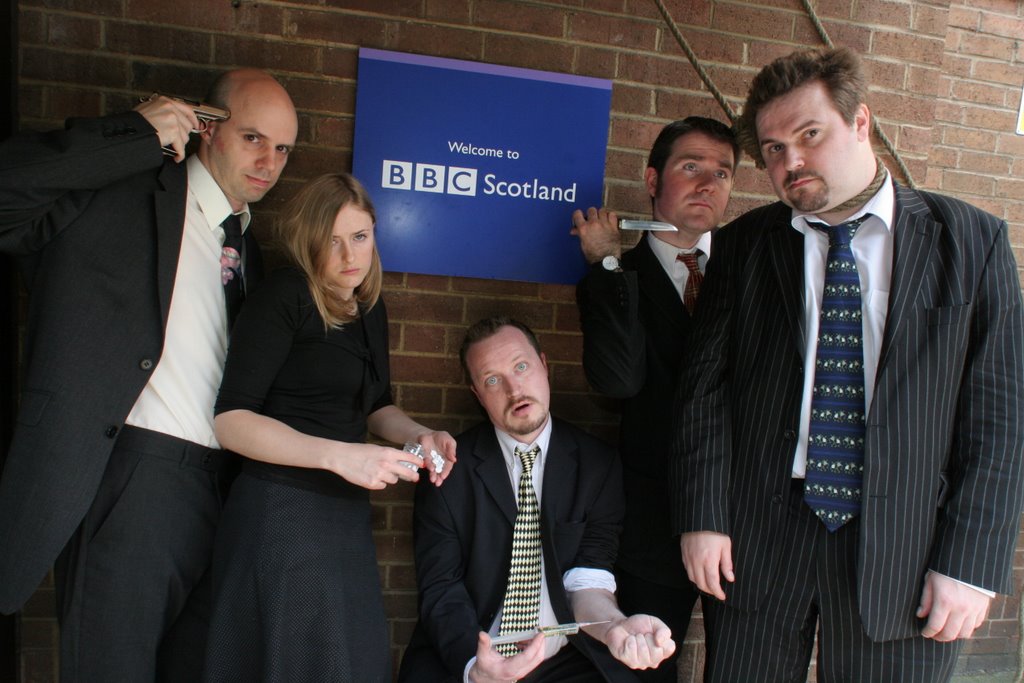
Franz Kafka Big Band publicity photo from their Web site
It seems that they haven't got around to updating this release just yet. But press releases are generally the last thing that people look at on Web sites, anyway. The 'Who and What' section of the main page contains the following:

The Franz Kafka Big Band is a comedy group that makes programmes for BBC Radio.

Recorded entirely in the studio, the shows combine the written sketch with a sophisticated editing and recording process, the surreal and the naturalistic, improvisation and music.

The Big Band have made two series for BBC Radio Scotland, and are currently in development for television.

Written by Colin Edwards & Innes Smith - additional material by the performers; Jenny Ann Marshall, Craig Stobo, Dave Barr & Innes Smith.
Original Music by Colin Broom, CNUT, Bozilla & Mind Sculpture.
Engineered & Sound Design by Kahl Henderson at Savalas Studios.
Produced by Colin Edwards.
Executive Producer is Nick Low.
The Franz Kafka Big Band is a Demus Production.
Website Content & Design by Rob Eijkman & Innes Smith.
Website Managed & Hosted by Bandspace

There is a complete rehash of the press release published on the Web site of The Daily Mail, a U.K. tabloid, which includes a place to leave comments. There are only three comments at the time of writing. I think I'll add my own thoughts about this curious debacle and the conundrum at its heart.

But I can just see Rolf Harris sketching Muhammad using a big, thick paintbrush and a tin of black paint. I'd love to see it, personally.

Doesn't it also strike you as odd the way the AAP story started: "Rolf Harris has been unwittingly entangled in a BBC scandal..."? I mean, he surely knew what he was painting, so how is it that he's 'unwittingly entangled' in the scandal? Surely it would be better to say 'embarrasingly entangled'? I think that's more accurate.

Friday, 25 August 2006

William T. Vollmann is interviewed by Matt Thorne for The Independent. The novelist, who Thorne describes as "known mainly as a cult novelist, revered more than read" divulges details of the books he's currently working on.

He's currently working on a number of new projects. One is a non-fiction book about his experiences hopping freight trains across America. "It's really fun to think about the connections with the Beats, rereading Jack Kerouac, but also Jack London and Mark Twain, travelling fast through the country, that solitary, wild American experience."

Another forthcoming book is about Imperial Valley. "I've been working on it for ten years," he told me. "I'm trying to tell the history of the US-Mexican border from earliest times to the present. I'm looking at how a line on paper can change things. When you first look at Imperial Valley it seems hot, flat and dull, but the more you look into it the more secrets you can find. There's a labyrinth of illegal Chinese tunnels, which was considered to be a myth. But I finally got to go into these tunnels and they're fascinating. There's parquet ceilings and I found this velvet nude painting, and some old Cantonese letters I had translated. Some tunnels became brothels and gambling dens and valuables were hidden down there."

Then there's the long-awaited volume five of the Seven Dreams series, his septet of novels dealing with "the repeated collisions between Native Americans and their European colonisers and oppressors", which concerns Chief Joseph of the Nez Perce tribe. Vollmann and his father are going to trace the route Chief Joseph followed when he attempted to escape to Canada.

He also talks about his working methods, which are said to be extraordinary, with massive injections of time from the moment he rises until he decides to go to bed. He says:

"It depends on the book. I read and write for most of the day, but I do let myself be interrupted by real life. I enjoy going out with friends and try not to take myself too seriously."
A review by Jenna Krajeski (an editor on the staff of The New Yorker) of Haruki Murakami's Blind Willow, Sleeping Woman has been posted on the Web site of The San Francisco Chronicle, SFGate.com.

It's one of the best reviews of this latest work by the Japanese master that I've read. I think. There have been a lot of them in the past month or so. As there should be: it's a publishing event in a major key.

Inconclusive, bewildering and totally engaging, the whodunit survives in Murakami's work as a tired framework to be purged of its contents and refilled with ironic, metaphysical, quixotic mysteries: hard-boiled narratives for the postmodern set.

And:

True, penetrating anxiety ... rumbles beneath many of the stories like a dormant volcano; just because Murakami never names names doesn't mean the murderer isn't ready to pounce.
As promised, I got back some comments on my assignment from a friend who is a trained journalist. I feel quite comfortable with the article now. It seems like everything is in place. If I had another two weeks to think about it, and if I were to let it lie for a week or so then come back and look at it afresh, I'd find something else to ponder and, no doubt, change.

The article is about the way that people living in some electorates vote. In some areas of the city, the same person who is voting for the Labor Party at the state level is voting for the Liberal party at the federal level. This is what I wanted to cover. Especially, there's a quote from a journalist, which will be revealed when I post the whole article on the weekend, that encapsulates very humourously the situation in a single sentence. I love this quote. It's wonderful. You'll see in a couple of days.

Here's a few of my friend's comments (she's going to hate me for posting these, but since you know neither my identity nor hers, I guess I'm covered):

“It’s just, you’ve got to look at the bigger picture and get John Howard out,” says Lauren, standing under the shade of the pedestrian overpass at the back entrance of the Penrith Westfield shopping centre as the cars and choppers swish and growl over the speed bump at the pedestrian crossing and the Saturday shoppers scuttle across against the lights.

BRILLIANT opening. It's just fantastic.

Lauren, a Penrith resident, is in the minority -- at least at the federal level: the Liberal Party holds the federal seat of Lindsay, which encloses Penrith, an enclave on the edge of the suburban sprawl of Sydney, near the weed-choked Nepean River and the mighty M4 motorway. Driving north along Mulgoa Road from the M4 exit you pass the massive Penrith Rugby League Club, its asphalt apron suffocating under the press of thousands of cars that glint luridly in the noon sun.

Okay, here's the onset of a problem: you're reveling too much in the prose, showing off (as well you have a right to), and it's overshadowing the point
of the story. I'd go through and take out every 3rd adjective and see if that doesn't lighten the reader's load.

point for governments. Some of the people interviewed were committed to an ideal, even if it was a negative one. “Well, Labor’s more for, you know, the ordinary people and the Liberal’s more for the, you know, the upper class,” says Cheryl. “And I mean, the way the federal government gives hand-outs to private schools and forgets the public sector, you know…”

I'm not sure if you're using the "you knows" and "I mean" to help create a character, which is of course one option. But to me, it makes her sound kinda like a valley girl... and in the same way that journos usually clean up all the "ummms" and "welllls" and things, IF you don't want to define her with those, I think they should be dropped.

Nicolle voted for John Howard at the federal level but she doesn’t remember who she voted for at the state level. “I just went there just so I didn’t have to pay a fifty-dollar fine,” she says. “It’s the truth.” Does the

WHAT? You guys are fined if you don't vote?!!

She also volunteers to be an electoral scrutineer on occasion.

Is this a real job description? It sounds like a Caribbean pirate!

“I think there is always a terrible tendency for people to try and draw conclusions on philosophies of views of the electorate,” he says, “when often what’s occurred is just an accident of history.”

Great concluding quote.

I just wish I didn't hate politics so much!

Thursday, 24 August 2006

Following the workshop on Monday night, on Tuesday my tutor sent me the following e-mail:

I thought I should check in on how you felt about the workshop - and to see if it was helpful for you? I think you got a lot of good advice. But it can seem like a free for all at times, and you do need to sift the useful advice for the not so useful. You also need to listen to your own conscience on this, and work out a writing process and style that SUITS YOU whatever advice you may have got. The trick of course is to consider why people might have offered the advice and respond in ways that make the story stronger, whatever direction you choose.

I responded on Wednesday:

To be frank I was dreading it beforehand. But I found a lot of the advice consistent, which meant that there were real problems with the story that many people saw. Definitely there were too many quotes by too many people in the first six paragraphs.

Especially, I decided to expand the introduction, describe Penrith (and the shopping centre) a bit more to give readers a feel for the location. Then I lifted the position of the information about the political settlement, to make it clearer to readers what the main focus of the story would be.

I also got a lot of good pointers from the comments handed to me, especially yours. I did indeed locate the donkey vote statistics for Penrith, so I added that.

In general I felt more confident about the direction I wanted to take after the workshop. I worked on the story the same night, and rewrote it quite a bit, removing a couple of the quotes and lengthening others.

Thanks for dropping me a line about this. I feel much more confident about my story, changed the title and worked on it for a good couple of hours straight. I'm also getting some feedback later this week from a friend of mine who is a trained journalist. That should also be helpful.

I must admit that I feel a little odd about doing a complete rethink on the tone of the story, as you suggested (having "a bit of fun" with it). I don't feel confident that I can achieve the correct tone -- maybe for the longer assignment at the end of semester I'll throw caution to the wind and lash out a bit. I will probably continue to play it pretty straight but to generally tighten up the construction, as advised during class.

To which he answered straight away:

That's all good news to me, and I am glad it was so useful. Watch out in seeking advice - and getting it! - from so many sources that it doesn't push and pull you in a million directions. It sounds though from your email that you have a much more coherent grasp of things now. As for my comment on 'tone', that is something that comes from you - it was just a suggestion, but you should go your own way. I look forward to reading it!

The whole experience is very satisfactory. I’m having a lot of fun with it.

Wednesday, 23 August 2006

In the row over ball-tampering it seems that nobody has got to the heart of the matter.

The Pakistanis were angry with the claim that they were abusing the ball and therefore would not return to the field after tea. But Darrell Hair is the umpire, not some puffed-up generalissimo in an Islamabad committee room. Whether you agree with Hair's call or not, you've still got to abide by it.

It seems to me that the problem with the Pakistani approach is that they did not deem the ruling sufficiently compelling to return to the field. Only when they realised that their dummy-spit wouldn't sway Hair, did they decide to return. An Australian side would never behave like this.

The Pakistanis come from a country where the rule of law is still rudimentary and abuses by the authorities are commonplace. That's why they took the stance they did. They think that such abuses extend to the cricket field. In Australia, even if you think you've been dudded by the umpire, you get on with it. You swallow your pride and play. The Pakistanis have simply shown the true nature of civil society in their homeland, and have made it clear to the rest of the world that Pakistan is a country where the rule of law — that the same laws apply for everyone — is a myth and not the reality.

It is shameful in the extreme, to show your own country's lack of development like this, on the world stage. No wonder they are so angry. To expose yourself and your country in public like this must be so painful.

Monday, 21 August 2006

I survived, and now see the light at the end of the tunnel. A cold glint that makes me smile with anticipation. Some time after it started — maybe five minutes — I realised it would be better than I anticipated. And it was.

Workshopping is fun. Now I know that, I've got nothing to fear. Most of the criticism was merited and the comments were remarkably consistent, demonstrating the existence of real flaws. So I rewrote the piece.

But there's one thing I don't want to do. They suggested using longer quotes from fewer interviewees. And that means going back into the recordings for more fuel. Not something I relish, especially with all the background noise on the recording making some people impossible to hear.

For kicks I've sent the story away to a friend who is a trained journalist, for her comments. When I get those back, I'll do some more digging next weekend, and post the result. Then you, too, can benefit from reading my cool constructions and stylish sentences.

Sunday, 20 August 2006

What a relief! Just completed assignment number one for one of my courses. 1600 words of perfect prose (although there was one missing pronoun that I discovered after e-mailing it out to the class). We workshop the piece tomorrow night. Workshopping is a frightening experience, I've concluded.

It's like being ripped to shreds by a pack of hungry beasts. Maybe that's wrong. Perhaps it's a useful way of discovering the weaknesses in your work, a method of taking another person's point of view. In any case, I'm frankly terrified. Probably I'll just cower in my seat like a rabbit caught in the headlights of an on-coming vehicle. On the other hand, maybe I'll enjoy all the attention. We all love to be talked about, after all.

I remember in the first class of the course, some weeks back... We had to interview our neighbour and write a few hundred words, in class, to make up a story. A tough assignment. My confrere — or should I say consoeur — did a nice little job on me. And because she's the outgoing type, and quite confident to boot, she read the thing out to the rest of the class! Mortified!

But I survived. To greet another day with assurance and humour. Now that I've finished my assignment, I'm going to sit down and read the assigned readings for Monday night's class. I haven't had time to read anything else for weeks.

Saturday, 19 August 2006

My new bookcase has just arrived. It's just under one centimeter too narrow to completely fill up the assigned place, but I'm not worried about such quibbling things. The two delivery blokes have just left to go on to their next delivery, and then return to Claphams Furniture and Antiques in Lane Cove, from whom I purchased this lovely item of tan-coloured pine furniture.

Already two and a half shelves of the seven are full, but I suspect that, what with my studies and continuing money issues (child maintenance etc.), it should take me at least two years or more to fill it completely. I hope so. I've only got a small apartment. When this unit fills up I'll need to get a new one made for the bedroom. Or maybe the kitchen. There's no room anywhere else!

I also picked up today a print that I had framed at Studio 275 in Earlwood: an etching by Pixie O'Harris that she gave me decades ago. So I'm happy.

Just time for lunch. I've done my laundry. After I finish with the broadsheets I'll get stuck into my uni assignment.

Friday, 18 August 2006

Accompanying a New York Times review of a new book by Ali Alatas, "the former longtime foreign minister and ambassador to the United Nations", is a map showing (purportedly) East Timor, the subject of the book and the article:

Bad
Note the location of the state, which somehow has been pushed up toward Sulawesi. Now, here is the actual map of the region, from another Web site:

Good
How could they get it so wrong?
David Mitchell looks like the kind of guy who marries Japanese womenDavid Mitchell lived in Japan for eight years and is married to a Japanese woman, Keiko (a common-enough name). As someone who has lived in Japan for nine years and is also married to a Japanese woman (although now separated), I can understand the allure of the place. According to The Guardian’s book page, “next month they move back to Japan”.

The heady narrative trips of the 37-year-old's first three novels owe a debt to the Japanese writer Haruki Murakami (the title of Mitchell's second novel, Number9Dream, is a veiled tribute to Murakami's masterpiece Norwegian Wood, in that both were named after lesser-known Beatles songs).

Mitchell’s novel Cloud Atlas sold 500,000 copies, so he’s obviously doing quite well on the financial front. After living in Holland, away from his permanent residence in Ireland, Mitchell will soon return to Japan.

In June, Murakami had an interview with Ben Naparstek, a Melbourne reviewer:

“You know the myth of Orpheus,” Murakami says. “He goes to the underworld to look for his deceased wife, but it’s far away and he has to undergo many trials to get there. There’s a big river and a wasteland. My characters go to the other world, the other side. In the Western world, there is a big wall you have to climb up. In this country [Japan], once you want to go there, it’s easy. It’s just beneath your feet.”

The floating world re-emerges as a paradigm of life in the land of the Rising Sun. A. S. Byatt said in The Guardian article:

"He is wise to live in remote places," says Byatt. "He needs time and space to write those long intricate books and I think he has the good sense and the confidence to give them to himself."

I miss many things about Japan. It is true that realities are more fluid than in the West. In Australia there is a solidity about daily life that is gently reassuring. In Japan, you never quite feel as though you know what’s going to happen next. You could see a person dressed in outrageous attire, a man sleeping on a train, a woman patiently putting up with the gropings of a salary man on board a train. And the politeness is astonishing and refreshing. Here we are so informal all the time. It’s first names for everyone. In Tokyo, you greet most people with the honorific ‘-san’ attribution, always mindful that you are living in a city with a population greater than that of all of Australia's towns and cities put together.

In an essay, Mitchell outlines his reasons for preferring life in Japan, from the point of view of his writing:

In Japan, I am, in writer/critic Donald Richie's phrase, an alien amongst natives. The Lonely Planet guide quotes the idea that some countries have a 'mission' attitude towards foreigners, and some have a 'club' attitude. 'Mission' countries define foreignness by behavior -- act like a native, and as far as other natives are concerned, you eventually have as much right to be there as they do. 'Club' countries define foreignness by your lineage or passport -- it will never matter what you do, how well you learn the language, how many soccer teams or famous department stores you buy -- you are foreign and always will be. Japan is a classic club society. Living here, I kiss my sense of social belonging goodbye. When I was a kid, my main talent was sulking -- spectacular, multi-day sulks. I don't think I sulked to manipulate: the point was to isolate myself. I sometimes believe that my real motive behind living abroad is to enjoy the same fruit.

He says he reads Japanese like a ten-year-old (which is better than me) and that he gets lost sometimes in adult discourse. I can understand that. When I lived there I spent a lot of time playing with children. Every weekend I would be with my own kids and they, in turn, would want to play with the kids next door. So I would be out in the car park at the back of the apartment block pushing five-year-olds around on skateboards and kicking a soccer ball with their big brothers and sisters. You learn a lot about a culture from playing with children: the way the games create a society, the way they get upset and run off home, the way they have adventures. And when we went skiing it was me (who couldn’t ski) who was delegated to mind the kids. I didn’t mind. In fact I rather enjoyed it, being a big brother to the rug rats. It all adds up.

In another interview, Mitchell said:

I can argue with my wife in Japanese, but I can’t win the arguments.

Amen to that.

Wednesday, 16 August 2006

It seems that I’ve been ‘tagged’ by Kimbofo of Reading Matters to do a book meme. This is not painful but still it is new to me: a newfangled invention beyond the powers of my jaded wit to criticise. Memes are part of the clutter of blogging that I have up until now hesitated to engage with, seeing them as an overly-cute method of communicating, and preferring always the direct, old-fashioned approach in my writing. They simply seem like a quick way of filling up space with short, direct sentences. But now that I’ve been tagged by one whose blog I esteem so highly, I’ll humbly comply. Here are my responses to the meme:

1. One book that changed your life?
Ada or Ardor: A Family Chronicle by Vladimir Nabokov

2. One book you have read more than once?
Love in the Time of Cholera by Gabriel Garcia Marquez

3. One book you would want on a desert island?
The Norton Shakespeare

4. One book that made you cry?
Bleak House by Charles Dickens

5. One book that made you laugh?
Ludmila’s Broken English by DBC Pierre

6. One book you wish had been written?
Whatever Nabokov was working on or thinking about when he died in mountainous Montreux when I was fifteen and growing up, unaware of his very existence, in sunny Sydney

7. One book you wish had never had been written?
There are lots of bad books, but much worse than that venal crime is censorship itself (i.e. the more the merrier)

8. One book you are currently reading?
Somersault by Kenzaburo Oe

9. One book you have been meaning to read?
The Embarrassment of Riches by Simon Schama

10. Now tag five people
Perry of Matilda, Kerryn of A Fugitive Phenomenon, Georg of Stack, Meredith of Marrickvillia, and Sharon of Bibliobibuli
The Man Booker Prize longlist has been announced:

Carey, Peter Theft: A Love Story (Faber & Faber)
Desai, Kiran The Inheritance of Loss (Hamish Hamilton)
Edric, Robert Gathering the Water (Doubleday)
Gordimer, Nadine Get a Life (Bloomsbury)
Grenville, Kate The Secret River (Canongate)
Hyland, M.J. Carry Me Down (Canongate)
Jacobson, Howard Kalooki Nights (Jonathan Cape)
Lasdun, James Seven Lies (Jonathan Cape)
Lawson, Mary The Other Side of the Bridge (Chatto & Windus)
McGregor, Jon So Many Ways to Begin (Bloomsbury)
Matar, Hisham In the Country of Men (Viking)
Messud, Claire The Emperor’s Children (Picador)
Mitchell, David Black Swan Green (Sceptre)
Murr, Naeem The Perfect Man (William Heinemann)
O’Hagan, Andrew Be Near Me (Faber & Faber)
Robertson, James The Testament of Gideon Mack (Hamish Hamilton)
St Aubyn, Edward Mother’s Milk (Picador)
Unsworth, Barry The Ruby in her Navel (Hamish Hamilton)
Waters, Sarah The Night Watch (Virago)

The longlist of 19 books was chosen from 112 entries; 95 were submitted for the prize and 17 were called in by the panel of judges.

I've only read one of these: Peter Carey's Theft: A Love Story. And with my study commitments it looks like I won't be reading any others before the shortlist is announced. According to their Web site:

The 2006 shortlist will be announced on Thursday 14th September at a press conference at Man Group’s London office. The winner will be announced on Tuesday 10th October at an awards ceremony at Guildhall, London.

Tuesday, 15 August 2006

On Sunday I telephoned Dymocks Booksellers in Penrith because the Burwood branch didn't have what I coveted: Mapping the World (2006). They had five copies at Penrith and one at Broadway, which is close to my work but inconvenient to visit at lunchtime.

So I ordered the book from the Penrith store by credit card: including postage it came to just over $36. The book is on sale. The big, full-colour volume that contains hundreds of pictures of maps, from various ages, arrived at work today.

The U.S. publisher, Chartwell Books (New Jersey) has licensed the book from a London publisher, Compendium Publishing Ltd. The author, Michael Swift, has assembled a large collection of maps painted and printed at various times in history. I'm a major map-lover, so this book is right up my street.

The chapters tell the story. It starts with some explanatory text, then there are time-specific sections:

Introduction (pp. 6 - 31) — 'Why Maps?', 'The Development of Cartography', 'Maps for a Growing Market', 'Major Figures in the History of Mapping', 'Types of Maps', 'Glossary of Cartographic Terms'.
To the End of the Sixteenth Century (pp. 32 - 109)
The Seventeenth Century (pp. 110 - 147)
The Eighteenth Century (pp. 148 - 205)
The Nineteenth Century (pp. 206 - 255)