Sunday, 13 August 2006

Patrick White seems to be out of favour with Christopher Pearson, a columnist for The Australian.

I suppose it's unnecessary to be unduly concerned by this, given the often right-wing stance held by the newspaper. But he wrote such a good column for this weekend's Inquirer section that I wonder if I'm missing something.

The column charts the history of his attraction to the written word, from earliest times. As a primary-school pupil, Pearson recounts, he all at once, one day, got the idea of writing, as he told an interrogator about his abiding interest in books and reading:

My mind raced back to a rainy afternoon in Bellevue Hill primary school in Sydney in 1956, with the smell of wet asphalt drifting into the classroom. The teacher had just joined up show cards — with a C, an O and a final W and a picture of a cow — and the penny dropped.

It was a short time later that he started reading The Rubaiyat of Omar Khayyam.

About the time of this first brush with the canon, there were a few other, more temperate encounters. I recall hearing one of my great-grandmothers and an aunt reciting by heart tracts of the Oxford Book of Ballads, getting a first taste of The Magic Pudding and Gulliver's Travels, and being given a bound volume of instalments of one of Charles Dickens's magazines called Household Words. Owning something that is more than 100 years old at the age of eight is a great stimulus to the imagination.

Later, in his teens, he encountered Evelyn Waugh, Anthony Trollope and the poets: Shakespeare, Marvell, Donne, Herbert, Marlowe, Hopkins and Eliot. "An only child with well-read parents, I soon realised that curling up with a book was the most exciting kind of companionable silence." "On first reading the novels of Patrick White at 16, it seemed to me as though the two (sacred and profane love and a countervailing sexual ambivalence) had converged, almost for the first time apart from Brideshead Revisited, in a way that wasn't louche or self-indulgent." This is all very straightforward reminiscence of good times had with a book in his hands. The problem comes, as in any good column, in the final paragraph:

But while I don't rate White as highly as before, no longer see him as any kind of role model and can seldom bring myself to reread his books, I don't begrudge the years spent immersed in them. It was a bracing, intellectually demanding encounter. They taught me a good deal about the vagaries of human nature and much else besides. The best of them, from Voss to The Eye of the Storm, often ran fiercely counter to the prevailing Zeitgeist until, nearing his dotage, the spirit of the age began to enthral White and exacted a terrible, exemplary revenge.

I wonder what he means? Any ideas?

Saturday, 12 August 2006

Interviewing people at Penrith Westfield is not my idea of a great way to spend an afternoon, but that's what I've just done. It's a 40-kilometer trek out west, and I wanted to arrive there around 2:00 p.m.

My assignment is due for workshopping on Friday so I needed to get some material this weekend. I drove out west on the M4, through the Light Horse Interchange, and then turned off onto Mulgoa Road. You drive about three kilometers northward from there to arrive at central Penrith. I turned into Westfield — you get three hours' parking for free.

It only took me about two. In order to avoid being interrogated by the shopping centre's security personnel, I stationed myself on the street at the east exit, between the old and the new sections of the shopping plaza. I think it's Riley Street that crosses between the two halves of Westfield.

In order not to be too conspicuous I only targeted people who were smoking, i.e. who were standing around filling in time. I'd say about 60 per cent of those I approached were willing to talk, which I thought was fair.

So, now I've got 22 short (1- to 2-minute) interviews to transcribe and weave into a meaningful narrative for my feature story. I hope to do a couple more interviews early next week, by telephone.

To add some spice to my visit I also popped into Angus & Robertson and Dymocks bookshops, just to have a quick squiz. Fairly typical, I thought, as I dashed back to my car on parking level 1. Then off back down the motorway, home.

Thursday, 10 August 2006

According to the Real Estate blog Patrick White's house was listed on "the New South Wales Heritage Register, to save it from any future development." The post is dated 21 November 2004. Matilda said on 23 February 2005: "It is now in private hands and is coming up for sale in the near future." The Real Estate blog followed up, on 8 March 2005:

The Centennial Park house of the late writer Patrick White has had its auction rescheduled for April 6, and the home's four beneficiaries still expect it to sell for at least $3.5 million.

The auction of the Federation bungalow, Highbury, was postponed in November to allow time for the National Trust to raise funds for its plans to create a writers' centre at the home.

Here the online record ends. There was a piece published recently but I didn't clip it, unless my memory is failing faster than I believe is the case. Does anyone remember?

Now, however, according the the Sydney Morning Herald, Grace Cossington Smith's home has been heritage-listed. It's taken her 60 years to reach this exalted region. I wonder if anyone will be willing to purchase the Turramurra property for a painting school, as supporters of White's legacy urged for his place. This artist was a significant modernist, in the Australian canon, anyway. Not comparable with White, in any case. But it's nice to know that these things still mean something, even if White's house was not fully repatriated. The tone of dismal failure is eloquently conveyed by Peter Watts, (then and still) director of The Historic Houses Trust:

"...we looked at the possibility of a museum but the house was so small and so fragile it could only have limited numbers of people going through it".

"We did a plan which showed a large loss. The Government explored some form of writer in residence scheme which would mean it would have an ongoing life," he said.

Some of their recent acquisitions can be viewed in the list on this page.

Tuesday, 8 August 2006

William Blake’s Adam Naming the Beasts has arrived from Scotland. As I mentioned earlier, I discovered the painting at Pollok House, which is located outside Glasgow. Although the package is slightly bent from transit, the print is undamaged. From the time I found the link to the William Blake Archive on Edward Champion’s blog to its delivery, was just under two weeks.

Adam Naming the Beasts by William Blake 1810I purchased the A3 version, and will take it to be framed in a few weeks (after my bank balance rebalances) at Studio 275 in Earlwood, just down the street from my place.

My impression of the painting, my visual image of it before opening the package, was different from the reality. For some reason, I had pictured in my mind Adam turned three-quarters on to the viewer, facing the marching procession of animals traversing the picture space of the middle ground. But, in fact, he’s facing directly toward the viewer, finger raised, eyes unfocused and aimed off to the left, into the distance, as he conjures up the mystical names from his subconscious. “Whatever the man called each living creature, that was its name” (Genesis 2.19). Of note is the fact that Blake painted a sister picture: Eve Naming the Birds. This is typical of Blake’s inherently irreverent attitude: although he was very religious, it was an idiosyncratic belief that he nurtured. He saw spirits. So he needed to embellish on scripture for his own ends. It’s fitting that he made a twin for his great painting, so that he could include women in his cosmology: the other half of the sexual equation.

Also, the colours I had imagined to be brighter than they are. It’s a very delicate colouring, with the predominant pale brown offset by the red of the snake Adam fondles at his breast, and the yellow bloom of the sky to the right of the space. Truly, a beautiful artefact.

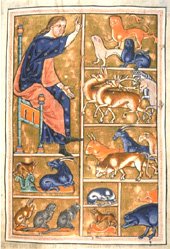
Adam Naming the Beasts in the Aberdeen BestiaryIt seems as if this is a favourite subject of pictures at different times in history. There is the Aberdeen Bestiary, which enters recorded history “in 1542 when it was listed as No. 518 Liber de bestiarum natura in the inventory of the Old Royal Library, at Westminster Palace.” According to the Web site: “this library was assembled by Henry VIII, with professional assistance from the antiquary John Leland, to house manuscripts and documents rescued from the dissolution of the monasteries.”

The subject reappears among the stained glass designs of William Morris, “one of Victorian England’s foremost leaders of the Arts and Crafts movement.”

Sunday, 6 August 2006

Patrick White Reader's Group gets a mention in The Sydney Morning Herald on Saturday. Susan Wyndham is obviously keen to exploit the Internet in her weekly column. She put a call out recently for votes on the best Australian fiction of the last ten years. And now she's put in the link to this blog, set up by Ron from BiblioBillaBong.

The headline of the piece is 'Patrick White Hoax Inspires Debate': "I thought the recent hoax by The Australian ... was silly and smug. But it has inspired some interesting discussion online. The contributors to sarsaparillablog.net ... have decided to read The Vivisector as a way to re-examine White's work."

Actually, the decision to read The Vivisector was finally taken by an online poll at the Patrick White Reader's Group. But the idea started at Sarsaparilla, that's true enough.

It seems from the comments on the Patrick White Reader's Group that some people have read the piece in The Herald and logged on. The reading challenge starts in September.

Friday, 4 August 2006

Another gala day of book buying… Gulp. After leaving work this afternoon, I sauntered down to the Co-op Bookshop and picked up a text book and a sale book:

The New New Journalism: Conversations with America’s Best Nonfiction Writers on Their Craft, Robert S. Boynton (2005)
The Clash of Fundamentalisms: Crusades, Jihads and Modernity, Tariq Ali (2002)

Then I loafed over to Gleebooks and bought the latest issue of The New York Review of Books because I had discovered at Matilda that it contains a review of Peter Carey’s Theft: A Love Story (a very good review, by the way, showing me aspects of the book that I’d neglected to see). I also picked up, on the sale tables upstairs at No. 49 Glebe Point Road:

30 Days in Sydney: A wildly distorted account, Peter Carey (2001)
The English Yeoman, Mildred Campbell (1942)

It was raining. I swished along Parramatta Road, turned up Crystal Street and into New Canterbury Road, then popped into the bottle shop for my Friday beers. Four bottles of Amsterdam Mariner, a packet of chips, and four mini salamis later, I received a telephone call on my mobile phone from the furniture-maker, who regretted to say that the carpenter couldn’t do more than 26 centimetres between shelves. My new bookshelf was delivered last weekend but only had six shelves, so I had them make a new one. I’d ordered seven shelves, after all. So now they’re making a new unit — to my specifications. It seems they’d got the height wrong. Sigh! The good bookshelf, that they’d successfully made for me and delivered about five months ago, has 30 centimetres between shelves. I don’t want the shelves too close together, since if they are I’ll not be able to fit hardbacks on the shelves. They won’t deliver before next weekend, anyway. I hope they get it right this time!
Review: Player Piano, Kurt Vonnegut (1952)

Vonnegut's satirical reach is refreshing. In this snapshot of the future (note publication date) he winds up the stoney-eyed simulacrum of Metropolis and gives us a binary class system: the engineers and managers vs. the average man. It takes a doctorate to become a real estate agent. The centralised planning of production — originally introduced during the most recent war — has generated mass unemployment and the plebs are either in the army or on road crews (Reconstruction and Reclamation Corps). A typical exemplar is Edgar R. B. Hagstrohm — chosen by the computer database to be shown to a visiting potentate, the Shah of Bratpuhr, who thinks that these people are all slaves.

The personnel machines had considered the problem and ejected the card of Edgar R. B. Hagstrohm, who was statistically average in every respect save the number of his initials: his age (36), his height (5'7"), his eight (148 lbs.), his years of marriage (22), his I.Q. (83), the number of his children (2: 1 m., 9; 1 f., 6), the number of his bedrooms (2), his car (3 yr. old Chev. 2 dr. sed.), his education (h.s. grad, 117th in class of 233; maj. in business practice; 2nd string f'ball, b'k'tb'l; soc. comm., sen'r play; no coll.), his vocation (R&R), his avocations (spec'r sports, TV, softb'l, f'sh'g), and his war record (5 yrs., 3 ov'sea; T-4 radioman; 157th Inf. Div.; battle stars: Hjoring, Elbesan, Kabul, Kaifen, Ust Kyakhta; wounded 4 times; P'ple H't, 3 cl.; Silv. Star; Br'ze Star, 2 cl., G'd Cond. Med.).

But the real drama in this wonderful, dark and intriguing novel occurs in the life of the protagonist, Paul Proteus, head of the Ilium Works, a massive, computer-automated manufacturing plant in New York State. Because Paul wants out. The pressure of his boss, his wife and his society are ranged against his desire not to give his friend up to the authorities, who continue to fear subversives.

Strange things happen occasionally, as Proteus discovers when he goes to the police station after being fired from his job:

While he waited for someone to notice him, he interested himself in the radiophoto machine behind glass in one corner, which was fashioning a portrait of a fugitive, and noting beside it a brief biography. The portrait emerged from a slit in the top of the machine bit by bit—first the hair, then the brows, on line with the word WANTED, and then, on line with the large, fey eyes, the name: Edgar Rice Burroughs Hagstrohm, R&R-131313. Hagstrohm's sordid tale emerged along with his nose: "Hagstrohm cut up his M-17 home in Chicago with a blow-torch, went naked to the home of Mrs. Marion Frascati, the widow of an old friend, and demanded that she come to the woods with him. Mrs. Frascati refused, and he disappeared into the bird sanctuary bordering the housing development. There he eluded police, and is believed to have made his escape dropping from a tree onto a passing freight—"
  "You!" said the desk sergeant. "Proteus!"

Wednesday, 2 August 2006

Beauty arrives by mail. Finally, I found it, and it will be here soon! The power of the Internet to provide good service is proven, in my books.

On 25 July Edward Champion’s Return of the Reluctant blog posted a brief notice on The William Blake Archive. I’d been looking for a particular painting by Blake for some years, without finding a commercial reproduction anywhere. So I e-mailed them:

I'm a big Blake fan and I've been looking for a specific painting: 'Adam Naming the Animals'. I've contacted print sellers here in Sydney but no luck — it's not on their books.

I wonder if you can help me find where this painting is located, and whether it has been reproduced?

Will replied:

The painting you are looking for is called "Adam Naming the Beasts," and it is located at Pollok House in Glasgow, Scotland. Blake executed it in pen and tempera on fine linen and dated it 1810.

We do not currently have this image available in the Blake Archive. To inquire about reproductions, you might try contacting the Pollok House directly.

So I e-mailed them and Suzanne Finn replied immediately saying they stocked postcards at 40 pence per card, but that if I wanted anything bigger I should try Glasgow Museums Photolibrary. I e-mailed Winnie Tyrrell there and we exchanged a few messages (her: “We can provide you with a colour ink jet print of this painting. Either A4 size at a cost of £10.45 or A3 at £20.90. Postage & packing of £4 would be added to these costs.” and me: “I assume that the quality of the ink-jet print will be adequate for framing (which will cost me at least as much again as the print itself). If you could send me details of the print resolution, that would be great.”) sorting out the necessary details and arrangements.

I also purchased a telephone card at my tobacconist and called her twice: once to ascertain the quality of the print they would supply and the packing method, and once to give my credit card details. The print is in the mail.

Tuesday, 1 August 2006

First Tuesday Book Club (“the show for people who love to read and want to share that passion with other enthusiastic readers,” according to host Jennifer Byrne in her intro, “after all, isn‘t that what readers do? We may read alone, but as soon as the reading ends the talking starts: what worked, what didn‘t, who we liked, who drove us nuts.”) is a casual, sparring affair. Five people sit on beige armchairs in a circle with shelves and mock-up books in the background, and debate the pros and cons of two books. One book is a recent release (“maybe something brand-new, maybe something already making waves”) and the other is considered by one of the (“brave”) participants to be a ‘classic’.

“We want you, Australia’s readers, to be part of our club,” said Byrne enthusiastically.

This month — the club’s first to air — the participants were Jason Steger (the literary editor of The Age and former sports journalist), Jacki Weaver (famous Australian actor), Marieke Hardy (granddaughter of the famous Australian writer Frank Hardy and now a script-writer and radio host), and Peter Cundall (host of “that television institution, Gardening Australia”).

Each book is introduced by a dramatisation of the plot. In the case of The Ballad of Desmond Kale this took the form of various clips of film of re-enactments of life in the early nineteenth century in the new colony: black-and-white snippets of action with some jazzy background music. It’s quite entertaining, but nothing special.

“I think The Ballad of Desmond Kale is a terrific book,” said Seger. “It’s got virtually everything in it, all you could ask for. It’s a fascinating picture of [the] early 1800s in Australia. It’s an incredibly imaginative book written in a very distinctive style, which I think makes demands on the reader. But if you respond to those demands, you get a huge amount of pleasure from the book.”

“Well, Roger McDonald is a poet,” said Weaver, “and so it is a bit like reading an epic poem. And some of the syntax is very odd and eccentric, and some of the sentences are very convoluted. But once you get used to that… the way that he’s writing… I mean, now and again you have to read a sentence several times like you do with a poem, to find the gist of the sentence…”

“I actually found that quite cumbersome,” interjected Hardy. “I was quite willing to go along on the journey with him with characters using dialogue but…” and the rest was masked by distortion as others joined in the discussion. You see how it is when people discuss books. They get very passionate and argumentative. And that’s good. We should get passionate about books.

“Occasionally I did find it like flicking through a school text book,” added Hardy. “I found it so ponderous.”

“I liked the characters, though,” Weaver jumped in. “The characters were very Dickensian, especially the villan…”

“Stanton,” piped up Cundall. “Well he is, but this is the amazing thing about the book. I mean, look at it, it’s the size of a house brick, isn’t it. The first thing I noticed is that there’s Desmond Kale — I mean ‘kail’ is an Irish cabbage.” Cundall, true to his grass roots, then took exception to the fact that Kale was flogged for stealing an iron rake. It was more likely to have been made of wood, he averred. Laughter ensued.

“Well let’s be honest,” resumed Byrne. “Kale is nowhere near the centre of the novel. … He’s retreated off to develop his superfine sheep, with some kind of gardening implement or whatever he’s using out there. But the real character, the real driver of the book is his rival for the sheep. And this guy — Matthew Stanton — I mean, did he work for you?” “Oh he’s brilliant,” replied Seger. “He’s a brilliant character, I think, and yet his very presence is absolutely, completely realised by McDonald.”

“I think the two points,” continued Seger, “the two characters: Desmond Kale, who is absent, and Stanton, who is so very present, I mean, that’s what makes the book really … So we’re seeing Desmond Kale through all these other peoples’ experiences, or the news that drifts around about him. Whereas Stanton is absolutely real, absolutely there all the time.”

Seger then quoted from the book. Hardy said that the character described sounded like the Magic Pudding. “I think it’s quite a weakness of the book that it takes two or three hundred pages to either get used to the style or go on a journey with it. And by that stage I resented Roger McDonald.” “I found these strange, back-to-front sentences a bit hard at first,” said Cundall, “and it’s true we had to go back. But I also noticed that as we got towards the end of the book it’s almost as if Roger McDonald decided to hurry things up a little. He dropped that style towards the end, he dropped it completely.”

“I didn’t enjoy the female characters at all,” said Hardy. “The ones that didn’t spend half the novel lying on their back were, I felt, not as fleshed out or fully realised… I guess the argument against that is that if he had fleshed out every female character we’d be in two volumes.” “I thought the women’s characters were quite layered,” said Weaver. “I was pretty impressed with the daughter of the parson and the Jewish girl and the relationship they developed I thought was terrific, and I thought showed quite an insight into the way women feel and behave.”

Some amount of confusion prevents me from redacting the entire discussion, but the verdict on McDonald’s book was mixed. Questions and comments posted on the Web site would be responded to by the author. This is a nice touch, and a demonstration of the benefits to be derived from using the Internet creatively. I think it’s wonderful that you can get feedback from the author of a book you admire, in real time (as it were). It'll be interesting to see if anyone participates online.

Book news: Jonestown, the much-debated biography of Alan Jones will apparently be published “some time before Christmas”.

The second novel to be discussed was Brett Easton Ellis’ American Psycho, chosen by Byrne herself. She thinks it’s “a classic and a brilliant satire”. After the music and the video clips, the discussion started.

“I think it’s brilliant, too,” said Weaver. “And I was one of the people that rushed out… the main reason I rushed out and devoured it as soon as it came out in 1991 was because: how dare anyone tell me what I can read. I’m very anti-censorship and like everyone else in my class at Hornsby Girl’s High School when we were fifteen I read Lady Chatterley’s Lover because it was banned. And at the time I devoured American Psycho, the particularly repugnant nature of the murders that he goes into with great detail was sickening and nauseating, but at the time I read it I kind of coped.”

“I found it really boring. I think that it could have been a fantastic short story,” said Hardy. “I’m with Marieke here,” added Seger. “I thought that in the end it was a dull book. I think it’s a very moral book, actually. I think anybody who says it should be banned is missing the point completely. It’s just in too much detail.”

“I couldn‘t believe what I was reading,” said Cundall. “It’s about the most insignificant, useless, parasitical, self-centred, greed-driven people on earth. And it’s a whole book about them. And, not only that, it’s got pages and pages of their half-witted conversation.” “The writer, he decided to spice it up,” went on Cundall in full irate mode, “with a few murders and a lot of explicit sexuality. And this is the part that really got me. Because the murders are horrific. They’re ghastly. And he’s delved into his shallow, little, inexperienced mind to dredge up the worst things he could think of.”

“But that’s the point,” countered Byrne. “These are the people, who have no morality, no judgement, are the richest and most powerful — as they were then — on earth…”

Cundall really let loose. Weaver added a bit of reasonableness: “Jacobean drama, all those plays that were written during the reign of James the First, the early seventeenth century, they are particularly bloodthirsty and gory, they are revolting and I hate going to see them, but that doesn’t mean I wouldn’t go to see them, because they are classics.” Cundall, however, wanted to cut the book up and use it for compost.

Nuf said. We'll see what the next month brings, when the books for discussion will be The Shadow of the Wind (1st pub. 2001, trans. 2004) by Carlos Ruiz Zafón and The First Stone (1995) by Helen Garner.

Monday, 31 July 2006

Televised: books. Finally! We get half an hour of First Tuesday Book Club tomorrow night at 10:05 p.m.

The blurb in The Guide (SMH) says: "Like a good read? Fancy a chat about latest book releases, classics and gossip about the world of words?" And there was a program break advert tonight that showed Jennifer Byrne ("dynamic, award-winning") clutching a pile of spilling tomes and laughing her head off. She seems like a nice person and is obviously excited about this première of a new show. I just wonder about the wisdom of including on the panel "the effervescent host of Gardening Australia, Peter Cundall."

I remember e-mailing the ABC some time ago (late march, to be exact) to moan about the demise of the Sunday-afternoon program, Words. Here's what Camilla Bourke of ABC Audience and Consumer Affairs said:

I am sorry you are upset about the decision to discontinue producing this program. Please be assured I have noted and forwarded your comments to the Arts and Entertainment Division who have informed me there are plans to present a new arts program in the Tuesday evening Arts time slot at 10.00pm.

She was very nice about it (even though I wasn't strictly aware that there even was a 'Tuesday evening arts slot'), and provided me with the information I wanted. And now, tomorrow night, we're going to get it. I can't wait.

Saturday, 29 July 2006

Too much sex: Kerouac censored On the Road

In 2007: the unabridged version. The writer’s brother-in-law speaks.

Article by Paolo Mastrolilli translated from Italian journal La Stampa, 28 July.

New York. Jack Kerouac wasn’t mad, didn’t consider himself a beat, hated fame, and didn’t write On the Road uninterruptedly. These are the two or three little details that John Sampas wants to clarify about his brother-in-law, publishing for the first time the unabridged version of the book that is a legend for a generation of readers. Sampas is the brother of Stella, Kerouac’s third wife, and therefore the administrator of his legacy. He has just signed a contract with Viking to print On the Road as Jack wrote it, without the deletions scribbled on the original to forestall the alarms of the censors. The book should appear in the autumn of 2007, to celebrate the fiftieth anniversary of the first publication.

Let’s start at the beginning, Mr Sampas. Who censored On the Road?

“Kerouac and his manager, Malcolm Cowley. Alone. Because Kerouac was a pragmatic person. He knew that the censorship would never allow certain passages of the book. So he decided to eliminate them in anticipation, to avoid having the whole publication blocked. In fact Ginsberg had problems with Howl, Burroughs with The Naked Lunch, and in the Seventies Kerouac himself would be subject to an action in Italy with Subterraneans.”

How long are the excised sections?

“Between five and twenty pages. It’s difficult to estimate precisely, before going to press, because of the nature of the original. As you know, Jack typed out On the Road on sheets of paper 12 feet long, which he then stuck together with sticky tape to make a roll about 120 feet long. There are no margins, paragraph breaks, interruptions, and therefore it’s not possible to know just by looking the precise length of the cancellations.”

What did the cut parts deal with?

“Some drugs, but above all sex.”

Homosexual relations, unacceptable at the time?

“More than anything else the types of act were scandalous and it was certain that the censorship would have forbidden publication of the book. And, he feared legal action by real people mentioned in the book.”

Ginsberg, Burroughs and who else?

“You’ll see the names. Apart from that we all know that On the Road is not a work of fiction. It’s a voyage that really happened, but presented as a novel for reasons of expediency.”

Why did you decide to publish the original version?

“To dispel some myths. First, we’re told that Jack wrote On the Road uninterruptedly, in three weeks, under the effects of coffee and Benzedrine. It’s not true, or at least it’s only part of the story. The first time the idea of On the Road appears in Kerouac’s diaries is 1948. He always wanted to write a saga of his life, entitled ‘Duluoze Legend’. Then for three or four years he made notes in note books and various pieces of paper. In 1951 he actually sat down in front of the typewriter to organise the material, and he typed it out in three weeks. Then, however, he continued to retouch the work for six years. Once the manuscript was written out he corrected it, and retyped it on the machine. Thus he produced three manuscripts and two edited versions. In short there are five On the Roads, but only the last was published.”

Which one do you want to publish?

“The first. The original, without corrections. The goal, however, is to demonstrate that On the Road was the product of a process that lasted almost ten years.”

The book became a legend. How did Kerouac react to the enormous fame that it generated?

“Badly, he couldn’t stand it. He said that fame is like “old newspapers blown by the wind on Bleeker Street”, the famous street in Greenwich Village. I believe that he meant the vanity of it all, and the ugly spectacle that celebrity offers. His telephone rang incessantly, they invited him to parties and conferences. But Jack wasn’t a New Yorker, used to publicity. He was a boy from a small town in Massachusetts, shocked by how much happened around him.”

They said he was the father of the Beat Generation.

“But he didn’t like to think of himself as a beatnick. He thought of himself as a sophisticated American man of letters.”

What pushed him to communicate by writing?

“Jack had a religious fever for universal brotherhood. He honestly believed that all the divisions between men are bogus or prefabricated, and so he wanted to depict the natural comradeship between human beings, like that which he saw being born spontaneously during his voyage. You know that during WWII he enlisted with the Marines, but he didn’t want to kill anybody. Consequently he served in the merchant marine, and was discharged with honours.”

In fact they took him to the psychiatrist, because they thought he was mad. All bogus?

“Jack’s brain was very sane, as sane as that of the most intelligent person you can think of. He pretended to be mad with the military doctors, but they knew very well that he was pulling their leg.”

Why did he do it?

“Because that was his nature. He didn’t want to kill anybody, not even his enemies. He knew that during WWII there were fundamental questions being asked, and in fact he enlisted. But he didn’t accept the idea of killing other human beings, and so he did everything possible to avoid this being his task. He believed in universal brotherhood and thought that differences could be eliminated with other means, being honest about their origins.”

Thursday, 27 July 2006

A box of old books and two cases of photographic slides brought by my cousin yesterday are awaiting my new bookcase and sideboard — due to be delivered to my flat this weekend. He hasn’t space enough in his house to store them, along with everything else from the estates of two of my uncles. One, Elmer, died some years ago. He had lived in New Zealand working as a ferry captain. The other, Geoff, an engineer who was very kind to me when I returned from Japan, is now living in a nursing home and suffers from dementia. Douglas collected their belongings and, now, having taken possession of a large collection of photographic slides and prints last December, I’m the main repository for all things ‘Elmer’.

The books reflect the interests of two generations of men and women. They’re a mix of old and not-so-old. The list:

Barry Humphries: More Please (An Autobiography), (1992)
The Coming of the Maori, Te Rangi Hiroa (Sir Peter Buck) (1950)
Rigby’s Romance, Tom Collins (nom de plume of Joseph Furphy) (1946)
Green Mountains, Bernard O’Reilly (1940)
Spoon River Anthology, Edgar Lee Masters (illustrated by Oliver Herford; no date in volume)
The Cicadas And Other Poems, Aldous Huxley (1931)
Rendezvous with Rama, Arthur C. Clarke (1973)
The Story of Japan, Juliet Piggott (1971)
Heaven and Hell in Western Art, Robert Hughes (1968)
500 Years of Art Illustration: From Albrecht Dürer to Rockwell Kent, Howard Simon (1942)

Quite a curious collection, to be sure. I’m looking forward to reading the Robert Hughes tome. It’s a lovely, big, illustrated first edition with an Angus & Robertson price sticker: it was purchased for $6.50!

It’s really great seeing what types of books other people have bought and read. The time and effort spent selecting and reading books, of whatever stripe, is always a source of interest. That’s why I’m always so keen on garage sales.

The Furphy novel should be good. I’ve never read any books by this man who, according to the Wikipedia, “is widely regarded as the "Father of the Australian novel".” According to the dust jacket, this book first appeared in 1905-06 in serial form in the newspaper Barrier Truth, and was apparently first published in a single volume in 1921, but the edition I now possess is spruiked by the publisher (Angus & Robertson) as the first “unabridged” edition. The dust jacket is a bit worse-for-wear and there’s some foxing on the top of the pages, but it’s still in pretty good nick.

It’s been a long time since I read any science fiction, so the Arthur C. Clarke book should be worthwhile. (I was a big fan of Philip Jose Farmer and Ray Bradbury in my youth.)

According to a Web page I found, Sir Peter Buck’s “achievements are astonishing for their diversity, reading more like a list of possible careers than a biography – a pioneering and internationally renowned anthropologist, the first Maori medical doctor, a politician, administrator, soldier, sportsperson and leader of the Maori people. Through exploring the Maori/Pakeha cross-cultural advantages of his birth and exercising a scientific rigour that was largely self-taught, Peter Buck extended the edges of knowledge.” So, this book also promises some good reading. “Buck, keen to reach a wider audience,” goes on the Web page, “produced a popular easy to read book, Vikings of the Sunrise, as well as the more erudite, The Coming of the Maori, which has graced the spectrum between university and coffee table.” Sounds like my kind of book!

Another Web page says that Bernard O’Reilly “bushman and author, was born on 3 September 1903 at Hartley, New South Wales”. “Easy-going, quiet and modest, O'Reilly wrote Green Mountains (Brisbane, 1940), largely through public demand; Charles Chauvel's film, Sons of Matthew (1949), was based on it.”

Edgar Lee Masters was born in 1896 and “began a series of poems about his boyhood experiences in western Illinois, published (under the pseudonym Webster Ford) in Reedy's Mirror (St. Louis). This was the beginning of Spoon River Anthology (1915), the book that would make his reputation and become one of the most popular and widely known works in all of American literature.” This volume is especially precious as there is a stamp placed on the fly-leaf by my maternal grandfather — Geoff’s dad — that is dated 1926.

You learn something new every day.

Wednesday, 26 July 2006

Murakami: “No to radical nationalism”

The Japanese writer attacks the governor of Tokyo who has imposed flag-raising in schools and denounces revisionism of WWII.

Translation of an article by Giovanna Zucconi that appeared in Italian journal La Stampa, 10 July.

Either by coincidence or out of obstinacy the Japanese writer Haruki Murakami evokes the same, identical scene, and with the same, identical displeasure, in his most famous novel, which is from almost twenty years ago and is being republished now in Italian, and in his more recent declarations: it’s the scene of the flag-raising. For him, the worst of the worst. The fifth novel by Murakami appeared in 1987, had a formidable success, was translated by Feltrinelli as Tokyo Blues and reappears from Einaudi as Norwegian Wood: which is the original title, but it is also the title of the Beatles song that, acting like a sonorous madeleine on the now thirty-seven-year-old protagonist, flings him into the memory of his delayed adolescence — a suicide friend, an eccentric room-mate, so much loneliness, so many books, two girls to chose between. In the beginning, as soon as the spark of memory shoots out, a landscape reappears, in the landscape a young girl whose face is now lost and a well that still calls up vivid anxieties (there’s always a well in Murakami’s dark universe).

Immediately afterward, the protagonist Toru Watanabe is in his student dormitory, in Tokyo, run disturbingly by people of the far-right: and here, “the days at college started always with the solemn ceremony of the flag-raising”. Every morning always at the same time two strange men dressed always in the same way appear in the garden, and with unchanging gestures one extracts the flag from its case and hoists it up the pole, the other turns on the tape recorder with the national anthem, then both straighten their backs and, with heads high, look straight at the flag waving in the breeze. The scene is short, dry — and makes you shudder.

A few days ago, twenty years after writing Norwegian Wood, Haruki Murakami granted an interview that ran in the Hong Kong daily South China Morning Post, saying that he was “very disturbed” by the growth of nationalism in Japan: “As a writer, I feel as if I have to do something,” he said, revealing that his next novel would be in fact about Japanese nationalism. Primary target for Murakami, in the interview, is the right-wing governor of Tokyo, Shintaro Ishihara, “a very dangerous man,” famous precisely for having required flag-raising, the singing of the national anthem included, in all public schools in the capital.

The governor hates China, says Murakami, rekindling the polemics of some years ago around the Sino-Japanese war. In China he’s extremely famous (his novels have sold three million copies, since the appearance of Norwegian Wood in 1989), and certainly also very popular for the stance he takes. For him, as he said in another controversial interview, the danger in Japan “isn’t fascism, rather it is nationalism and revisionism. They say there was no massacre at Nanking, no problem with Chinese and Korean women being sexually enslaved by the Japanese army. They rewrite history, and that is very dangerous. Nobody can deny the past, but they are doing it. We shouldn’t be prisoners of the past, but remember is as it was.”

It’s also due to his political radicalism that Murakami, now fifty-five, is still in synch with younger readers, with whom he talks with rare openness (his fans are true fans, stubborn, they argued with him over details in the most recent of his novels translated into English, like Kafka on the Ashore). Murakami is an ‘outsider’ but, then again, as Giorgio Amitrano explains in his introduction to Norwegian Wood, is very good at catching without banality the spirit of the times, at sweeping away stereotypes, at mixing high and pop culture, tradition and sentiment.

It’s possible that this novel intersects, as they say, with Catcher in the Rye and David Copperfield. It is extremely possible that the glance backward that the protagonist makes, toward the Sixties, had its first impulse in another distance, that between Murakami and Japan: when he wrote it he was in Rome, in the suburbs; he saw from his windows the loops of the Tiber and the dust on a soccer field; clouds, wind and rain seemed to him “strange and mysterious”, and for us today mysterious and beautiful his story.

Tuesday, 25 July 2006

Review: Angels and Insects, A. S. Byatt (1992)

In the first of the two novellas in this volume, ‘Morpho Eugenia,’ William Adamson, an impecunious naturalist living in nineteenth-century England, falls in love with the daughter of his patron, Harald Alabaster. Eugenia is the eldest daughter, whose army fiancé had died tragically, and now her sister Rowena is to marry a young man. To compensate for her distress, William organises to create a cloud of butterflies; she is delighted. In the evening, the moths he has assembled will emerge and create a similar spectacle in dimmer colours.

He hoped to be able to sit alone with her in the dusk for a short time, companionably. This was the reward he had promised himself, which shows how things had changed a very little, how he had changed towards her. He even once or twice went over Harald’s remarks, so full of some kind of charge of meaning, so ambivalently impenetrable. ‘Say nothing. Say nothing. Your feelings do you credit.’ Which feelings? His love, or his respect for her difference, her station? What would Harald say if he said ‘I love Eugenia. I must have her or die’ — no, not that, that was ridiculous — ‘I love Eugenia; it is painful for me to stay in her presence, unless I may hope where I cannot expect to hope —’ What would Harald say? Had he imagined a paternal benignity in his gaze? Would paternal ire and outrage take over if he spoke? Did Harald respect his patience or his discretion?

.  .  .

She sat beside him on the bench, and her presence troubled him. He was inside the atmosphere, or light, or scent she spread, as a boat is inside the drag of a whirlpool, as a bee is caught in the lasso of perfume from the throat of a flower.

A kind of fate develops around the physical presence of Matty Crompton, as they make their book together, after the marriage, which goes off successfully (too smoothly, perhaps — not enough drama there to satisfy the fictive imperative — so that we start to wait for something else to happen). The book is their hope of economic independence. Their prison: the Alabaster household, a great country residence filled with horses, maids, cooks, and whispers. There’s also the evil brother, Edgar, and the flighty maid Amy, plus the wretched mediocrity of Harald, who — as a pastor — is struggling to develop a theory of intelligent design to offset the growing body of evidence for evolution — and all that it entails. Finally, Matty and William are free of the great secret, the ill that dwells in that haven of comfort, that sterile copiousness.

And the second picture is very different. Imagine the strong little ship, Calypso, rushing through the mid-Atlantic night, as far from land as she will be at any point on this voyage. The sky is a profound blue-black, spattered with the flowing, spangled river of the Milky Way, glittering and slippery with suns and moons and worlds, greater and smaller, like spattered seed. The sea is a deep blue-black, ribbed with green, crested as it turns, with silver spray and crinkled crests of airy salt water. It too is swarming, with phosphorescent animacules, the Medusae, swimming with tiny hairs, presenting a kind of reverse image of the lavish star-soup.

The second novella in this volume, ‘The Conjugial Angel,’ opens at a gathering. There is a startling connection with the last tale, however: Mrs Papagay is the widow of the captain of the Calypso. So, you wonder: what happened to them? In this second novella there is much spiritualist action, so maybe we’ll find out.

The other characters, all finely drawn, are found at first at Emily Jesse’s house, where they are conducting a séance. There is a further twist, just to prove that Byatt can juggle five balls at once: Emily was born a Tennyson so, yes, she is the poet laureate’s sister, and had been the sweetheart of Arthur Hallam, whose premature death Tennyson commemorated in In Memoriam.

These being denizens of the late nineteenth century, and gentle to boot, there is much reciting of poetry. The séance is a wonderful contrivance, full of ghoulish desires and unspoken yearnings, and spiced with matter-of-fact interactions: the balance is marvellous.

It was wrong, [Emily] knew it was wrong, to see Arthur in terms of mouldering heads and moral oppression. When he came to Somersby he had made it into a real Summerland of its own, a land of Romance. She could see him now, leaping down out of the gig into the lane, under the trees, embracing Alfred, Charles, Frederick, his Cambridge friends, smiling amiably at the younger boys and the assembled garden of girls, Mary the beauty, Cecilia the intelligent, Matilda the damaged innocent, Emilia, Emily, the wild and shy. ‘I love you all,’ he had told them, sitting out on the lawn in the evening light, ‘I am in love with every one of you, however romantic, however prosaic, however strange and fantastic, however resolutely down-to-earth.’ He had put up his arms in a great circular gesture embracing them all, which echoed, or more properly was echoed in, the gestures of the witch-elms, in In Memoriam, the trees who ‘Laid their dark arms about the field’. She remembered them reading Dante and Petrarch aloud, she remembered singing and playing the harp, and Arthur’s watching, delighted, ear and eye, gave the music a kind of perfection of intention and resonance they never had when the family played and sang only to itself.

Sunday, 23 July 2006

Review: The Orchid Thief, Susan Orlean (1998)

The first thing that is necessary to say about this book is that it differs in almost every respect from the movie made in 2002 called Adaptation, starring Meryl Streep and Nicholas Cage. I saw this movie at the Dendy Opera Quays, with it’s lovely views of the Harbour Bridge and The Rocks, when I was still living in West Pennant Hills. It was a weekend outing. I enjoyed the movie.

Now, I’ve enjoyed the book, which contains much historical background on southern Florida, orchid collecting (from earliest days in the early eighteenth century) and U.S. laws surrounding plants and animals. It does not contain drama in the way the movie does. In fact, it is difficult to orient yourself in this book. It’s about a hobby, I guess: orchid collecting. The people who collect orchids and their ways are outlined in great detail. The character of John Laroche does indeed have missing front teeth and is built like a coat hanger — as he is in the movie — but there any resemblance between the two versions ends.

Orlean is a journalist and this is a work of non-fiction. It has all the hallmarks of enterprise, research, and hard labour at the word-processor. Laroche in the book is a quixotic person, of strong opinions, great self-regard, and a deep oddness that sets him apart from his fellows — even though many of the orchid-fanciers Orlean meets during her season in Florida are odd. After being pushed out of his position with the Seminole indians, Laroche suddenly gives up orchids, gets rid of his holdings, and dedicates himself to making Internet pages and publishing pornography.

From the first time I’d heard of Laroche, I had been fascinated by how he managed to find the fullness and satisfaction of life in narrow desires—the Ice Age fossils, the turtles, the old mirrors, the orchids. I suppose that is exactly what I was doing in Florida, figuring out how people found order and contentment and a sense of purpose in the universe by fixing their sights on one single thing or one belief or one desire. Now I was also trying to understand how someone could end such intense desire without leaving a trace.

Laroche in the book is like a Pied Piper, leading the journalist into his world and showing her things she’s never seen before. Then, just as suddenly, he’s out of reach again. A Peter Pan of orchids. Even physically, he’s a striking character:

Every time I saw Laroche I was freshly amazed. His tallness, thinness, and paleness seemed always to be growing taller, thinner, and paler. He had the bulk and shape of a coat hanger. Even though he had spent a lot of time in his life walking around the woods he was wispy and unmuscled. The aura of peacefulness and repose was not anywhere around him. Instead he had the composure of a jackrabbit.

Saturday, 22 July 2006

Review: The Alphabet Versus the Goddess: The Conflict Between Word and Image, Leonard Shlain (1998)

The advent of literacy has been mapped to a significant degree. Shlain asks a further question: why, at the same time as humans discovered literacy, were the many ancient goddess cults suddenly eclipsed by monotheism?

I should start by saying that I didn't finish reading the book. Shlain is a medical doctor and his basic premise — that the advent of literacy changed the perceptual attitudes of those peoples, 3,000 years ago, so that they began to think differently than they had previously — is a grand idea, and you can feel his excitement. (It apparently came to him during a visit to some ancient ruins in Greece.) As a doctor, he is uniquely positioned to ask questions about perception and cognitive processes.

But beyond the initial discussion, the book begins to pale. It often has an undergraduate feel, as he lists more and more things as evidence of a radical change in thinking. The relentless accumulation of disparate facts eventually palls. Methinks he doth protest too much.

In a review of the book available online Thom Hartmann encapsulates the theory: "when we teach abstract alphabets — the type where the letters are not pictures of the meaning conveyed — to children at an early age, we cause the abstract/male side of their brains to rise up and take over, suppressing the intuitive/holistic/female side."

Hmm... Could such stimuli so radically and suddenly alter human behaviour?

Soviet psychologist Lev Vygotsky worked on the Marxist theory that "man transforms physical nature with the use of tools, and in the process of tool use he transforms his own nature". "Vygotsky extended this to signs (language, writing, number systems — any abstract representational system created by Man)," says academic Anna Brill on a Web site, "stating that any change in sign systems caused an alteration in intellectual processes."

Shlain takes this theory further by noting that the Bible contains many stories that denigrate women, and he also examines stories from Greek mythology to expand on it. The ancient Hebrews, who wrote the Old Testament, had already mastered the alphabet before the events it details occurred. The rise of left-brain thinking, the theory goes, has subsequently helped to nurture Western culture, science and politics. And, in tandem, there have been many events of great horror: its benefits have sometimes been overshadowed by its downside.

Thursday, 20 July 2006

Event: Vice Chancellor's Distinguished Lecture with Professor Quentin Skinner

Skinner is the Regius Professor of Modern History at Cambridge University and his topic was "How many concepts of liberty?". A lot of it went over my head, and he spoke very fast, so some of it was lost on me. Generally though, it was really a wonderful exegesis of the history of political thought, from Hobbes through Locke and from Bentham through Mills to the twentieth-century thinkers. There will be a podcast published and when it is they'll put up the link.

It was raining, so after work and before the talk I trotted down to Gleebooks and picked up two books:

The Orchid Thief, Susan Orlean (1998)
My Name Is Red, Orhan Pamuk (2001)

This set me back about $50, so I went into Fisher Library and sat down on a comfy seat on the fourth floor. I read for half an hour before meeting up with my friend, eating a hot dog, and walking up to the Great Hall of The University of Sydney for the performance.

And really it was a performance. Skinner sloped, twirled, gesticulated, made pushing gestures, spoke rapidly, spoke succinctly, put up overhead transparencies and took questions from the audience, who filled the room. Afterward, there was a reception organised in MacLauren Hall, but I didn't feel like going, so we both went home.

Today, I finally received the following in the mail (having waited for over two months):

A Year in the Life of William Shakespeare: 1599, James Shapiro (2005)

And also yesterday I finally ordered my new bookshelf. They will have it made by the weekend, but since I also ordered a new sideboard they'll hold off until both are ready before making the delivery. I expect to have the new units installed and filled by the weekend after next.

Tuesday, 18 July 2006

Results are in for my media course, for first semester. I took two units of study last semester, both of which saw a result of Distinction. I don't usually like to capitalise overly much, but I'm feeling pretty chuffed right now. 'Writing for the Media', which is a very practical unit, was the bigger surprise, as the three assignments returned to me so far for it only earned Credits: around 70%. But my final grade for this unit was 80%, no doubt due to my performance in the weekly quizzes and in an editing assignment that was worth 20% of the total mark.

For the other unit of study, 'Making Magazines', I fell just shy of a High Distinction, receiving 84%. This unit had a major assignment: to make a mock-up of a magazine which should include all the other assignments handed in over the course of the semester. It was a group assignment.

Now, I just have to get through the second semester. Here's hoping that I can bring off the two units of study I've selected, as well as I did those in the first. They are 'Advanced Writing for the Media' and 'Literary Journalism: Theory and Practice'.

Monday, 17 July 2006

Review: A Perfect Peace, Amos Oz (1985)

Yonatan is restless — he wants to quit the kibbutz life and travel to a far-away place; perhaps overseas. Oz has created a taciturn, irrascible man with a petite, retiring, slightly simple wife who he's sick of. In fact he's sick of the whole life of the kibbutz, the meddling, the lack of freedom, the constant back-biting. What were you thinking, he asks her, just before we got married? Rimona, for her part, is engaging and demure — the only character in the saga with whom we can really sympathise. Perhaps she really is simple. But she at least treats people with respect, avoids conflict, and attempts to soothe situations as they get out of hand.

Yonatan is the eldest son of the kibbutz secretary — Yolek — and one winter's night Yolek is suddenly in the presence of a strange, young man, recently discharged from the army, where he was bullied. His name is Azariah. He's the second godsend for the reader. Garrulous and overapologetic, he nevertheless injects much-needed humanity into the story, and gets his just deserts.

He is a mechanic, and it just so happens that the kibbutz' mechanic has recently left. So they take him on. Eventually he acquires full membership of the kibbutz. Unlike Yonatan, who wants to roam the world, Azariah only wants to settle down and make a life in one place, a good life. And that's what he does, although his means to his end are slightly unconventional, to say the least, taking the rather unconventional aspects of kibbutz life to their logical extreme.

This is a wonderful book. It is full of life and a great, deep humour. Accompanied by a great sense of sadness. There is something so affecting about Oz' methods. The last book of his that I read, Fima, was also mesmerising. Highly recommended. Here's a short quote for an example of Oz' style:

The promise of [Rimona's] touch and the lilt of her voice set Azariah to rummaging frantically through his pockets. He found a pen-knife but no handkerchief. Flustered, he couldn't find any cigarettes either. Yonatan, sensing what he was after, offered him a smoke and he lit one for himself. I'll break every bone in your body, you little grasshopper, he thought, but reversed himself at once. Never mind. Tomorrow I'm taking off and leaving her behind. She'll be yours for the asking, you dumb grasshopper, because you'll be all that she'll have. And all you'll have is a stuffed kewpie doll.

Sunday, 16 July 2006

Review: Europe Central, William T. Vollmann (2005)

Vollmann’s vision enshrouds and underlines great swathes of history: from Russia at the time of the 1917 revolution to pre-WWII Germany, where Kathe Kollwitz struggles with her art to the defeat of the Third Reich and beyond. His ironic, impassioned prose breathes life into forgotten or neglected corners of history. Europe Central is a spangly, dark-burning book about the realities of life, catching moments of thoughtfulness and transforming them into iconic symbols of human enterprise.

Clearly, Vollmann has learned much about writing. Obviously, he is a major talent. And he is indefatigable, commanding millions of facts at his fingertips (the ‘Sources’ section details 748 individual locations of source data), making them ripe for his purposes: illustrating the thunderous climactic of a continent rent asunder by struggle. Death, life, art, weariness, ambition all take on new forms under the enchantment of Vollmann’s pen. Kollwitz, being presented with a prize, meets the famous Professor Moholy-Nagy at the Prussian Academy, and Vollmann turns their rencontre into a rumination on the causes of WWII:

Professor Moholy-Nagy vindictively interrupted: The traditional painting has become a historical relic and is finished with.
  She smiled at him. Then slowly she turned away to receive more congratulations from elitists and militarists, the ones who had killed Peter, and not just Peter, but all the brave young men in helmets who toiled white-faced through zig-zag trenches and marched through hellscapes, falling a dozen at a time, the smoke skinned young men with daggers who crept through tunnels to murder one another, the brave young men who rushed against barbed wire, got impaled, and hung there until the bullet-wind blew through them; or else if they were lucky they became squinting prisoners, marched away between lines of Frenchmen on horseback; then they could look forward to coming home years later, bitter, poor and hateful, ripe for the next war.

The problems that Shostakovich faced in the aesthetic wasteland of Soviet Russia were multiple. How could this sheepish genius atone for the ‘formulism’ of his work? What would happen to him, to his family? The lock-step attitude of the authorities could hound him to despair but what about posterity? In the brightly-lit diorama that Vollmann has laid out in this novel, Shostakovich wanders around, dazed by fear.

As for all who’d ever praised “Lady Macbeth,” they found themselves in much the same position as those two female parachutists, Tamara Ivanovna and Liubov’ Berlin, who’d been so desperate to best each other in the recent All-Soviet competition that neither one pulled her rip cord in time. What would the praisers do in this turnaround race? Pravda had denounced their “fawning music criticism.” To save themselves, they must leap as far and fast as possible, leaving Shostakovich alone in the stormy skies of formalism. (And he knew that; he knew the rules. He’d done it to Malko. From Archangel he sent Glikman a telegram: Please send all the press clippings immediately, dear Isaak Davidovich! He wanted to hear each individual note in the symphony of denunciation.) They must rush to earth. They must exclude him from friendship, charity, memory. Ruthless seclusion in private, ruthless conformity in public—those were the two wires they must pull, to steer themselves safely down to obscurity.

There is a timely article just published this weekend in the Guardian Review about Shostakovich and his efforts to evade censorship. I also want to include here a poem by an American (Owen Campbell Mortimer) published in the early 1950s in an Australian Communist journal. It is very illuminating, showing us how the thoughts of Communists veered away from the aesthetic to the utilitarian:

Lines To A Conventional Poet…

Fashionable poet, he belongs
Where decadence puts forth its precious blooms;
Pretentiously he pens anaemic songs
Recited in the smartest drawing rooms.

He wears his hair artistically long,
Against the gentle pallor of his brow;
He doesn’t give a fig for right or wrong—
It isn’t done this season, anyhow!

He publishes exclusive little tracts
Of wonderful and pessimistic verse;
Of course, his utter disregard for facts
Continues, like his lines, from bad to worse.

He writes romantic lines to Liberty,
To Love and flowers, rainbows after rain,
Entirely unconcerned by History—
My God, don’t tell me they did that in Spain!

    *    *    *

Leave him his trivial verse, his idle eye;
He holds no stature with the things immense—
And after all, the world has passed him by
To sing instead the Songs of Common Sense.

Well, history has surely passed this poet by.

‘The Last Field-Marshal’ clearly will not please everyone. Because, in this story we begin to sympathise with this dutiful, but finally doomed, man. The increasing activity of the Russian forces is the death-knell; tank production has been successful in Russia and the balance of power at Stalingrad shifts rapidly — at least in this version of events. I have nothing to compare it to. Vollmann imagines into life the obsequious deference paid to Hitler — and its inevitable consequences. The politics of the field command come alive and so too the heavy banalities of Aryanism; these are transformed by pathos into a dream-like enchantment that is set to shatter beneath the relentless advance of the Soviet forces. The movement from summer to winter is also, obviously, heavily metaphorical. This story is so long, the detail so brilliant, that we come to respect Paulus, although he was part of a system that has long been discredited, to say the least. And so this is a very challenging story narrated by a German — each story in the book has not only different characters, but a different narrator.

‘Clean Hands’ is a wonderful story, full of life and great reading, complete with a breathless expectancy as we ponder the fate of this curious man:

He was present, trying to laugh with his comrades, when they stripped the Jews naked, beat them and shot them. An old man, needing to relieve himself, squatted down in the bushes and got overlooked by his murderers. Gerstein whispered in his ear, urging him to hide in the forest.—No, thank you, Herr Obermeisterfürer, the Jew said coldly, in perfect German. I prefer the company of my wife and children.&#8212And then he pulled up his pants and joined the next batch of lean, yellow-faced Russian Jews with upraised hands, bearded, kneeling, while the Order Police stood smiling easily, posing for pictures beside their bagged quarry. They were so at ease that they could have been Sunday equestrians in the Tiergarten. In the town, the church bell under its cross-roofed platform stayed silent, dangling between massive wooden legs.

In another story, ‘Ecstasy’, we see Shostakovich in love with Elena. But she can’t reciprocate his feelings. So he lends her books:

She knew how much he loved her. At first she’d disbelieved, but now she believed (so he thought; she said that she didn’t believe him but he supposed she had to say this in order to avoid encouraging him). Wasn’t that enough? So he lent her books. After all, one of life’s pleasures is reading a book of perfect beauty; more pleasurable still is rereading that book; most pleasurable of all is lending it to the person one loves: Now she is reading or has just read the scene with the mirrors; she who is so lovely is drinking in that loveliness I’ve drunk.

.  .  .

I should mention that this beautiful volume, which was such a pleasure to hold, began its tale with a dazzling abruptness, as if the reader had just emerged from a dark tunnel into another world, a perfect world whose ground was a hot white plain of salt upon which the words lived their eternal lives.

Finally, we get it — the whole shebang. The chapter entitled ‘Opus 110’ is nothing less than the story of the composer’s life and, in it, the story of this piece of music. A life surrounded by evil and terror. Hanging on either end of the life are Opus 110 and his love for Elena. For he never stopped, it seems, loving Elena Konstantinovskaya.

He remembered the cries which Elena used to utter: first appassionato, almost con dolore, then morendo, then after a long rigid silence with her face locked away in pleasure, con brio for the very finish, not explosively as other women so often did, but as calmly unstoppably as a rocket rising upon its own flame, with superhuman brilliance, really; hence that smooth shrill pass of the cello’s bow in the second movement of Opus 40; that was when he’d first known how far above everyone she truly was. Well, that was over. The waffles which this American had made (she seemed to be suffering from a case of leftwing infantile deviation) reminded him of war-skeletonized buildings. It was all a matter of scale. Instead of charred square concrete pits which had once been rooms, square wells of golden starchiness looked up at him, glimmering with melted butter and maple syrup imported all the way from Canada!

Saturday, 15 July 2006

The 2MBS book and record bazaar is on again this weekend, this time at Chatswood. At 8:00 a.m. I got into the car and drove up through Newtown, crossed the Harbour Bridge and turned left onto the Pacific Highway. I arrived at the Willoughby Civic Centre just before opening time, at 8:50 a.m. The doors opened at 9:00 and we all filed in. I attacked the fiction tables, collecting an armload, then veered off to see what was on offer at the poetry and drama table.

I got 13 books for $52.00:

The Oxford Book of English Verse: 1250 - 1918 (1900, new ed. 1939)
An Anthology of Modern Verse, A. Methuen ed. (1921)
1914 and other Poems, Rupert Brooke (1927)
The Poems and Plays of Robert Browning, The Modern Library (1934)
Water Man, Roger McDonald (1993)
Heavy Water and Other Stories, Martin Amis (1998)
Granta 70: Australia, The New New World (2000)
The Story of the Night, Colm Tóibín (1996)
The Virgin in the Garden, A.S. Byatt (1978)
The Pilot's Wife, Anita Shreve (1998)
The True History of the Kelly Gang, Peter Carey (2000)
(and so forth), Robert Dessaix (1998)
Night Letters, Robert Dessaix (1996)

On the way back to the car I picked up the broadsheets at the newsagents at the top of the mall near the station. I got back home at around 10:15 (the bridge toll is only $3). It's raining. Wonderful. We need it.

Wednesday, 12 July 2006

Review: Brazil, John Updike (1994)

This hard-nosed romance spans “twenty-two years, from the mid-sixties to the late eighties,” according to the Random House Web site.

The clues of its temporal chronology are there for the knowledgeable, but for the rest of us they are hidden among the sharp but confusing profiles of the country’s social apparatus. Yet the plot has its own logic and dynamic, and even without knowing all the angles you can still find much to admire.

Tristão, a very mature, black teenage tough, espies Isabel, a very mature, white convent beauty (and a virgin), on the beach in Rio de Janeiro, and approaches her. He gives her a stolen ring. She accepts his advances and then decides to give him something in return. Soon they are in her bed, within the comfortable walls of her uncle‘s spacious apartment. After their first, exploratory, fuck they become lovers.

His mother is a foul-mouthed whore, his father forgotten. Her father is a tight-lipped diplomat and an unbearable snob.

Their first flight into a shared destiny takes them from Tristão’s cramped shanty in the favela on the hillside above Rio de Janeiro to São Paolo. In the shabby hotel and on the busy streets they are as one: inseparable. Her playfulness and his stoicism prevent us from considering the likely outcomes of their liaison: we are too busy watching them share their bodies and their lives to worry about what is to come. The book contains magic.

We are also made to wonder about the political and economic realities of the country where the two lovers mingle their bodily fluids. According to the Wikipedia:

Because no civilian politician was acceptable to all the factions that supported the ouster of João Goulart in 1964, the army chief of staff, Marshal Humberto de Alencar Castelo Branco (president, 1964-67), became president with the intention of overseeing a reform of the political-economic system.

We are in the time of the generals, which renders their story even more romantic. The law is a flexible tool for the rich, and Isabel’s father is determined to prevent them from attaining their avowed destiny of love.

For two years Isabel attended the Universidade de Brasilia, studying art history. Slides of cave drawings and cathedrals, historical tableaux and Impressionist landscapes appeared in the darkness of the lecture hall and disappeared. All were French. Art was French, and the lecturers twanged out the French nasals and the rasped r as if returning home. Oh, there were some Cambodian temples, and German woodcuts, and after 1945 one had to take some note of the New York School, but in the end it was all dim spinoff or especially ingenious savagery, compared to Chartres and Cézanne. True culture, Isabel learned, was a surprisingly local, a purely European, and mostly a French, affair. Only biology was global—billions of copulations, adding up.
  If she did “date” some of her fellow students, conservative and pusillanimous but handsome and admiring sons of the oligarchy and its servants, what of it? She was young, full of nervous energy, and on the Pill. One can be faithful in spirit, especially if at the moment of orgasm one closes one’s eyes and thinks, Tristão. Removed from her life, changeless in his absence, he had become inviolate, and untouchable piece of herself, as secret as a child’s first sexual inklings.

Events in this novel are surprisingly memorable. The action jerks surreally from Brasilia to a mining settlement in the hinterland, from there to the deep forests of the inland which are peopled by savage tribes. One wonders if the tone of the novel is meant to be as comic as it is, like a Tintin cartoon with a sprinkling of adult themes. The miner they purchase their claim from, the leader of the rough clan of bandidos who are stuck in the imagined territory of an earlier century, the lesbian concubine who wishes to introduce Isabel to the blessings of a shaman.

Does Updike really think these things will not appear slightly outrageous? The kidnapping of their children, Isabel’s resort to prostitution, the murder of the old woman, Kupehaki… Slightly ridiculous, all of it. But memorable.

Tuesday, 11 July 2006

Review: Beloved: A Novel, Toni Morrison (1987)

His care suggested a family relationship rather than a dying man’s claim. For years they saw each other in full daylight only on Sundays. The rest of the time they spoke or touched or ate in darkness. Predawn darkness and the after light of sunset. So looking at each other intently was a Sunday-morning pleasure and Halle examined her as though storing up what he saw in sunlight for the shadow he saw the rest of the week. And he had so little time. After his Sweet Home work and on Sunday afternoons was the debt work he owed for his mother. When he asked her to be his wife, Sethe happily agreed and then was stuck not knowing the next step. There should be a ceremony, shouldn’t there? A preacher, some dancing, a party, a something.

I’ve started out with a quotation because this is the charm of Morrison’s work: we enter the narrative in the middle of the story: it has always been ‘being told’. We plunge into the stream of the consciousness of the world the characters inhabit. Into the thick of it. We feel the author’s encyclopaedic command of her material: she knows the future and she knows the past.

Gradually, the stream of information permits us to build up a meaningful narrative ourselves. We winnow the depths of this stream like Tennyson’s huge polypi, and the characters quickly come alive. We have seen these people before, although their fantastic stories are new. These are real, living, breathing people.

The story solidifies, becomes concrete, as the daughter, Denver, the mother, Sethe, and the old acquaintance, Paul D, emerge from the stream. When they return from the circus, they find a young woman at 124: it’s Beloved.

Sethe believed [the hunger Beloved displayed for sweet things] was a recovering body’s need—after an illness—for quick strength. But it was a need that went on and on into glowing health because Beloved didn’t go anywhere. There didn’t seem anyplace for her to go. She didn’t mention one, or have much of an idea of what she was doing in that part of the country or where she had been. They believed the fever had caused her memory to fail just as it kept her slow-moving. A young woman, about nineteen or twenty, and slender, she moved like a heavier one or an older one, holding on to furniture, resting her head in the palm of her hand as though it was too heavy for her neck alone.
  “You just gonna feed her? From now on?” Paul D, feeling ungenerous, and surprised by it, heard the irritability in his voice.
  “Denver likes her. She’s no real trouble. I thought we’d wait till her breath was better. She still sounds a little lumbar to me.”
  “Something funny ’bout that gal,” Paul D said, mostly to himself.
  “Funny how?”
  “Acts sick, sounds sick, but she don’t look sick. Good skin, bright eyes and strong as a bull.”
  “She’s not strong. She can hardly walk without holding on to something.”

Beloved battens onto Sethe, who starts talking about her own past, deeply gratified by the unexpected attention she gets from this strange creature. But Paul D doesn’t like her:

From all those Negroes, Beloved was different. Her shining, her new shoes. It bothered him. Maybe it was just the fact that he didn’t bother her. Or it could be timing. She had appeared and been taken in on the very day Sethe and he had patched up their quarrel, gone out in public and had a right good time—like a family. Denver had come around, so to speak; Sethe was laughing; he had a promise of steady work, 124 was cleared up from spirits. It had begun to look like a life. And damn! A water-drinking woman fell sick, got took in, healed, and hadn’t moved a peg since.
  He wanted her out, but Sethe had let her in and he couldn’t put her out of a house that wasn’t his. It was one thing to beat up a ghost, quite another to throw a helpless coloredgirl out in territory infected by the Klan. Desperately thirsty for black blood, without which it could not live, the dragon swam the Ohio at will.

Freedom for blacks lay beyond the Ohio River. Immigrants from another country, they found succour at 124. There, Baby Suggs looked after them, treated their ills, gave them joy, until she died.

Baby Suggs grew tired, went to bed and stayed there until her big old heart quit. Except for an occasional request for color she said practically nothing—until the afternoon of the last day of her life when she got out of bed, skipped slowly to the door of the keeping room and announced to Sete and Denver the lesson she had learned from her sixty years a slave and ten years free: that there was no bad luck in the world but whitepeople. “They don’t know when to stop,” she said, and returned to her bed, pulled up the quilt and left them to hold that thought forever.

The personal dynamics of this foursome — Baby Suggs, the grandmother, is already dead when the book opens — the politics, if you will, are strange. You’ve never seen the like before. Sethe and Paul D, Beloved and Sethe, Beloved and Denver, Paul D and Beloved, Denver and Sethe, Denver and Paul D. You don’t know what will happen next: which way will the coin fall: heads or tails, good or bad, virtue or evil.

Freedom may be sweet, but you’ve still got to pay for it:

Pigs were crying in the chute. All day Paul D, Stamp Paid and twenty more had pushed and prodded them from canal to shore to chute to slaughterhouse. Although, as grain growers moved west, St. Louis and Chicago now ate up a lot of the business, Cincinnati was still pig port in the minds of Ohioans. Its main job was to receive, slaughter and ship up the river the hogs that Northerners did not want to live without. For a month or so in the winter any stray man had work, if he could breathe the stench of offal and stand up for twelve hours, skills in which Paul D was admirably trained.

Morrison tells the story her way. Not simple, but complex, difficult, unpolished — the way the lives she describes are: complex, difficult, unpolished. It’s an aesthetic choice, to go through the motions as if the motions could happen, did happen. The nightmare of inbred racism, racial hatred.

Very few had died in bed, like Baby Suggs, and none that he knew of, including Baby, had lived a livable life. Even the educated colored: the long-school people, the doctors, the teachers, the paper-writers and businessmen had a hard row to hoe. In addition to having to use their heads to get ahead, they had the weight of the whole race sitting there. You needed two heads for that. Whitepeople believed that whatever the manners, under every dark skin was a jungle. Swift unnavigable waters, swinging screaming baboons, sleeping snakes, red gums ready for their sweet white blood. In a way, [Stamp Paid] thought, they were right. The more coloredpeople spent their strength trying to convince them how gentle they were, how clever and loving, how human, the more they used themselves up to persuade whites of something Negroes believed could not be questioned, the deeper and more tangled the jungle grew inside. But it wasn’t the jungle blacks brought with them to this place from the other (livable) place. It was the jungle white folks planted in them. And it grew. It spread. In, through and after life, it spread, until it invaded the whites who had made it. Touched them every one. Changed and altered them. Made them bloody, silly, worse than even they wanted to be, so scared were they of the jungle they had made. The screaming baboon lived under their own white skin; the red gums were their own.

This is the story of a crisis, one so grave that it appears no one can solve it. A crisis whose roots go so deep there’s no way to disturb them without causing more damage. And the mystery of Beloved remains undisturbed, opaque, as ineffable as the sin of the fathers. It seems as if there really is magic, and a spirit that looks like evil, stirred up by that sin.

Monday, 10 July 2006

A biography of Robert Southey has recently been published by Yale University Press: Robert Southey: Entire Man of Letters. It is reviewed at Scotsman.com. I would love to read this book.

The reason [that Byron didn't regret taking the piss out of Southey in his early poem 'English Bards and Scotch Reviewers'] was Southey's acceptance of the laureateship in 1813. Put in context, the previous laureate, Pye, had been execrable, and his appointment was purely political, but so too was Southey's. The difference was that while Pye had been a commissioned officer in the Berkshire militia, an MP and a police magistrate, Southey had been a dangerous radical.

Southey, along with Coleridge and Wordsworth, was indeed a bit of a radical in his youth. The war that Napoleon waged against the rest of Europe turned them all off revolution pretty quick smart, though.

His laureateship was actually owed to Walter Scott, who was offered it and declined, suggesting to the authorities that they pick Southey instead. By this time, you might imagine, Southey was a died-in-the-wool conservative. As was Scott, who often wrote for the Tory magazine The Quarterly Review. In that publication, which was founded in 1809, Scott reviewed Jane Austen's Emma, in 1815.

Naturally, when Southey finally died the laureateship went to Wordsworth.

The 'Scotch Reviewers' part of Byron's title refers, of course, to The Edinburgh Review, a Whig publication founded in Scotland in 1802.

In those days, book reviews were significantly more elaborate than they are now, more on the scale of those found in The New York Review of Books than those found in your average broadsheet. They always contained large quotations from the works they focused on. This is a policy I've tried to follow on this blog, too, in case you hadn't noticed.

Saturday, 8 July 2006

Review: Atomised, Michel Houellebecq (2000)

It’s a dog-eat-dog world. Cruelty and indifference, moderated by historical processes, characterise Houellebecq’s world vision. Bruno and Michel are half-brothers whose mother refuses to attend to them. They are brought up by their grandparents. They interact with their parents in sporadic fashion. They are strange and impure.

Every Thursday afternoon Bruno would go to see Michel, taking the train from Crécy-la-Chapelle. If it was possible — and it almost always was — he would find a girl on her own and sit near her. Most of them wore see-through blouses or something similar and crossed their legs. He would not sit directly opposite, but at an angle, sometimes sharing the same seat a couple of feet away. He would get a hard-on the moment he saw the sweep of long blonde or dark hair. By the time he sat down, the throb in his underpants would be unbearable. He would take a handkerchief out of his pocket as he sat down and open a folder across his lap. In one or two tugs it was over. Sometimes, if the girl uncrossed her legs just as he was taking his cock out, he didn’t even need to touch himself; he came the moment he saw her knickers. The handkerchief was a back-up; he did not really need it. Usually he ejaculated across the folder, over pages of second degree equations, diagrams of insects or a graph of coal production in the USSR. The girl would carry on reading her magazine.

But it’s not all bad:

In the midst of nature’s savagery, human beings sometimes (rarely) succeeded in creating small oases warmed by love. Small, exclusive, enclosed spaces governed only by love and shared subjectivity.

While recharging his batteries at the New-Age Lieu du Changement, Bruno meets Christiane in the jacuzzi. She gives him a blow-job and they repair to her caravan, where he gives her oral pleasure. While Houellebecq’s prose is crisp, technical, lucid, intellectual, and his world-view is quite dark, when one of his protagonists meets someone they can like (and lick) it is a benediction of sorts. The same thing happens in his other novel, Platform.

One of the most surprising things about physical love is the sense of intimacy it creates the moment there is a trace of mutual affection. Suddenly — even if you met the night before — you can confide things to your lover that you would not tell another living soul. And so, that night, Bruno told Christiane things that he had never told anyone — not even Michel — much less his therapist. He talked to her about his childhood, his grandmother’s death, how he was bullied at boarding school. He told her about his adolescence, about masturbating on the train with a girl only a few feet away; he told her about the summers he spent at his father’s house. Christiane stroked his hair and listened.

While Bruno finds love with Christiane, Michel, his half-brother, meets up with an old flame, Annabelle.

For dinner, she grilled a sea bass; the society in which they lived accorded them a surplus above and beyond their basic needs, so they could live a little, but the fact was, they no longer wanted to. He had an immense compassion for her, for the boundless reserve of love he could feel simmering inside her, which the world had wasted; he felt compassion and, to be honest, it was perhaps the only emotion which could still touch him. As to the rest, a glacial reticence had taken over his body; he simply could not love.

Houellebecq takes us on a moral journey through the twentieth century and beyond. What he depicts is disquieting and sometimes profound. His protagonists chart trajectories that demonstrate the difficulty of finding happiness in this world.

Since the middle of the nineteenth century the reading classes have been historically aware. The well-spring of Western culture has been examined in tremendous detail, and history has been altered by this awareness. The very notion of ‘history’ is now understood to be complex, multifaceted, and difficult to grasp. The history of Bruno and Michel is similarly hard to understand and their utterances deserve to be taken with a grain of salt. But given their histories, the author’s dénouement has a tight, rigorous aptness to it.

We may be on the verge of a new world order, there may even be more just and righteous forms of life on the horizon. Whatever our destiny, we can only hope that other such works of art continue to be produced.

Friday, 7 July 2006

Review: Will in the World: How Shakespeare Became Shakespeare, Stephen Greenblatt (2004)

Greenblatt's immense scholarship is worn lightly. In this highly entertaining book he struggles to resuscitate from the abyss of history, the formulative events of Shakespeare's life. Like studying with forensic precision the barrell that had held — once all the plays and poems have been emptied out of it, like rich wine — the playwright's copious works. This method, dubbed 'New Historicism', is the best way to tread upon the well-trod sands of this particular bay along the expansive coastline that is literature in the English language.

The chapter titles appear at first cryptic — 'Primal Scenes', 'The Dream of Restoration' — but once read they make perfect sense. And we learn that Shakespeare might — as Marlowe did — have gone on to study at university but for his father's economic troubles. We read about the things that might have influenced, and other things that undoubtedly did influence, Shakespeare's work.

But that 'might' is of paramount consideration. For, being a lowly player, the record as regards Shakespeare is extremely thin. Digging away like an army of termites at the foundations of ignorance, Greenblatt and the legions of literary scholars who preceeded him have worked to topple it, and clear the way for a new knowledge to be constructed, one based on fine and compendious knowledge.

Books on Shakespeare never seem to stop coming, and this is a tremendous addition to the shelves that already groan with biographies and critical studies. Greenblatt is a humanities professor at Harvard University and one of the editors of The Norton Shakespeare, which I own.

This is an illustration and an explanation of the author's method:

Though his imagination soared to faraway places, the fantasies that excited his imagination seem often to have had their roots in the actual circumstances of his life or rather in the expectation and longings and frustrations generated by those circumstances. Hence, in settings as remote as the mythical Athens of A Midsummer Night's Dream or the romantic Bohemia of The Winter's Tale, there are notes that take us back to the young man who grew up on Henley Street in Stratford and dreamed that he was a gentleman. Sometime in his late adolescence, the young man awoke to find that the dream had fled, along with his mother's dowry and his father's civic stature. But, as we have seen, he did not give it up, either in his life or in his art.

The study of Shakespeare — the man and the poetry — is a guessing game because so little is known of his life. He may have been a Catholic recusant, he may have been a tutor in the household of a Lancashire gentleman, he may have met strolling players in Stratford. We don't even know when and how he came to London. He most certainly, says Greenblatt, saw Christopher Marlowe's Tamberlaine:

The fingerprints of Tamberlaine (both the initial play and the sequel that soon followed) are all over the plays that are among Shakespeare's earliest known ventures as a playwright, the three parts of Henry VI—so much so that earlier textual scholars thought that the Henry VI plays must have been collaborative enterprises undertaken with Marlowe himself. The decided unevenness in the style of the plays suggests that Shakespeare may well have been working with others, though few scholars any longer believe that Marlowe was among them. Rather, the neophyte Shakespeare and his collaborators seem to have been looking over their shoulders at Marlowe's achievement.

At least we know something about the young men who congregated around the theatres, along with Marlowe: the university wits. There was Thomas Watson:

Watson's disturbing combination of impressive learning, literary ambition, duplicity, violence, and rootlessness is a clue to understanding his deep kinship—his blood brotherhood—with Marlowe.

Thomas Lodge:

Neither this nor the other plays in which Lodge had a hand showed much talent, and he seems in any case not to have staked all his hopes on a career as a playwright, for in 1588 he embarked on an adventurous voyage to the Canary Islands.

George Peele:

Another member of the circle of writers, George Peele, the son of a London salt merchant and accountant, had already as a student at Oxford begun to earn a reputation for wild pranks and riotous living—a book was published chronicling his supposed adventures—but he was also early noted for his gifts as a poet and a translator of Euripides.

Thomas Nashe:

Nashe was not normally one to give compliments. Of the university wits, he was the most bitingly satiric, and in the late 1580s, newly arrived in London, he was demonstrating his gift for mockery in a succession of anti-Puritan pamphlets.

Robert Greene:

But Greene was larger than life, a hugely talented, learned, narcissistic, self-dramatizing, self-promoting, shameless, and undisciplined scoundrel.

The complex wonderfulness of Hamlet causes Greenblatt to once more hark back to recusancy. If the ghost of Hamlet's father were a reimagining of his own father's plight, then the words he speaks make more sense. Shakespeare's father was ill and old at the time Hamlet was written. John Shakespeare was most probably a closet Catholic. Did his son wish to address the fears that a Catholic, unable to have last rites performed, would have?

The ghost has suffered the fate so deeply feared by pious Catholics. He has been taken suddenly from this life, with no time to prepare ritually for his end. "Cut off even in the blossom of my sin," he tells his son, adding in one of the play's strangest lines, "Unhousled, dis-appointed, unaneled" (1.5.76-77). "Unhouseled"—he did not recieve last communion; "dis-appointed"—he did not undertake deathbed confession oo appointment; "unaneled"—he did not recieve extreme unction, the anointing (or aneling) of his body with holy oil. He went into the afterlife without having undertaken any preparatory penance, and now he is paying the full price: "O horrible, O horrible, most horrible!" (1.5.80).

Greenblatt thinks that Hamlet is a mode of addressing uncertainties about death in the world of Reformed Anglicanism.

The Reformation was in effect offering [Shakespeare] an extraordinary gift—the broken fragments of what had been a rich, complex edifice—and he knew exactly how to accept and use this gift. He was hardly indifferent to the success he could achieve, but it was not a matter of profit alone. Shakespeare drew upon the pity, confusion, and dread of death in a world of damaged rituals (the world in which most of us continue to live) because he himself experienced those same emotions at the core of his being. He experienced them in 1596, at the funeral of his child, and he experienced them with redoubled force in anticipation of his father's death. He responded not with prayers but with the deepest expression of his being: Hamlet.