Thursday, 6 July 2006

Review: White Teeth, Zadie Smith (2000)

This book doesn't end neatly, it peters out. But the joy is in the journey, the development of the characters over a period of decades, and their personal efforts at salvation and fulfillment.

And the breadth of Smith's comic genius is staggering. Her delivery is crisp and rapid, making you keep up with the narrative. The construction is assured.

Like a cross between Jane Austen, Charles Dickens and Salman Rushdie, the book has massive quantities of humour, pathos, irony and humanity. There are many characters, and we see them exposed at various times in their lives. This book is filmable, eminently so.

Archie and Samad meet Clara and Alsana. They marry. The two blokes have been pals since WWII. We see them negotiate its last stages. Clara comes from a Jamaican background, Archie from a working-class, white background, yet they marry and have a daugter, Irie. Samad and Alsana are both Bangladeshi. They have two sons: Millat and Magid. Shocked by the corruption of Western society, Samad has Magid sent back — at age nine — to Bangladesh to be raised. But Samad is a conflicted human being. He has an affair with his children's music teacher. Alsana doesn't find out about that but she's devastated by his legal kidnapping of the eldest of her twins.

The pace is irresistible:

It was a new breed, just recently joining the ranks of the other street crews: Acidheads, Sharons, Tracies, Kevs, Nation Brothers, Raggas and Pakis; manifesting itself as a kind of cultural mongrel of the last three categories. Raggastanis spoke a strange mix of Jamaican patois, Bengali, Gujarati and English. Their ethos, their manifesto, if it could be called that, was equally a hybrid thing: Allah featured, but more as a collective big brother than a supreme being, a hard-as-fuck geezer who would fight in their corner if necessary; Kung Fu and the works of Bruce Lee were also central to the philosophy; added to this was a smattering of Back Power (as embodied by the album Fear of a Black Planet, Public Enemy); but mainly their mission was to put the Invincible back in Indian, the Bad-aaass back in Bengali, the P-Funk back in Pakistani. People had fucked with Rajik back in the days when he was into chess and wore V-necks. People had fucked with Ranil, when he sat at the back of the class and carefully copied all teacher's comments into his book. People had fucked with Dipesh and Hifan when they wore traditional dress in the playground. People had even fucked with Millat, with his tight jeans and his white rock. But no one fucked with them any more because they looked like trouble. They looked like trouble in stereo. Naturally, there was a uniform. They each dripped gold and wore bandannas, either wrapped around their foreheads of tied at the joint of an arm or leg. The trousers were enormous, swamping things, the left leg always inexplicably rolled up to the knee; the trainers were equally spectacular, with tongues so tall they obscured the entire ankle; baseball caps were compulsory, low slung and irremovable, and everything, everything, everything was Nike™; wherever the five of them went the impression they left behind was of one gigantic swoosh, one huge mark of corporate approval. And they walked in a very peculiar way, the left side of their bodies assuming a kind of loose paralysis that needed carrying along by the right side; a kind of glorified, funky limp like the slow, padding movement that Yeats imagined for his rough millenial beast. Ten years early, while the happy acid heads danced through the Summer of Love, Millat's Crew were slouching towards Bradford.

Millat and Irie get involved with the Chalfens, a family of the middle class, parents both professionals. They help the kids with their schoolwork. Irie is changed, wants to go overseas for a year before university. One night she goes to her parents' bedroom to talk — Clara doesn't want her to go — and steps barefoot on Clara's false teeth. This wakes up her instincts and she ruminates.

But Irie was sixteen and everything feels deliberate at that age. To her, this was yet another item in a long list of parental hypocrises and untruths, this was another example of the Jones/Bowden gift for secret histories, stories you never got told, history you never entirely uncovered, rumour you never unravelled, which would be fine if every day was not littered with clues, and suggestions; shrapnel in Archie's leg ... photo of strange white Grandpa Durham ... the name 'Ophelia' and the word 'madhouse' ... a cycling helmet and an ancient mudguard ... smell of fried food from O'Connells ... faint memory of a late night car journey, waving to a boy on a plane ... letters with Swedish stamps, Horst Ibelgaufts, if not delivered return to sender ...
  Oh what a tangled web we weave. Millat was right: these parents were damaged people, missing hands, missing teeth. These parents were full of information you wanted to know but were too scared to hear. But she didn't want it any more, she was tired of it. She was sick of never getting the whole truth. She was returning to sender.

Mohammed Hussein-Ishmael, the local halal butcher who saves Archie from dying at the very beginning of the book, all those years ago, now joins in the ranks of the supporters of KEVIN — The Keepers of the Eternal and Victorious Islamic Nation:

The second reason for Mo's conversion was more personal. Violence. Violence and theft. For eighteen years Mo had owned the most famous halal butchers in North London, so famous that he had been able to buy the next door property and expand into a sweetshop/butchers. And in this period in which he ran the two establishments, he had been a victim of serious physical attacks and robbery, without fail, three times a year. Now, that figure doesn't include the numerous punches to the head, quick smacks with a crowbar, shifty kicks in the groin or anything else that failed to draw blood. Mo didn't even phone his wife, no matter the police, to report those. No: serious violence. Mo had been knifed a total of five times (Ah), lost the tips of three fingers (Eeeesh), had both legs and arms broken (Oaooow), his feet set on fire (jiii), his teeth kicked out (ka-tooof) and an air-gun bullet (ping) embedded in his thankfully fleshy posterior. Boof. And Mo was a big man. A big man with attitude. The beatings had in no way humbled him, made him watch his mouth or walk with a stoop. He gave as good as he got. But this was one man against an army. There was nobody who could help. The very first time, when he received a hammer blow to his ribs in January 1970, he naively reported it to the local constabulary and was rewarded by a late-night visit from five policemen who gave him a thorough kicking. Since then, violence and theft had become a regular part of his existence, a sad spectator sport watched by the old Muslim men and young Muslim mothers who came in to buy their chicken, and hurried out shortly afterwards, scared they might be next. Violence and theft. The culprits ranged from secondary-school children coming in the cornershop side to buy sweets (which is why Mo only allowed one child from Glenard Oak in at a time. Of course it made no difference, they just took turns beating the shit out of him solo), decrepit drunks, teenage thugs, the parents of teenage thugs, general fascists, specific neo-Nazis, the local snooker team, the darts team, the football team and huge posses of mouthy, white-skirted secretaries in deadly heels. These various people had various objections to him: he was a Paki (try telling a huge drunk Office Superworld check-out boy that you're Bangladeshi); he gave half his cornershop up to selling weird Paki meat; he had a quiff; he liked Elvis ('You like Elvis, then? Do yer? Eh, Paki? Do yer?'); the price of his cigarettes; his distance from home ('Why don't you go back to your own country?' 'But then how will I serve you cigarettes?' Boof); or just the look on his face. But they all had one thing in common, these people. They were all white. And this simple fact had done more to politicize Mo over the years than all the party broadcasts, rallies and petitions the world could offer. It had brought him more securely within the fold of his faith than ever a visitation from the angel Jabrail could have achieved. The last straw, if it could be called that, came a month before joining KEVIN, when three white 'youths' tied him up, kicked him down the cellar steps, stole all his money and set fire to his shop. Double-jointed hands (the result of many broken wrists) got him out of that one. But he was tired of almost dying. When KEVIN gave Mo a leaflet that explained there was a war going on, he thought: no shit. At last someone was speaking his language. Mo had been in the frontline of that war for eighteen years. And KEVIN seemed to understand that it wan't enough — his kids doing well, going to a nice school, having tennis lessons, too pale skinned to ever have a hand laid on them in their lives. Good. But not good enough. He wanted a little payback. For himself. He wanted Brother Ibrahim to stand on that podium and dissect Christian culture and Western morals until it was dust in his hands. He wanted the degenerate nature of these people explained to him. He wanted to know the history of it and the politics of it and the root cause. He wanted to see their art exposed and their science exposed, and their tastes exposed and their distastes. But words would never be enough; he'd heard so many words (If you could just file a report ... If you wouldn't mind telling us precisely what the attacker looked like), and they were never as good as action. He wanted to know why these people kept on beating the shit out of him. And then he wanted to go and beat the shit out of some of these people.

Wednesday, 5 July 2006

Haruki Murakami has said that he will address issues of Japanese nationalism in his next novel. The Guardian reports comments the author made to the South China Morning Post (an English-language paper based in Hong Kong). On Shintaro Ishihara, the right-wing governor of Tokyo:

"He's an agitator," Murakami reportedly said. "He hates China."

In Blind Willow, Sleeping Woman there is a story which became part of Norwegian Wood about a young student living in a dormitory in Tokyo. The Japanese flag is raised and lowered every day, at dawn and at dusk, in the grassed area between the dorm buildings. But the narrator's mild scepticism lies a long way from Murakami's personal loathing of fanatical nationalism.

The writer's new vigour in the face of a detestable trend in modern Japan represents a move toward engaging in public discourse in a way that more closely approximates that of other, more traditional Japanese men of letters. This would represent a change of direction for the reclusive author. But the message Murakami is brandishing is at odds with that purveyed by the majority of Japanese writers, and they may be dismayed at what is happening.
The story about Chris Masters' book on Alan Jones has grown legs:

RADIO host Mike Carlton has told listeners a book about rival broadcaster Alan Jones might have been dumped by the ABC board because it accuses the powerful Sydney figure of being gay.

Now this would be a stunner, wouldn't it? I reckon he deserves anything that's dished out to him, having been extremely vociferous against anything slightly left-wing for years. Not that I listen to his radio broadcasts.

I'm very interested in this story, as Jones is a major backer of the Howard Liberal government, and he is also one of the most popular of the radio shock jocks. It would be interesting to read, though: if Melbourne University Press ever publishes it. You may remember that, even before the first story I posted on, the ABC had received a letter from Jones' lawyer warning them that the radio presenter would take legal action if they published the book. Masters had already heeded legal advice last year, and amended the book.

Jones is very wealthy, and can afford to engage the most expensive lawyers available to defend himself. Masters, with 20 years' experience as an ABC journalist, is the ideal candidate to expose the flaws in the Jones facade.

Tuesday, 4 July 2006

Watching the sunrise this morning from the balcony of my rented apartment was quite pleasant. In the distance, beyond the Maroochy River estuary, lay the angular bump of Mudjimba Island, ringed with reefs on its south side. To the left of this sat Coolum Mountain, a breast-shaped protruberance lying between Maroochydore and the more famous settlement of Noosa.

At first, Mudjimba Island was just a darker smudge in the gloom, but after a few minutes it emerged clearly against the lightening sky. The lambent expanse of the lagoon shimmered faintly in the dawn, and pelicans skimmed low across the smooth surface of the water.

Returning inside the living room, I picked up my copy of White Teeth by Zadie Smith and, caught up again in the gyrations and disturbances of its extraordinary comic characters, whiled away the hour or so before I had to shower, leave the apartment and walk down for breakfast at my parents' place.

This is a nice, orderly little town. Unfortunately the cinema complex isn't showing Tristram Shandy, as I had hoped. But I've got enough books to keep me occupied for the rest of the week. I fly back to Sydney on Saturday.

Monday, 3 July 2006

The Financial Times ran a review of Blind Willow, Sleeping Woman over the weekend. It's by Ben Naparstek, the same journalist whose interview with Murakami I posted on recently.

It contains many of the same quotes and goes further into the writer's feeling of alienation from the country of his birth. Apparently he's just about to move back to the U.S. for a teaching spell. The newspaper's introductory text to the piece is forthright and uncompromising:

The lone wolf of Japanese literature snaps at the stultifying convention of Japanese society by determinedly looking west for inspiration - and freedom.

I read this piece during the hour-and-a-half flight from Sydney to Maroochydore yesterday, and last night lying on the sand-coloured couch in the living room of my rented apartment I finished reading Blind Willow, Sleeping Woman. It's a very satisfying read. Some of the stories I've read before in various journals, but many of them are new. The overall feeling is of depth and competence. This is a writer at the top of his game, perfactly able to handle anything his imagination brings forth.

I planned on reviewing the book here, but now I think I'll wait until I've read it again, as I didn't have the opportunity to take notes, as I normally do.

But it's very interesting to know that Murakami might make a "public statement" about Tokyo's governor, Shintaro Ishihara. I absolutely cannot wait to see what he comes out with. Bring it on, Haruki!

Saturday, 1 July 2006

It’s Murakami day. Two reviews of Blind Willow, Sleeping Woman: in The Australian by Stella Clarke and in The Sydney Morning Herald by Andrew Riemer.

And early this afternoon Suzi at Gleebooks called to tell me my copy had arrived in the store. After reading the broadsheets I jumped in the Echo and scooted down there. No parking on Glebe Point Road, of course, but just off it I managed to find a space. But no coins. So I ran down the road panting and picked it up, quickly, before I got a ticket. And then back to Campsie to gloat over my new possession.

A review will follow soon.

Riemer doesn't like the translation:

I found myself wondering how much had been lost in translation with these slight, occasionally almost silly stories. The two translators who take turns with these tales seem competent enough, even though they are prone to write in what I think of as American College English (both are academics). I suspect that there are nuances of style and allusion in the originals which these workaday versions fail to capture. Perhaps these stories had something vital and urgent to say to their Japanese readers of past decades.

And later:

Here, despite the Japanese themes and characters, I fancied that I had landed - in a somewhat surreal way, perhaps - bang in the middle of an American college campus. But it struck me that the effect may be appropriate, given Murakami's popularity in the US, reflected by the clamour from his agent for more and more short stories.

Not the most enthusiastic reception, you must admit. Of course, many others, not the least such luminaries as Kenzaburo Oe, have voiced similar misgivings about Murakami's work. But light-weight is not what occurs to me when I read his transient, mystical stories.

Clarke also muses on the possibility of really making a story that works in one language, work in another:

The result of his fusing of sensibilities is that readers inside and outside Japan find his work fresh and provocative, whether from different perspectives it is difficult to say. Is a poor aunt a different entity across borders? Is adultery in Japan a misdemeanour of another order?

On the translation itself she is more positive:

Murakami's translators have done a good job for him, not snagging on those aspects of the language that may draw attention to Japan's otherness.

In his introduction to the English translation, Murakami himself voices his opinion of his work:

Come to think of it ... everything I write is, more or less, a strange tale.

Strange indeed! Yes: these are strange tales, but beautiful, lyrical, and rich with a very human voice. I'll end with the author's own opinion of his standing in the Japanese world of letters. Obviously he's not comfortable there:

At the time [of his first publishing], I could not fit in well with the Japanese literary establishment, a situation that persists to the present day.

This only increases my opinion of him. Japan is a tight, stultifying place, filled with men and women of mean spirits and narrow views. If this writer feels more at home in the West — where I live — I feel more at home here as a result.
Journalist Errol Simper has joined with Tracy Ong to pen a news story in today’s Australian about the Chris Masters biography debacle at the ABC.

Masters is a Four Corners journalist who was commissioned by the ABC to write the book, which developed out of a program he made in 2002. He says:

“All I know is the board took an interest in the book, a report was given to the board about the book (and) the board met (on Thursday) and a decision was made at the end of the board meeting,” he told The Weekend Australian last night at the ABC’s Ultimo headquarters in Sydney.

Simper wrote another article critical of the ABC board recently, which I posted on.

If the board really did ‘take an interest’ in the biography, then it’s pretty grim. But the interest generated by these headlines will ensure a solid readership for it when it eventually gets published. If Alan Jones is so hung up about his reputation, then I say: bring it on.

Friday, 30 June 2006

Markus Zusak is featured in the (sydney) magazine (a monthly supplement to The Sydney Morning Herald that appeared with yesterday's edition):

To come up with "preposterous ideas", the author of The Book Thief recommends stealing stories from everyday life.

When Markus Zusak visits a school to talk to the students about writing, the first thing he teaches them is how to be thieves. "I'll spend the first 15 minutes of a school visit talking about stealing," he says. "They ask about getting caught and I'll say, 'Everyone steals. Think of the nicest person you know' — they'll think of their mum — and I'll say, 'I'm telling you, she steals. Every time I go to the supermarket, I see someone's mum eating the grapes and the nuts.'" That's when the kids "start buzzing", says Zusak. "The teachers will try to calm them down but I say, 'Leave them. They're doing exactly what I want them to do — they're telling stories.'"

The stories don't have to be about stealing, he adds, but the point is that everyone can draw from their own experiences in order to create a compelling piece of writing. "You can steal stories from your own life." It seems apt for an author who has written a novel called The Book Thief, a bestseller about Liesel, a young girl growing up in Nazi Germany who becomes a literary kleptomaniac — and who has a Jewish fistfighter hiding in the basement of her house. "I gave it everything," he says. "It's like every piece of me, that book."

Zusak's fifth novel, The Book Thief was inspired by stories told to him by his mother, Lisa, who was born in Munich and witnessed the bombing of that city at the age of six, and by his father, Helmut, who grew up in Vienna. Zusak was particularly affected by his mother's recollections of an old Jewish man who couldn't keep up when he was being marched to Dachau by the Nazis. "A teenage boy ran inside and grabbed a piece of bread and this man fell to his knees thanking him. Then a soldier threw the bread away, whipped the old man for taking it and chased the boy down and whipped him as well. That story has everything in it — pure beauty and destruction. I was fascinated by that small percentage of people who helped during the war — not just the people who survived but the people who hid them."

Intriguingly, the book's narrator is a personification of Death. He's not so much a grim reaper as a vaguely endearing character who tells bad jokes and is more afraid of his victims than they are of him.

That may seem improbable but Zusak, now 31, is already a veteran of what he calls "preposterous ideas". His fourth book, The Messenger, a young adult's title being re-released this month by Picador, features "a dog who will only drink coffee with milk and sugar in it. But even in works like that there has to be an element of truth as well."

His quirky formula seems to be working. In the last decade he has been shortlisted for the Commomnwealth Writer's Prize and has won the NSW Premier's Literary Award, the Queensland Premier's Literary Award and the Children's Book Council Award of the Year. In March, USA Today said The Book Thief was "poised to become a classic".

But he hasn't grown accustomed to the accolades. "I grew up in the Shire," he laughs. "My dad's a house painter; my mum's a house cleaner. I didn't know anyone in publishing. I didn't even know a writer's festival existed."

Still, at age 16 he decided he was going to be a writer "and nothing was going to stop me". A bit of knocking about from his three older siblings helped fuel his ambition. "It comes from all those times when I was 'too small'. I thought, 'One day I'm going to show all of you bastards.'"

Zusak, whose wife, Dominika, is due to give birth in September, has amply fulfilled that brief. Now working on his sixth book, he was named one of The Sydney Morning Herald's best young Australian novelists in May.

On St Patrick's Day, he was in New York when Fox bought the rights to make The Book Thief into a film. Just hours earlier, he had appeared on Good Morning America — the upshot of which was that his book hit the number one spot on Amazon, albeit briefly. "I was outselling The Da Vinci Code for about six hours," he laughs. "You don't have many better days than that."
J.M. Coetzee's wonderful novel Disgrace is set to be filmed, reports The Australian:

THE Australian film-making team of writer-producer Anna-Maria Monticelli and director Steve Jacobs, together with Emile Sherman, son of South African-born Australians Gene and Brian Sherman, has secured actor John Malkovich to play the lead in the movie Disgrace, an adaptation of the Booker Prize-winning novel by J. M. Coetzee that goes to the heart of ethical complexities in modern South Africa.
Peter Ackroyd, the master storyteller of English civilisation, does it again. This time, it's Newton that he reveals in black and white. The book is recently published and promises to provide more illuminating factual evidence of high culture and aspiration in the land of the pork pie.

The Guardian has also published a brief review of this book, which I'm sure my father would enjoy reading. I'm going up to Queensland to visit my parents on Sunday, so I'll mention it to him then.

They write:

Isaac Newton probably wouldn't be the best role model for the aspiring mathematician. Newton famously grouched even about having his ideas published, because: "It would perhaps increase my acquaintance, the thing which I cheifly [sic] study to decline."

Thursday, 29 June 2006

This should be fun. Michael Winterbottom has just released Tristram Shandy: A Cock and Bull Story. Although I'm not a big film-goer, I relish the combination of a good novel and a good director. And since Winterbottom's 9 Songs was banned here when released some years ago, I'm even more determined to make the trek to the cinema. I'm on holidays next week, so hopefully they'll be screening it in Maroochydore.

"We just couldn't get anywhere with the script when we were thinking about only filming the book," Winterbottom says during a moment of quiet on the street. "The more we looked at the book it seemed that Sterne was playing around with the reader a lot, and the only way to deal with that was play around with the viewer by showing the problems of making a film.

"So we came up with the idea of Steve kind of juggling his girlfriend, the baby, the script, his obsession with the height of his shoe heels, the agent, his co-stars, even a tabloid reporter. It was a version of real life. You try to focus on important things, but all this other stuff is always going on, too."

Wednesday, 28 June 2006

The philosopher Fernando Savater on the fate of the printed page, from La Stampa, 28 June. According to the Wikipedia he is a “Spanish philosopher and essayist most famous for his popular books on ethics and his newspaper articles. Presently he is Philosophy professor at the Complutense University of Madrid.”

Books don’t die if they run, travel and cross the seas

Walking down the main street of Hay-on-Wye I started thinking about the strange, vagabond destiny of books. “Fata sunt belli” said — if my clumsy Latin doesn’t deceive me — the classics, before the birth of our language: minor and even great books have, each one, their own destiny, their idiosyncratic coming and going, written in the fatal twinkling of certain stars. They are the ones to determine (I still use metaphor, but I’m not superstitious yet) the direct or collateral feelings that these pages will engender, their marginalisation or their success — sometimes both, in different times — and also the multiplication of their interpretations. Or oblivion, pious and atrocious.

Hay-on-Wye is a small town in the English county of Herefordshire, in that green and pleasantly ordered border land next to Wales. A community of less than 1,500 inhabitants that boasts the amazing existence of around 50 bookshops, which are almost exclusively dedicated to antique and used books, at second- or third-hand.

It’s not a cemetery of literary elephants because books well looked-after don’t die even if they pass through many hands but, on the contrary, become richer and grow: like lovers who have loved too much… For over 10 years Hay has been home to a literary festival at which writers speak openly with their readers, poets declaim and scientists explain their theories, you can meet Nobel Prize-winners next to politicians or authors of bestsellers, and books, the most vigorous and technically advanced tool invented by humans, are celebrated in all possible ways. How many subjects can you write something about! Because a bookshop (or a library) is like a pharmacy: you can find legible remedies to all the ills of mankind, from ignorance to sorrow, and also magic potions that provide knowledge, happiness or erotic stimulation. And we must admit that there are also poisons…

I walked, therefore, along the main street of Hay on that sunny, balmy June morning thinking of the books that run, travel, fly and cross the seas. And the last occurrence of the show, that took place in January in Cartagena delle Indie, occurred to me. I forgot to say that, now, the literary event at Hay has “branches” in other cities, like the one in this Columbian town or, in the near future, in Segovia in Spain. During the festival of Cartagena I didn’t restrict myself to enjoying the justly famous tourist attractions of the place, but I also went to visit a school in the Nelson Mandela colony, a very poor sector that the tourist in search of beaches or colonial beauty has scarce interest in visiting. The heat was tremendous, but there was no running water: two or three times a week a water-truck arrived.

My guides showed me the shanties people live in, constructed from precarious and unmatched materials, and said: “See? These houses are made from ‘paroy’.” I could not understand what material they were referring to and, then, they explained: “We call them that because they’re “of today” (‘para hoy,’ in Spanish — ed.): tomorrow, perhaps, they’ll no longer be standing.” There were no macadam roads, no footpaths: they got to school in any way they could. The teachers hadn’t been paid for six months, but they overflowed with enthusiasm: they reminded me of those medieval monks who, on land sacked by barbarians, copied and watched their manuscripts in which was enshrined a defeated culture but one that would one day return to flower.

And here are the children: with dark skin or light, rippling with laughter, free, curious. They asked me about everything, with laughter and without cease: where I lived, what time I usually prefer to write, how I came up with ideas and whether I was engaged. Then they started dancing to show me how happy they were to be there. I was hardly able to utter a few words because I was overcome with emotion and — I have to say it — admiration. How exultant it was, that happiness, able to throw down walls of egotism and blindness! They needed everything, but they deserved much more. I noticed, at a certain point, that they had some copies of my books on their desks, tortured by long use but raised, even, to unmerited glory thanks to the benediction of so many little black hands. And I felt ridiculously proud.

For once it seemed to me that not everything was vanity or habit, that I could give something, offer a service where it was needed. A feeling that I had felt, at another time, in Guatemala while visiting a small bus that had been transformed into a movable library and I came across one of my works. Or when a colleague at the university showed me the photograph of the very modest house of a student in Guinea in which I had stayed one night: I glimpsed, on a shelf, the back of another of my works.

Launched on the ocean of uncertainty all these books whose limitations I know too well — a mixture of perplexity, ideas and dreams — had finally arrived home. I wish that you, brother readers, and also that I — seeing that our destiny is to be travellers and to never know the place that only occasionally we occupy — obtain, on the last day, a comfortable and useful corner in the great library of the universe.

Tuesday, 27 June 2006

Rupert Murdoch is aware of the blogosphere. In comments delivered after a meeting with government ministers at Kirribilli House, the residence of the prime minister, and reported in his flagship broadsheet, The Australian, the media mogul gave voice to his interest in the Internet.

"I feel very confident that good, sound, honest journalism will prevail in the long term — even though it may not be delivered on destroyed trees," Mr Murdoch said.

"Broadband will bring about tremendous choice for people about where they get their information, what information they want, and where they can put their views out.

"There are millions and millions of new writers on the internet, mainly writing rubbish, but a lot are writing words of wisdom. As you find your way around it, it is a magnificent thing to see."
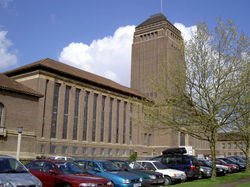
Cambridge University library, showing the tower
Treasures of Cambridge are to be catalogued for online access. The New Zealand Herald ran this story recently, detailing what has been found in the Cambridge University library tower, a "big Stalinist building of eight or nine storeys".

First editions of what are now classics abound among literary work that was once considered second-rate but is now highly valued. Jim Secord, "a professor of the history of science who has explored the contents of the tower" says:

"If you like browsing in old bookshops then this is about 10 times better."

The story originally appeared in The Independent.
Mark Bowden
The Scotsman has run a review of Mark Bowden's latest work. Dubbing him "the reigning champion of narrative non-fiction," Alex Massie suggests that the book, entitled Guests of the Ayatollah, is timely. It deals with the hostage crisis of 1979.

Bowden sometimes becomes bogged down by the demands of juggling the stories of the hostages, their captors, and the diplomatic and military efforts to end their agony, but still produces a narrative that illuminates the divide between Persia and the west.

Bowden has a blog dedicated to the book where you can ask questions or make points about facts.

The New York Times ran a review of the same book in May. James Traub says: "Guests of the Ayatollah is, at bottom, a story of mutual incomprehension."

Sunday, 25 June 2006

Interview: Zadie Smith (in Italian journal La Stampa, 20 June)

Yes, I'm cute, but what about my talent

Giovanna Zucconi: Have you ever been to Rome before, Ms Smith?

Zadie Smith: No, but my husband and I will live in Rome for seven months from November.

GZ: Oh, with your husband the poet Nick Laird, with whom you are writing a musical on Kafka. And how do you end up in Rome after London, after Harvard? For you, who reads publicly all over the world, is there a difference between reading, let’s say, on an American campus or among the Roman ruins?

ZS: It’s impossible to say until I’ve had experience of Rome and its ruins. At first glance, I think that some things in Italy will be more attractive than elsewhere.

GZ: We don’t often realise it, around here, but anyway… Do you like to appear in public? How do you maintain a balance between the public and the private life?

ZS: I don’t have a public identity. I don’t like the notion of ‘the public,’ it’s a reductive term. At readings I read in front of many individuals, then I go home to my house and they to theirs.

GZ: To be a writer is also a job. Interviews, autographs, prizes, readings. Has your attitude changed toward these professional rites and obligations, compared to in the beginning?

ZS: I don’t have any attitude. I only think about getting back to my study and writing. The rest happens for a few months every few years.

GZ: Even so, isn’t it true that these days being a writer has a lot to do with the ‘look,’ with showing yourself, with appearance…

ZS: Writing a book has nothing to do with the ‘look’ or with appearance. These things are for journalists and the press. When I write I depend only on my brain, and when I read I don’t care about the look of the writer. Either you can write or you can’t, and if someone sells a few extra copies of their book because they’ve got a nice face means nothing. Soon I’ll be forty, then fifty, then sixty, I’ll keep on writing and you, hopefully, will stop asking ridiculous questions about my appearance.

GZ: But writing a book and being a writer are two different things, you can’t deny it. Zadie Smith has been ‘sold’ as a ‘personality’ even before writing the first book (attractive, multiethnic background, liveliness), and you know it: admitting it takes nothing away from your books, but such as it is, we’ll let it go. You said that novelists are not only intellectuals, that a basic literary talent is the emotional intuition. What intuition were you thinking of? Maybe a feeling for the spirit of the times? That’s required to write the ‘right’ novel at the ‘right’ moment?

ZS: What interests me is writing a great novel before I die. The spirit of the times has nothing to do with literature, if you want to get into that you’ve got to be a pop star.

GZ: But you are treated like a pop star, including the paparazzi and the press frenzy: won’t you ever be asked why? Have you never reread White Teeth, even just to understand how that book at that time clicked with so many people?

ZS: Never.

GZ: In the judgement of the Orange Prize, which you just won for On Beauty, they say that the novel is a “literary tour de force”. What does that mean? It's satisfying to read…

ZS: I don’t know. It was a lot of fun to write, three years shut up in my room is, for me, the pleasantest of experiences.

GZ: Success always means quality?

ZS: If fifty million people buy something it doesn’t mean that it’s either good or bad. Eminem is talented and an enormous success, Kafka had enormous talent but with no success. For me, my books have sold well but if I’m a good writer — that is, if my books are good — individual readers will decide, and future readers.

Comment: There seemed to be a lot of friction between them. She was quite prickly, I thought. But the interviewer was treating her like a megastar, rather than a serious intellectual.
Censorship has gone mad in North Carolina. The Guardian in the U.K. has published a short piece about the banning of the Cassell Dictionary of Slang in local schools. The compiler of the book, Jonathon Green, responded equably enough:

"I'm very flattered," said Mr Green. "It's not exactly book-burning but, in the great tradition of book censorship, there never seems to be the slightest logic to it."

The group responsible is called Called2Action.

But Catharine Lumby, head of Sydney University's Media and Communications Department, says there's nothing to worry about. In an article published in the weekend supplement goodweekend — which is distributed along with The Sydney Morning Herald — and aimed squarely at politicians and those in the community who have made comments recently on education issues, and who say that the curricula in schools are being 'dumbed down' and infected by postmodern influences, she observes that:

The ability to appreciate complex works of art and literature is a valuable skill, but a great source of pleasure for a minority of people. It was ever thus. Our schools should certainly give all students the opportunity to develop that kind of refined sensibility. But let's not kid ourselves that most Australian teenagers in the 1960s were lying around under trees quoting Milton and Wordsworth.

She says that teaching kids through media such as Buffy the Vampire Slayer is just as valid as teaching them through the classics. But she also says there is no correlation between what kids read and how they behave. And so claims by groups such as Called2Action are baseless:

[If] we look at the research into which kids are most at risk of becoming abused, violent, drug-addicted or winding up in jail, it's clear that popular culture has very little to do with it. One of the most comprehensive Australian reports ever done into the causes of violence in Australian society, published in 1990 by the Australian Institute of Criminology, put media influences at the very bottom of a long list which begins with the influence of family and economic equality. And while there is understandable concern that it's children most at risk who are most likely to be vieweing media unsupervised, it is countered by research showing that the place they are most likely to be learning antosocial behaviour is out on the streets.

So it's hardly likely that The Cassell Dictionary of Slang is going to cause youths to become disaffected and take drugs. These right-wing evangelical Christians — and we have plenty of them in this country, too — are just incredible. In fact, a family that bought this book and studied it along with their kids would have a lot of fun:

It covers the recorded lexicon of English slang from the Elizabethan period down to the present day. It includes rhyming slang, street slang, idioms, colloquialisms, and even some standard English terms where these have arisen out of slang. And not only British slang, but also that of other English-speaking countries, including North America, South Africa, the anglophone Caribbean, and Australasia, though not India.

Saturday, 24 June 2006

Haruki Murakami was interviewed for The Sydney Morning Herald, 24-25 June, 2006
Ben Naparstek is “a Melbourne literary journalist and arts/law student. He writes for The Age, The Jerusalem Post and The London Times,” according to a Gleebooks Web page.

He had the good fortune to interview Haruki Murakami, whose new collection of short stories, Blind Willow, Sleeping Woman is due to be released here in July. I’ve just pre-ordered a copy.

Murakami spends a lot of time in the United States teaching: he holds a writer’s fellowship at Harvard. But he meets with Naparstek in Tokyo. It’s not altogether evident why he says this:

“I feel I have a responsibility as a novelist to do something.”

But presumably it has to do with politics in Japan.

Yet he refuses to fulfil the typical public duties of writers — participating in talk shows, judging panels and literary festivals — and declines all requests for television and telephone interviews.

This begs the question: why is this isolated creature now talking with an Australian journalist? The new collection of short stories must be the catalyst. Maybe he has something in his contract that obliges him to participate in interviews close to the release date of new books.

Having been weaned on foreign fiction, and being a dedicated translator of it for years, it’s no surprise that Murakami — born in 1949 — says things like this:

“I wasn’t interested in working for a big company like Toyota or Sony. I just wanted to be independent. But that’s not easy. In this country, if you don’t belong to any group, you’re almost nothing. Among the many values in life, I appreciate freedom most,”

Having lived for many years in Japan myself, I can attest to the truth of what he says. Australia is a much more developed country than Japan, and our emphasis on the individual — mature liberal humanism, if you like — is one reason for this.

His fabulistic style is defended at the end of the interview:

“You know the myth of Orpheus,” Murakami says. “He goes to the underworld to look for his deceased wife, but it’s far away and he has to undergo many trials to get there. There’s a big river and a wasteland. My characters go to the other world, the other side. In the Western world, there is a big wall you have to climb up. In this country [Japan], once you want to go there, it’s easy. It’s just beneath your feet.”

The ‘floating world’ re-emerges as a paradigm to describe the reality of his enigmatic country.

Friday, 23 June 2006

Incredible. Fantastically rich woman PhD-holder buys publishing gem and goes into therapy.

From The Guardian: When she bought the publishing house Granta, Sigrid Rausing - heiress to the Tetra Pak fortune - become a major player in British cultural life.
Inheriting is a funny thing. It confers immense privilege, but also delegitimises: Rausing apparently finds being referred to as the "Tetra Pak heiress", with its implication that any intellectual interest is dilettantism, infuriating. She has said that when she was younger, an aspiring academic living in a dingy London flat, she hid the fact of her wealth. Eventually, she sought therapy because: "I wanted to be who I was and didn't want to hide anything any more. I know people who are emotionally crippled by money they inherited."

She now owns Granta, one of the most prestigious publishing houses in the English-speaking world. From Tetra Pak to terrifically well-connected, it seems like a dream. What wouldn't one do?

But emotionally crippled? Crikey. Let me try it out. Give ME some. We'll see how I fare. Probably pretty well. I'm willing to try.

I can see that a philanthropist might think they could do an awful lot of good with an imprint possessing the cachet of Granta. After all, it's published some of the leading names in literature (before they became famous). The only problem I have with the magazine is that their Web site uses Times font. I hate Times in online contexts. As you may have noticed, the font used on this blog is Verdana — by far the best font for online publication. I generally rate Sites that use Verdana very highly. Much better than Ariel, another popular online font.

Thursday, 22 June 2006

Errol Simper is a star. He's also a bloody good journalist. In today's 'Media' supplement — a regular Thursday offering from The Australian — he outlines the case for and against the likelihood of Keith Windschuttle making waves on the ABC board.

Robert Manne, a former editor of Quadrant — the right-leaning magazine for which Windschuttle, [journalist Janet] Albrechtsen and [anthropologist Ron] Brunton have written — welcomed Windschuttle with this: "The Howard Government is in the pocket of the (commercial) television networks. They will never agree to advertising on the ABC. It is his (Windschuttle's) program, however, for an ideological purge of the ABC, if he forms an alliance with the other right-wing heavy-hitters on the board, that is likely eventually to succeed."

Quentin Dempster, the succinct host of the ABC's Friday-night staple, Stateline, discusses the digital media options the ABC can use to increase its income.

KEITH Windschuttle on the ABC board? It is all highly diverting and a bit of a hoot. But when the digital revolution is transforming online, print, radio and television media globally, what Australia desperately needs is a board that understands the exciting possibilities for enhancing the quality, programming range, innovation, reach, professional training and public value of the ABC.

And all we get from the federal Government is tired, old, adversarial, party-political patronage and ideological influence peddling.

Another article, published in the opinion page of one of the broadsheets this week (can't remember which one), suggested that by conscripting the historian into the ABC stable, the broadcaster had effectively gagged him.

But these are interesting points of view from two of Australia's most experienced media players. We'll see if Windschuttle continues calling elements of the national broadcaster Marxists, and succeeds in altering the trajectory of this important institution.
Popped into The Co-op Bookshop on the off-chance of a sale and found five books to add to my collection.

Struck it lucky. There were three tables of sale books, heavily discounted. I really don’t know why I’m buying more books. I purchased 11 books on sale three weeks ago and four more two weeks ago. Today’s offerings were mainly non-fiction titles and, this being a university bookshop, many were of an esoteric cast. But I found a bunch of appealing titles to add to my collection.

I’ve got three bookshelves. All are full. The big one in my study has shelves that are spaced too far apart for normal-sized books. So to accommodate new arrivals, I’m stacking them on top of the books already placed on the shelves. I’m buying a new unit in August from Claphams Furniture in Lane Cove. (They make them up to-size using an external contractor.) All these new purchases will probably already half-fill the new bookshelf when it arrives.

On the sale tables each book had a discount sticker. But because I’m a member of the co-op, when I reached the check-out they deducted an additional 75% off the sale price. Bingo.

The five books I picked up for just under $17 are:

The Transit of Venus, Shirley Hazzard (1980)
Player Piano, Kurt Vonnegut (1952)
Three Dollars, Elliot Perlman (1998)
Left Right Left: Political Essays 1977-2005, Robert Manne (2005)
The Alphabet Versus the Goddess: The Conflict Between Word and Image, Leonard Shlain (1998)

So now I've got tons of stuff to read when I go on holiday in July. Any suggestions on where to start?

Wednesday, 21 June 2006

At Sarsaparilla and also on her own blog, Kerryn Goldsworthy has highlighted the paucity of fiction about real things in Australia at the moment. "Where, [journalist and historian David Marr] more or less asked, was the Australian Coetzee or McEwan?" She points out that he wanted "fiction about the conditions and the values of contemporary Australian life".

Overland, which blogger TimT says on Intersecting Lines is "not just leftish, it's far to the left of the Labor Party", has just posted a story by Anthony Macris on its Web site. It's about a young Australian man living in London in 1991, surrounded by the images and feelings of Operation Desert Storm. It also treats issues of consumerism and love. Macris' style is hypnotic: you are dragged into the consciousness of the main character inexorably, you see the evidence of consumer culture gone berserk, you wonder about the affair that might reveal itself if you travel with him to Brisbane.

This is fiction that addresses real issues. And his literary pedigree should work to attract readers. Macris was named by The Sydney Morning Herald as one of its Australian Best Young Novelists in 1998 and published Capital: Volume One in 1997. It's a good read for anyone who enjoys McEwan or Coetzee. Somewhere between Simon and Carey.

The Overland story is an excerpt from his upcoming book Capital: Volume One, Part Two. Here's a clip:

  A small crowd gathers around you in front of the television. You stand there watching, transfixed. The helicopter sequence ends. Suddenly you are on the ground, right in the thick of it. You all go together into the slaughter. The shots change frequently, indicating heavy editing. That’s all that’s left of the dead, these cuts from one image to the next. The camera studies the scene. It soon gets bored with vehicles riddled with bullet holes, with shattered axles and engines spilling from under bonnets like entrails. It turns its attention to the loot, begins to pick out ghoulish contrasts. There seems to be no lack of them. The top half of a washing machine, its bottom half torn away, rests on the sand next to a gleaming mortar shell, seemingly unspent. A car door, its paint blistered off, its window a drip of molten silicon, forms the backdrop to a carton of Marlboro, a bottle of Chanel N°5, and a large-scale model of a black racing car. A blackened, mangled heap of metal, the long gun barrel that rises up out of it indicating it used to be an artillery gun, has a large double mattress leaning against it, more or less intact. And on it goes. It soon becomes apparent that there’s virtually nothing the Iraqis haven’t tried to steal: power tools, air-conditioning units, entire racks of women’s dresses and men’s suits, cartons of washing powder, computers, stereos, VCRs, cots, prams, toys. Everywhere there are televisions. The editor of the report has saved these for last. The shots are so clear you can read the brand names: Panasonic, Sharp, NEC, and of course Sony, everywhere there are Sonys. Some of the televisions have their screens blown out, others are in perfect condition, lying there in the desert as if they were waiting to be turned on.
  The crowd around you has grown so large that a salesman comes over. He takes one look at the screen, then discreetly walks away. A few seconds later the channel changes. The desert highway is replaced by a young woman on the studio set of a kitchen. She’s wearing a tight, low-cut top. She beams and talks and shreds carrots. You feel a small shock go through the crowd, as if you’ve all just woken up from a deep trance. Everyone quickly disperses, and the buying mood immediately fills the store again. The man standing next to you, however, lingers a moment. He’s probably in his mid-fifties, judging from his long grey beard. “Bloody disgrace,” he mutters, half to you, half to the woman on the widescreen TV who leans forward to peep under a saucepan lid, at the same time offering you a generous helping of cleavage.
  You turn around and walk straight out of the store. Now doesn’t seem the time to get a Discman.

Another piece from the book is available on the Web site of the French journal le Passant Ordinaire.

Give him a try, tell us what you think.

Monday, 19 June 2006

The Australia Council for the Arts is the premier funding body for the liberal arts in this country. It provides much-needed funds for start-up activities. I was once involved in a small magazine (we only lasted one issue) that received funds from them. Now, a new chairman has been appointed to the Literature Board.

Imre Saluszinsky is well known to readers of The Australian, one of the leading broadsheets here and the flagship of Rupert Murdoch's News Ltd. He writes intelligently, mainly on political topics. But he's also involved in the magazine Quadrant, which is considered to be right-wing in outlook. This is what has caused consternation in some quarters.

Accompanying Saluszinsky's appointment recently has been the move of controversial historian Keith Windschuttle to the ABC's board.

These two appointments have caused a lot of anguish and gnashing of teeth among liberal (left-wing) intellectuals. Windschuttle is a regular contributor to Quadrant, where Saluszinsky is a member of the editorial advisory board.

Well, I vote for The Greens at both state and federal levels and I buy Quadrant. It's a great magazine that takes public life seriously and publishes new fiction every month. I was a bit surprised that Phillip Adams didn't bring the magazine into the discussions of the panel of New Yorker staff who visited Sydney for the Writer's Festival last month. But being an unregenerate leftie, it wasn't ever likely.
Review: The Ice-Shirt, William T. Vollmann (1990)

Dewey Decimal Classification: 813.5 V924 J2 1

In 1993, Vollmann responded to a question put to him by an interviewer about his “absorption as a kid in books”: “My primary world is just this one basic "dream world" that I've been in from the time I was a kid.”

Another online piece describes the Seven Dreams: A Book of North American Landscapes series of books as “a historicofictional account of the settlement of North America”. The Ice-Shirt constitutes volume one in the series. It is wonderful. In it, one reviewer says, he “encourages his readers to enter a time when myth and history overlap”.

A New York Times review is available for this book. It makes much of the American aspect of the novel. But the trip that the overweening woman Freydis and her compatriots from Greenland — another colony of the Norse Vikings — actually make to Vineland (or Wineland, as it is alternatively dubbed in the book) only starts half-way through. There are also many stories of other Greenlanders. Stories of outlawry, settlement, disease, family, step-children and more are thrust forth into the reader’s consciousness by Vollmann’s fine prose. And fine it certainly is. More than fine: superfine. It is shot through with poetry, peppered with clusters of Shakespearean compound nouns, mostly hyphenated, that raise the narrative to a level that can encompass themes of shape-changing and magic — the ‘trolls’ or Skraelings the settlers meet are endowed with magical powers — that accompany the Greenlanders on their adventures.

Like Jose Saramago, there is also much dry humour to enjoy in this book. Although a tale of adventure, the irony of many utterances works to bring the narrative down from the heights of poetry to the level of the every-day. This is satisfying and apt, and allows us to get close to the feelings of individual characters, regardless of their proximity to the other-worldly or their distance from us in time. As in Saramago’s excellent Balthasar and Blimunda, there is magic that can become real: a flying machine in Portugal that levitates using the power of people’s souls or a god with BLACK HANDS (the capitals dot the pages) named AMORTORTAK living in the wastes of the icy north can coexist with living, breathing humans. In this sense, Vollmann adheres to the fabulist tendency of much modern fiction, stretching from Gabriel Garcia Marquez to Haruki Murakami. And is he up to the demands of such exalted company? Yes, I say. He is. Very much so.

Will I be purchasing more work by Vollmann? Absolutely. It is also of interest to me that these dream worlds derive from the same pen that writes about prostitutes and war zones. His output is Herculean, but the quality is extremely high. Is Vollmann himself satisfied with this ambitious book?

“The first three-quarters of The Ice-Shirt are OK. I think that the last quarter I'd do differently. I was still trying to figure out how to mix history and fiction as I went. That was the first attempt at the seven. It was harder with The Ice-Shirt. I wish that I had more money too. For instance, I would've liked to have gone to Norway and Sweden for that one. If I had, that part would have been longer.” This from an interview at McSweeney’s, who in 2003 published his magisterial, seven-volume work, Rising Up and Rising Down: Some Thoughts on Violence, Freedom and Urgent Means, which has been dubbed "a moral calculus for violence". It was originally published for $US120.00 but now sells second-hand for three or four times that on Amazon.

Have you read any books by Vollmann? What do you think of his work?

Sunday, 18 June 2006

This was handed in as an assignment for one of the units of study in my postgraduate award course. The mark my tutor awarded was a more than respectable 87. What do you think of it?

When A Clean Break Gets Dirty

DBC Pierre has traversed the highway from obscurity to literary success — and global notoriety. Where will this forty-something author go from here?

A radical faction in a religious sect had planned to turn a nuclear power station into an atomic bomb. Stung by the ensuing publicity, the sect disclaimed all its tenets. After the event, it must forge a new path.

This brief synopsis of Kenzaburo Oe’s 2003 novel, Somersault, could apply to writer DBC Pierre’s life since that year, as it has traced a similar trajectory but, as in a photographic negative, with the tones inverted.

The explosive device in Pierre’s case was Vernon God Little, his first novel — a rapid and inspiring romp through the preposterous and poignant backstreets of suburban U.S.A. — which propelled him into the stratosphere, securing the Man Booker Prize. In 38 years, only one other first novel has ever won the prize. Global sales of the novel, including translations into 43 languages, are healthy at around 1.5 million.

Like the sect, Pierre stood — and stands — outside the mainstream. Before the life-changing event no-one knew he even existed. But with the release to mixed reviews of his second novel, the startling Ludmila’s Broken English, he must start to forge a new path.

It’s apparently not enough that the novel is so different, in subject, tone and structure, from its predecessor. “Well, there aren’t many writers who’ve had such an extraordinary life, so I suppose it’s inevitable,” said his London agent, Clare Conville. “And I think, sort of, a backlash is inevitable, his success, you know, was so incredible.”

Pierre was born Peter Finlay in Adelaide, grew up in Mexico, and lived a wayward life in the U.S., Australia, the Caribbean, and England. He now works in a secluded corner of Ireland. Almost without exception, commentators have expressed mixed feelings about his chequered past, coloured as it is by inglorious undertakings.

Winning the Booker, among the most prestigious prizes in the literary world, seems to have exerted a quantum of pressure on the 43-year-old to conform to our view of what an award-winning author should be. It is true that he has survived many adventures, from illegal importing of cars to drug abuse, from obtaining money under false pretences to domiciling in Ireland for tax reasons. (A interviewer recently added this to his list of sins. But while this latest accusation is also no doubt true, it is relatively venal compared to the rest).

For critics to accept that a new writer deserves their applause, the difficult second novel must be unquestionably good. This is. But in Pierre’s case it must also be demonstrably virtuous. And this is anything but. Like DBC Pierre himself, the novel is ‘dirty but clean.’ It is a frazzled and imaginative hurly-burly filled with intimations of mortality and Shakespearian phrases that confound expectations.

“I haven’t seen any of them,” said Pierre philosophically when asked about the reviews during a talk to promote the book in The Rocks with Sydney Writer’s Festival doyenne Caro Llewellyn. “It doesn’t matter. Well, first of all, I just feel lucky to have a job, anyway. So I’m not that fussed, but if those reviews came out when I was still writing it, that would be problematic. But there’s a timeline — and it’s easy to forget — that once you deliver a book it walks on its own feet, and I’m just not responsible for it. There’s nothing you can absolutely do any more, you can’t go back in and shift anything… it’s all after the fact. … You know, I had to take risks and try and become a good writer, as best I could. And that’ll take a while.”

DBC Pierre was pictured on the cover of The Weekend Australian's Review supplement for 25-26 February, 2006
At his previous appearance, for the 2004 Festival, the Sydney Theatre was filled. This time attendance was limited by organisers, and about 100 antipodean fans entered the Belgian Beer Café from the bright autumn sunlight.

Did he think the world is harder for people who don’t fit the mould, asked Llewellyn: “I’m still trying to figure that one out,” he said. “I certainly don’t think that your loose cannons and your explosive people roaming outside the herd are any danger at all to society. In fact they’re probably the mixers that keep the rest of us in some sort of cohesiveness. But I’m still wondering what the relative benefits are of sticking with the pack and just having a nice life versus… not quite getting things together and staying outside the edge of it. And it’s interesting… we need both of them anyway, really. Especially, if you’re a bit of an outsider you need the herd to come and pick up the pieces when you hit the wall. And they probably need something to look at on TV every night.”

Having lost his footing on numerous occasions, Pierre speaks from experience, and his attempt to distance himself from those outside the mainstream is unconvincing. But he is genuinely determined to succeed. “He’s very firmly sure about what he wants to do and how he wants to do it,” said Conville.

Pierre’s ‘radical faction’ remain his drive, imagination, and sense of humour — the qualities that launched his career and now propel him past the obstacles set in his path. He seems determined to make the best of things. Living always in foreign countries, he has felt an outsider all his life and he admitted that this has touched his work: “Since writing I have found that that’s really helpful, actually. It’s good.”

I bought a copy of Ludmila’s Broken English as soon as it became available and enjoyed it immensely. It is quite sufficient to upset him that others didn’t, yet he appears resigned to completing any number of about-turns, fulfilling the role of enfant terrible of modern publishing, his new work both awaited and bemoaned. But only a month after the novel’s release it generates almost 40 pages of Google-search results.

That’s a solid endorsement, especially for an outsider, and indicative of better things to come. Having faced new challenges since the initial detonation of fame, it’s not beyond the pale of probability that Pierre will experience further somersaults in his life. After all, Oe had to wait 36 years for his Nobel Prize.

Monday, 12 June 2006

Today's a holiday, so after buying and reading the broadsheets this morning, I took a nap. Waking up just after 2:00 p.m., decided to buy some ethnic chow. Walked up Beamish Street to the Happy Chef Seafood and Noodle Restaurant, which is my usual resort when I don't feel like preparing my own food.

Sat in one of the new plastic chairs they've installed recently and got a menu. Ordered egg noodles with a side order of fried pork. They're pretty fast with the food up there and it arrived within five minutes. I polished it off pretty darn quick also. The 15-year-old waitress took my $8.50 and gave change.

I crossed the street to the two-dollar shop and picked up a face towel with which to wipe the inside of my windscreen in the mornings, when it's cold, and ambled into the Campsie Centre. Picked up a pack of smokes and checked out the newsagent's shelves, but the selection of magazines is not very encouraging. A downside to the multicultural nature of this suburb: they carry newspapers in Chinese, Vietnamese, Italian, Greek, Arabic, and what-not, but the mags are shocking. Not even The Economist, Quadrant or Vanity Fair, although they do have Quarterly Essay.

But further down Beamish Street in the other newsagent they had an old copy from March of The Economist, so I picked that up.

The sun is out today and the temperature around 17 or 18 degrees C, I reckon. Nice day for a stroll. But I quickly returned home.

Saturday, 10 June 2006

Got a tip from be_zen8 in a comment to this blog that there's a sale on at Gleebooks this long weekend. So after showering I stopped off at Campsie shopping centre to do my weekend shopping. Then I headed off to see what they had on offer.

The first section of my journey mirrored the trajectory I traced last weekend. But instead of crossing Parramatta Road at Leichhardt, I turned right into it and followed it up to Sydney University, where I turned left into Ross Street. Then right into St John's Road, where I parked. Walked up to the old Gleebooks shop at No. 191 Glebe Point Road and discovered I'd gone to the wrong place. So I trekked down to the new shop at No. 49 and up the stairs on the left.

There are three tables with sale books. Many are non-fiction titles, with a fair collection of Palgrave editions on things like marketing and globalisation. Not that many novels, unfortunately. I spent $24.95 on four books. They are:

Watson's Dictionary of Weasel Words, Contemporary Clichés, Cant & Management Jargon, Don Watson (2004)
Tietam Brown: A Novel, Mick Foley (2003)
Kissing the Rod: An Anthology of Seventeenth-Century Women's Verse, with an introduction by Germaine Greer (1988)
Gregory's Canberra 2004 Street Directory

On the way back I stopped in at Cornstalk Bookshop to see what had happened to their shop in King Street, Newtown, which closed some months ago. "Everybody says that," said Resh, the girl at the computer to the left as you walk in, when I asked why it had shut. Why did they close? "Rent," she said. Apparently the building's owners kept putting up the rent until it became uneconomical. They had sales at 25%, 50% then 75% of the sticker price and finally a bloke with a bookshop across the road bought the rest.

It's sad, to see a good outlet shut down. Especially one like Cornstalk which had been there so long. The awning on King Street still says Cornstalk Bookshop, but the shop itself is gone, never to return. Paul Feain, who runs Cornstalk, keeps mostly Australiana at his Glebe Point Road store, so the general second-hand stuff has just disappeared. I wonder if he'll open another outlet in the future.

My return journey exactly mirrored my outward trajectory. It started to rain. I was flicking the wipers on and off from Crystal Street, and at Canterbury Road switched them to intermediate mode. Hopefully it'll keep raining for a few more days. We need it.
This post is for careful householders, especially those in New South Wales.

Sydney is on a consumption reduction drive. 'WaterFix' is a good deal for householders. Spend $22.00 and they install a new shower head (and arm), check for leaks, replace all washers in your home, and install water-efficient aerators on your taps.

Keith is a contractor with Sydney Water and has been a plumber since the age of 15. He services 10 homes every day. There's plenty of work for contractors, and since leaving full-time employment with Sydney Water a decade ago, he's been fully employed. He arrived on time — just as I got home yesterday — and worked quickly to finish the job within half an hour.

My new shower head — haven't even used it yet — is called a 'Bermuda Flexispray'. When you twist the bottom of the head to the left the flow diverts and out shoots a thumping stream of water. Twist it back and the flow reverts to a gentle shower.

The company is making it easy for home owners to upgrade their water delivery systems. They make appointments after hours and on weekends. Keith says that if he wanted to work all weekend, there's plenty of work. He covers a different area every day. Yesterday he was in the Sutherland area and tomorrow it'll be somewhere else. Each home he services looks to save 21,000 litres of water annually.

After he left, John Moses the electrician popped over. John is also excellent value. He lives just up the street here in Campsie and will come out for emergencies any time, weekends included. This time it was to install a smoke alarm. These devices are now legally required in all homes in New South Wales. Legislation that was enacted recently came into force on 1 May and by 1 November you must have one installed or face a $500.00 fine. John isn't sure who will be policing the requirements, but he thinks it will be the municipal council.

The new alarm is a Clipsal Firetek and it runs on mains power with a 9-volt battery backup. Installation and alarm unit conform to AS 3786 standards. John says to change the battery every two years. He charged me $88.00 for installing the alarm plus $5.00 to repair a sagging light fixture in the hall outside my bathroom.

Thanks John! Thanks Keith!

P.S. Used the shower before going out this morning. It feels much lighter than previously, with the old shower head. But it's quite adequate for my needs.

Saturday, 3 June 2006

Event: Today saw the 2MBS FM book and record bazaar on at the Balmain Town Hall. For those of you who don’t know, 2MBS is the Sydney-based classical music radio station, which started broadcasting in 1975. It survives on donations and advertising, but they also run these events periodically to raise money for their operations.

Drove out of my flat at about 8:40 a.m. and down Canterbury Road, turned right into New Canterbury Road, through Petersham, then left into Crystal Street, across Parramatta Road into Balmain Road, across the City West Link, then turned right at the top of the hill into Darling Street. The Balmain Town Hall is located at number 370 Darling Street. There was a parking space right across the street.

There were about ten people waiting for the doors to open and I joined the queue. We trundled up the old staircase when the doors opened at 9:00 and into the hall at the top. It’s an old building but still quite sound. Across the street is the local fire station, which is in a building that was constructed in 1894.

Found a nice collection of titles on the novels table at the back of the room and purchased 11 books for $44. They are:

White Teeth, Zadie Smith (2000)
The English Patient, Michael Ondaatje (1992)
The Heather Blazing, Colm Tóibín (1992)
Paradise, Toni Morrison (1998)
Beloved: A Novel, Toni Morrison (1987)
Dark Palace, Frank Moorhouse (2000)
Accord on Crimes: A Novel, E. Annie Proulx (1996)
A Perfect Peace, Amos Oz (1985)
Angels & Insects, A. S. Byatt (1992)
Possession: A Romance, A. S. Byatt (1990)

Also rifled the poetry and drama table, as I like to find old editions of poetry when given the chance. I found a beaut little collection of English poetry: The English Poets subtitled ‘Selections with Critical Introductions by Various Writers and a General Introduction by Matthew Arnold’. It is volume 2 in a series and covers Ben Jonson to Dryden. It was published in 1920.

I arrived back home after driving around the back of Leichhardt, across Parramatta Road and all the way up Canterbury Road from the railway line. The entire adventure took just on an hour. A good morning’s work, I think. I also picked up the newspapers. When I got home I had a call from mum. I'm planning to visit them in Maroochydore in early July and she was calling about the accommodation. The last time I visited was in the Echo in December.

Saturday, 27 May 2006

Event: The New Yorkers, Sydney Town Hall (as part of the Sydney Writer’s Festival) Friday 26 May, 2006. Panellists: Rhonda Sherman, Hendrik Hertzberg, Andy Borowitz, Phillip Adams (moderator), Aleksandar Hemon, Susan Orlean.

This event was recorded for video streaming by Bigpond.

Parking in the city is a nightmare. So this was the first time I took the train from my new flat. I’ve been here six months now and this was a big event for me. Big night out. Riding into the city, about 40 minutes were spent watching the station signs pass — Canterbury, Hurlstone Park, Dulwich Hill, Marrickville — and listening to the various groans, squeaks, trills, grunts and rattles of the CityRail train as it forged through the inner western suburbs into the heart of the metropolis.

There was a line of hundreds of well-dressed and affluent-looking ticket holders waiting to enter when I emerged into the chill night air from the subway beneath the pavement, about twenty minutes before starting time. But the queue progressed rapidly and, not long after, we were ensconced in the lit chamber awaiting amusement. The lights dimmed, the throng hushed. The panellists filed onto the stage and took their seats in the order shown above. They comically wore little, cream-coloured head mikes.

The night started at Ground Zero. The reactions of each to the news of the blasts that destroyed the Twin Towers on 9 September, 2001, were trotted out with due reverence and awe. Most watched it unfold on TV, just like everyone else in the world.

Then the politics began. Now, I’m not a big supporter of the U.S. Republican cause and I don’t know enough about U.S. politics to get really interested. These guys are, however, without exception, blue. “Here in the bluest borough of the bluest city of the bluest state in all our red-white-and-blue American Union, it has not been a happy week,” wrote Hertzberg in The New Yorker on 8 November, 2004. The magazine has been an opponent of the administration ever since.

Hertzberg, as Senior Editor, was the elder statesman on the panel. (Although I took along my recording device, I turned it off because of the consternation I would face next day when it came to listening to it over again and transcribing. I sort of regret this decision now. Never mind.) As such he was like a peg the others hung onto. Borowitz was the comedian, a source of endless amusement for the audience. Hemon was the outsider — a resident of Chicago and a foreigner to boot. Sherman and Orlean bracketed the men physically and while Orlean held her own technically, Sherman tended to get lost in the mix. She added factual details and dutifully answered questions when asked by Adams, but seemed junior to the others. But a nice bunch of people, to be sure.

But were they liberal. Bush-bashing never had it so good. As I say, I’m no Bush supporter, but the sense in the hall of an overwhelming liberal bent was overpowering and distasteful. It was assumed that you should dislike the 43rd President of the U.S., period.

Phillip Adams, of course, is a famous leftie and showed his pedigree flamboyantly. But he was overall a good host, asking valid questions and responding with cogent follow-ups. The talk was to be broadcast on ABC Radio National.

Question time was not. Some people asked about the magazine, which was good, because a lot of the preceding discussion was about politics and not publishing.

On the way home I didn’t have much time to reflect on the evening. A bunch of noisy louts flitting about the carriage monopolised my attention. But I managed to reach my door unscathed and hale, ready to finish reading the newspapers before turning in. I’m glad I bought this flat: it’s comforting to know that I can use the train to get somewhere if driving is unattractive.

Hertzberg rides his bicycle to work in Manhattan, which must also be comforting. As the New Yorkers of Australia, Sydneysiders are curious about the Big Apple. We see similarities in our attitudes to life: a taste for irony and detachment, a fierce energy when it comes to competing in the workplace. On the train, I felt that the sort of shenanigans those youths were getting up to must also be prevalent in the other place. And my winter jacket would not have looked odd over there. From here, New York looks inviting, a little scary, and sometimes just strange. Inside the covers of The New Yorker it looks a lot better, as does the rest of that country.

For a start, they are one of the only magazines to consistently publish new fiction. This is sad but inevitable when we think about it. At one point Adams reflected sadly on the fact that there’s not a magazine like theirs in this country. I wonder why he didn’t mention Quadrant? Possibly because that publication is stoutly right-wing. He mentioned The Monthly, a relatively new mag that publishes quality articles on a range of topics. It is a good read, I’ll grant that. But I prefer Quadrant. Again, it’s not that I’m right-wing — in fact I voted for The Greens last time and probably will again in 2007 — it’s just that they cover things in great detail and are unapologetically high-minded. They really talk about the important issues in politics, education, history, law, and other areas of public life that we need to know about. I generally read the whole magazine through, while I only read a few articles in the issue of The Monthly that an acquaintance recently lent me.

Monday, 22 May 2006

Review: Money, Martin Amis (1984)

John Self is mercilessly corrupt. Amis pulls out all the stops in his effort to make this most ordinary of mortals — awful. But we’re not filled with awe: hatred, disgust — any of these things. What strikes us most immediately is how pitiful he is. We feel sorry for him. If that was Amis’ aim, he has succeeded. Self doesn’t exude power, just a potential for self-destruction. And he’s happy with it. He ambles along and spends his time fantacising about his girlfriend: is she doing it with someone else? Selina Street is out of our grasp, a siren with a heart of ice.

I had fever. And I had Selina fever too. Lying in that slipped zone where there is neither sleep nor wakefulness, where all thoughts and words are cross-purposed and yet the mind is forever solving, solving, Selina came at me in queries of pink smoke. I saw her performing flesh in fantastic eddies and convolutions, the face with its smile of assent and the complicit look in the flattered eyes, the dermatology of her underwear suggesting spiders and silk, her sharp shoulders, her fiery hair, the arched creature doing what that creature does best — and the thrilling proof, so rich in pornography, that she does all this not for passion, not for comfort, far less for love, the proof that she does all this for money. I woke babbling in the night — yes, I heard myself say it, solve it, through the dream-mumble — and I said, I love it. I love her. . . I love her corruption.

But John Self is fuelled by money. He’s a gas-guzzler, a straight-8 with roof racks for the booze. Everything comes down to dosh and he wants more of it. The anonymous caller who gets up his nose is a relic from his past, it seems, but that’ll be cleared up in good time. Meanwhile, John needs to quit the city he’s just arrived in, return to London and find out what’s happening in Selina’s life. Is she faithful? Before he leaves, he rummages around in his pockets for some crushed bills.

In the end I had ample time for my farewell to New York. First off, I gave Felix a fifty. He seemed strangely agitated or concerned and for some reason kept trying to make me lie down on the bed. But he was pleased, I hope, by the thought. I love giving money away. If you were here now, I’d probably slip you some cash, twenty, thirty, maybe more. How much do you want? What are you having? What would you give me, sister, brother? Would you put an arm round my shoulder and tell me I was your kind of guy? I’d pay. I’d give you good money for it.

Amis is trying to shock us. The debauch in slow motion that is John Self’s life, however, never really rises to the top. It’s pathetic and somehow cleansing to know that a person can be so crass. The imperatives of money are laid out for our delectation. Fast food, advertising, pornography. All the minimalist subterfuges that some people use to delay disappointment.

But is that really the way to make money? What about financial planning, being an electrician, an endodontist, or a real estate agent? Why are these methods of milking the masses ignored? Surely they’re just as lucrative? But, then again, you need training and discipline to enter these fields, whereas Amis is trying to shock us by showing how someone who has neither can become rich. The horizon slims to a point and disappears in a tiny, technicolour blink. Gone is the suspense and the magic of the story. We’re left gaping at the gold chains and centre spreads, like amazed schoolboys.

Indeed, lamentably under-informed, Fielding Goodney. He smiled in innocent self-reproach, then swung sternly and made the reverse V-sign at the watchful waiter. Two more Red Snappers were on the way. We ordered. Fielding held the crimson menu (silken, tasselled and beautified, reminding me and my fingers of Selina and her secrets) in slender brown hands, the wrists cuffed in pale blue and the gold links taut on their chains. Over dinner Fielding explained to me about the lucrative contingencies of pornography, the pandemonium of Forty-Second Street, the Boylesk dealerships on Seventh Avenue and their prodigies of chickens and chains, the Malibu circuit with the crews splashing through the set at dusk for the last degrees of heft and twang and purchase from the beached male lead on the motel floor, the soft proliferations of soft core in worldwide cable and network and its careful codes of airbrush and dick-wipe, the stupendous aberrations of Germany and Japan, the perversion-targeting in video mail-order, the mob snuff-movie operation conceived in Mexico City and dying in the Five Boroughs.

We get a look at John’s aspirations. He wants out of the porno grind, the spew train, the junk junket. He wants a real life: books, good conversation, a real job, perhaps. But what chance has he got? It doesn’t sound too convincing.

Look at my life. I know what you’re thinking. You’re thinking: But it’s terrific! It’s great! You’re thinking: Some guys have all the luck! Well, I suppose it must look quite cool, what with the aeroplane tickets and the restaurants, the cabs, the filmstars, Selina, the Fiasco, the money. But my life is also my private culture — that’s what I’m showing you, after all, that’s what I’m letting you into, my private culture. And I mean look at my private culture. Look at the state of it. It really isn’t very nice in here. And that is why I long to burst out of the world of money and into — into what? Into the world of thought and fascination. How do I get there? Tell me, please. I’ll never make it by myself. I just don’t know the way.

The pace of John’s squandering is extraordinary. We see him waste thousands but we don’t feel the loss. Not yet. It seems as though there’s a never-ending supply of cash. John is like a filter for money, a sieve. And the fast pace of his debauches helps to make the value of money nugatory. Filling up and spewing out is achieved without our noticing, almost, so the pain of losing and the pleasure of gaining are minimised. He’s a money sieve, a transaction account, a node in the matrix where the speed of currency is hastened to the point of burlesque. Spastic twitching in a sea of green.

There was a knock on the door and I wriggled to my feet. An impossibly elegant young black scythed into the room with several polythene body bags in his arms.
  ‘On the bed, sir?’ he asked.
  ‘Yeah. No,’ I said. ‘I don’t want them. I’ve changed my mind. Take them back.’
  He looked at me quizzically, and raised his lordly chin. ‘The terms of purchase are on your receipt, sir.’
  ‘Okay. Sling them over here. I was only kidding.’
  I gave him a ten and he left. A ten . . . For the next hour I took delivery of many additional purchases, the vast majority of which I couldn’t remember purchasing. I just lay on the bed there, drinking. After a while I felt like Lady Diana would no doubt feel on her wedding day, as the presents from the Commonwealth contingent started arriving in their wagon trains. A squat kit of chunky glassware, an orange rug of Iranian provenance and recent manufacture, a Spanish guitar and a pair of maracas, two oil paintings (the first showing puppies and kittens asnooze, the second a nude, ideally rendered), an elephant’s foot, something that looked like a microphone stand but turned out to be a Canadian sculpture, a Bengali chess set, a first edition of Little Women, and various other cultural treasures from all over the world. When it seemed to be over, I went to the bathroom and was explosively sick. Stress, it’s expensive. There is great personal cost. But out it came, the lunch, the champagne, the money, all the green and folding stuff. When it seemed to be over, I went next door and called Fielding and asked him to give me an incredible amount of money. He sounded as though he’d been expecting my call. He sounded pleased. That evening a large envelope was brought to my room. It contained a platinum US Approach card, a brick of traveller’s cheques, and a cash-facility authorization at a Fifth Avenue bank for a thousand dollars a day, if needed. I was so relieved I went to bed for two days. Actually, there wasn’t much choice. Steady, I thought, steady. Money holds firm but you have no power. It seems that, whatever I do here in this world I’m in, I just get more and more money . . .

After Selina, it finally dawns on John:

My clothes are made of monosodium glutamate and hexachlorophene. My food is made of polyester, rayon and lurex. My rug lotions contain vitamins. Do my vitamins feature cleaning agents? I hope so. My brain is gimmicked by a microprocessor the size of a quark, and costing ten pee and running the whole deal. I am made of — junk, I’m just junk.

It’s not surprising, this new self-knowledge, From one extreme consumption point to the other, he waggles his brain at the universe — and the universe signals back. Amis’ dense prose ambles on through drama to hilarity and the death of appetite. The movie they are making shambles on: how will it all end? What about his Frank, the anonymous New York caller? The humour takes us through the pathos a step at a time. The jokes pile up like butts in an ashtray: eventually you have to dump them in the bin. The hilarity is the medium and the message is that even with a 120 kilo smart-ass there is redemption, the positive spin keeps the planet on trajectory towards a bright future. Even in the life of a junk merchant there is something more than nail-biting obscurity and waste.

Sunday, 14 May 2006

Review: Play It As It Lays, Joan Didion (1970)

There’s something wrong with Maria (Mar-eye-ah, as she stresses). She’s unhinged, slightly batty, off in her own world. She must be on the freeway by 10:00. She must move. Anywhere. Other people in her life: Carter, Lang, Helene, BZ, Benny Austin, her father (now dead), her mother (ditto), and her daughter Kate.

Once she was on the freeway and had manoeuvred her way to a fast lane she turned on the radio at high volume and she drove. She drove the San Diego to the Harbor, the Harbor up to the Hollywood, the Hollywood to the Golden State, the Santa Monica, the Santa Ana, the Pasadena, the Ventura. She drove it as a riverman runs a river, every day more attuned to its currents, its deceptions, and just as a riverman feels the pull of the rapids in the lull between sleeping and waking, so Maria lay at night in the still of Bevery Hills and saw the great signs soar overhead at seventy mile an hour, Normandie ¼ Vermont ¾ Harbor Fwy 1. Again and again she returned to an intricate stretch just south of the interchange where successful passage from the Hollywood onto the Harbor required a diagonal move across four lanes of traffic. On the afternoon she finally did it without once braking or once losing the beat on the radio she was exhilarated, and that night she slept dreamlessly.

In the spaces between bouts of narrative light, Maria continues to live, feel and suffer. The spaces are black with fuzzy edges and we drift in and out of the light in short sections of narrative, stepping across the spaces of darkness and entering a new area of consciousness populated by Maria and her fears: of Carter, of not having her period, of the abortionists who she dreads, of her friends in New York. Stranded in Los Angeles at the end of the string of her life, Maria is adrift. She won’t tell Carter whose child it is. She dreams of being with Kate. She is alone.

In the dream from which she woke when the telephone rang again that night she had the baby, and she and the baby and Kate were living on West Twelfth Street with Ivan Costello. In the dream she did not yet know Carter, but somehow had Carter’s daughter and Carter’s blessing. In the dream it was all right. She supposed that she had dreamed of Ivan Costello because the telephone was ringing, and he used to call her in the middle of the night. “How much do you want it,” he used to say. “Tell me what you’d do to get it from me.” The telephone was still ringing and she pulled the cord loose from the jack. She could not remember what she would have done to get it from any of them.

After the abortion, the divorce. Carter, Helene and BZ at the courthouse with Mrs. Maria Lang, the plaintiff. Didion reveals confidences in her writing: the legacy of planning and structure, the rightness of everyday drama that is just a little more surreal than our own, lived lives. We feel as if we are there, hear the hollow echo of Maria’s voice and the harsh clangours of the voices of the others. As if each voice that brings a pain to Maria causes us mentally to flinch.

Every night she named to herself what she must do: she must ask Les Goodwin to come keep her from peril. Calmed, she would fall asleep pretending that even then she lay with him in a house by the sea. The house was like none she had ever seen but she thought of it so often that she knew even where the linens were kept, the plates, knew how the wild grass ran down to the beach and where the rocks made tidal pools. Every morning in the house she would make the bed with fresh sheets. Every day in the house she would cook while Kate did her lessons. Kate would sit in a shaft of sunlight, her head bent over a pine table, and later when the tide ran out they would gather mussels together, Kate and Maria, and still later all three of them would sit down together at the big pine table and Maria would light a kerosene lamp and they would eat the mussels and drink a bottle of cold white wine and after a while it would be time to lie down again, on the clean white sheets.

It sounds like Ballad of Lucy Jordan, doesn’t it?

Maria schlepps around about: Vegas, the desert. She is rootless, unbridled, desperate for comfort of any kind. Immobility alternates with movement: she gets in her car and drives at 80 miles an hour into the desert. The desert has fewer memories but she makes them all the same.

The town was on a dry river bed between Death Valley and the Nevada line. Carter and BZ and Helene and Susannah Wood and Harrison Porter and most of the crew did not think of it as a town at all, but Maria did: it was larger than Silver Wells. Besides the motel, which was built of cinder block and operated by the wife of the sheriff’s deputy who patrolled the several hundred empty square miles around the town, there were two gas stations, a store which sold fresh meat and vegetables one day a week, a coffee shop, a Pentecostal church, and the bar, which served only beer. The bar was called The Rattler Room.

The conversations are slightly opaque, the characters unformed. This quality makes your mind slide over the action like a coin on a Teflon sheet. You’re not sure what each utterance actually means, and so you try hard to find meaning where you can. The book makes you work but provides something else, too: the certainty that life never stops coming, that tomorrow you’ll do the same things you did last week, and that sometimes things get out of hand. You can only try.